


Determinants Impacting User Behavior towards Emergency Use Intentions of m-Health Services in Taiwan
- PMID: 34063637
- PMCID: PMC8147645
- DOI: 10.3390/healthcare9050535
Determinants Impacting User Behavior towards Emergency Use Intentions of m-Health Services in Taiwan
Abstract
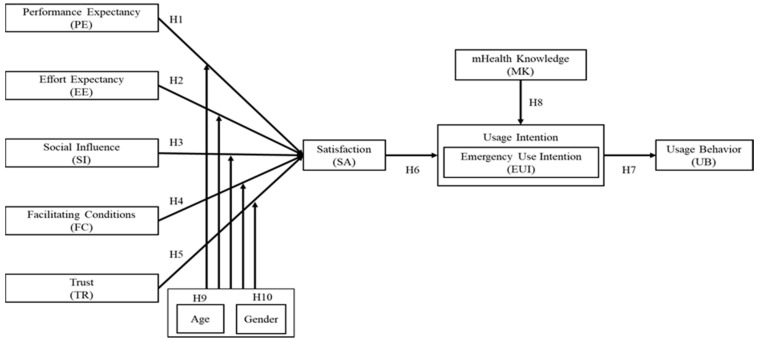
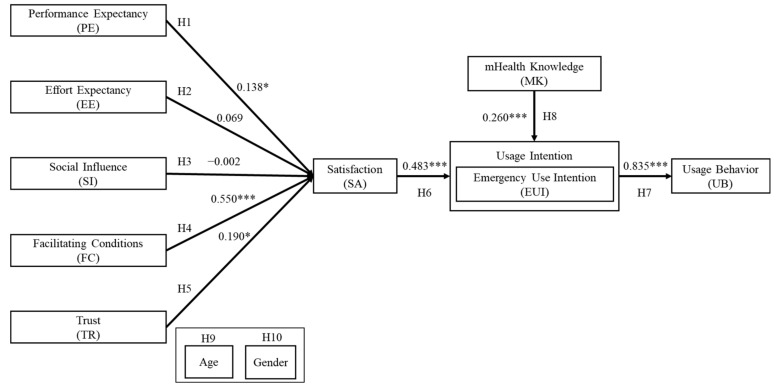
Emergency usage intention and behavior are crucial to business service success for m-Health providers and patient healthcare service. This study aimed to identify the factors that influence m-Health acceptance and the effect of emergency use intentions on usage behavior among Taiwanese m-Health users by adopting and extending the Unified Theory of Acceptance and Use of Technology (UTAUT). This study also examines the moderating role of gender and age in the effects of the independent variables on satisfaction with m-Health services. An online questionnaire was used to collect data from 371 participants. The results revealed that performance expectancy, facilitating conditions, and trust had positive effects on user satisfaction. Additionally, m-Health knowledge and user satisfaction had positive effects on emergency use intentions. However, social influence and effort expectancy did not have a significant effect on satisfaction. Moreover, age and gender significantly moderated the effects of some predictors.
Keywords: emergency use intention; m-Health; satisfaction; usage behavior.
Conflict of interest statement
The authors declare no conflict of interest.
Figures
References
-
- Coronavirus Press Release. [(accessed on 10 April 2020)]; Available online: https://www.cdc.gov.tw/En/Bulletin/Detail/JrlVKIn-427XAfDELEuDEg?typeid=158.
LinkOut - more resources
Full Text Sources
