


Back to Basics: Choosing the Appropriate Surface Disinfectant
- PMID: 34063833
- PMCID: PMC8224088
- DOI: 10.3390/antibiotics10060613
Back to Basics: Choosing the Appropriate Surface Disinfectant
Abstract
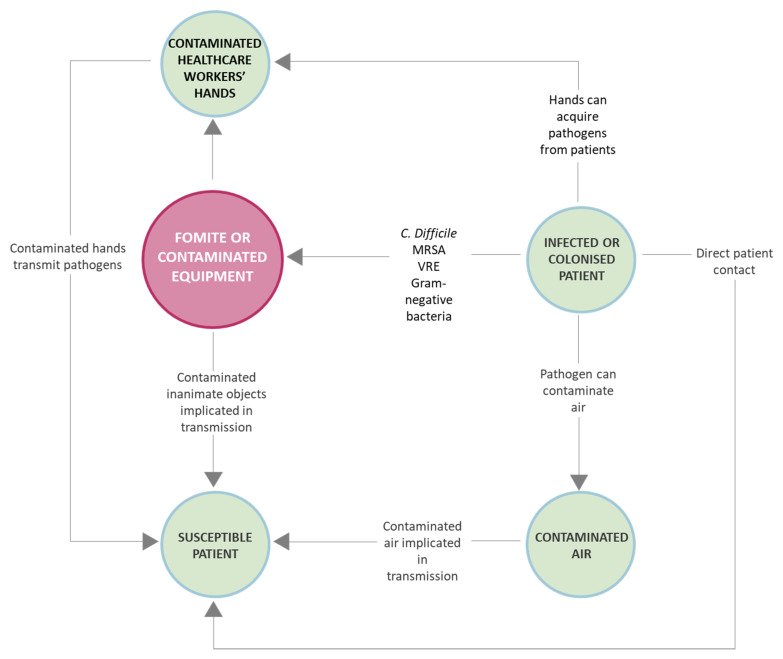
From viruses to bacteria, our lives are filled with exposure to germs. In built environments, exposure to infectious microorganisms and their byproducts is clearly linked to human health. In the last year, public health emergency surrounding the COVID-19 pandemic stressed the importance of having good biosafety measures and practices. To prevent infection from spreading and to maintain the barrier, disinfection and hygiene habits are crucial, especially when the microorganism can persist and survive on surfaces. Contaminated surfaces are called fomites and on them, microorganisms can survive even for months. As a consequence, fomites serve as a second reservoir and transfer pathogens between hosts. The knowledge of microorganisms, type of surface, and antimicrobial agent is fundamental to develop the best approach to sanitize fomites and to obtain good disinfection levels. Hence, this review has the purpose to briefly describe the organisms, the kind of risk associated with them, and the main classes of antimicrobials for surfaces, to help choose the right approach to prevent exposure to pathogens.
Keywords: antimicrobial; disinfectant; fomite; microorganisms; surface contamination; surface disinfection.
Conflict of interest statement
The authors declare no conflict of interest.
Figures


References
-
- Hayden M.K., Blom D.W., Lyle E.A., Moore C.G., Weinstein R.A. Risk of Hand or Glove Contamination After Contact With Patients Colonized With Vancomycin-Resistant Enterococcus or the Colonized Patients’ Environment. Infect. Control Hosp. Epidemiol. 2008;29:149–154. doi: 10.1086/524331. - DOI - PubMed
-
- Guerrero D.M., Nerandzic M.M., Jury L.A., Jinno S., Chang S., Donskey C.J. Acquisition of spores on gloved hands after contact with the skin of patients with Clostridium difficile infection and with environmental surfaces in their rooms. Am. J. Infect. Control. 2012;40:556–558. doi: 10.1016/j.ajic.2011.08.002. - DOI - PubMed
-
- Stiefel U., Cadnum J.L., Eckstein B.C., Guerrero D.M., Tima M.A., Donskey C.J. Contamination of Hands with Methicillin-Resistant Staphylococcus aureus after Contact with Environmental Surfaces and after Contact with the Skin of Colonized Patients. Infect. Control Hosp. Epidemiol. 2011;32:185–187. doi: 10.1086/657944. - DOI - PubMed
Publication types
LinkOut - more resources
Full Text Sources
Research Materials
