


Potassium Metabolism and Management in Patients with CKD
- PMID: 34063969
- PMCID: PMC8224083
- DOI: 10.3390/nu13061751
Potassium Metabolism and Management in Patients with CKD
Abstract
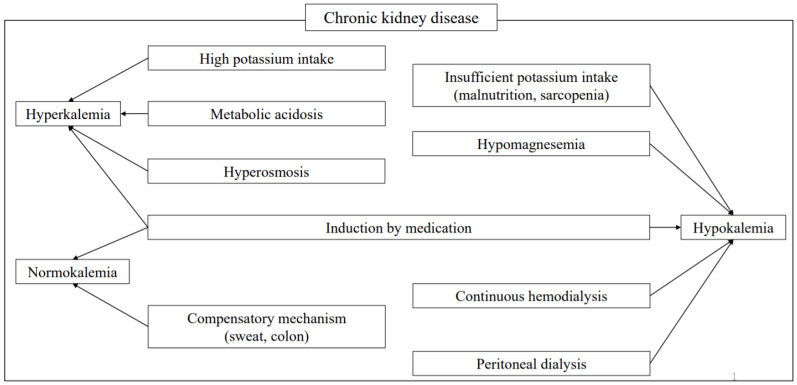
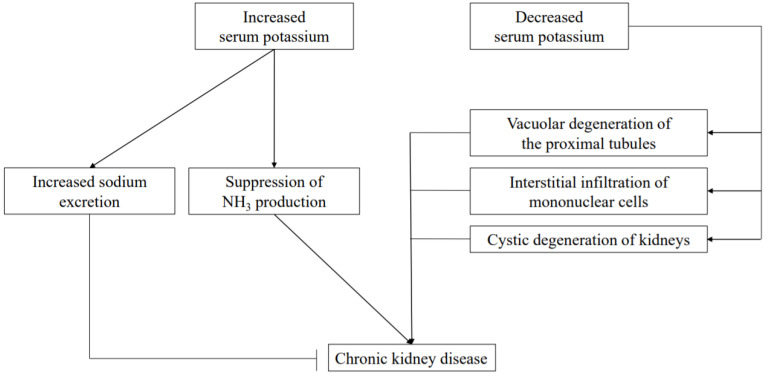
Potassium (K), the main cation inside cells, plays roles in maintaining cellular osmolarity and acid-base equilibrium, as well as nerve stimulation transmission, and regulation of cardiac and muscle functions. It has also recently been shown that K has an antihypertensive effect by promoting sodium excretion, while it is also attracting attention as an important component that can suppress hypertension associated with excessive sodium intake. Since most ingested K is excreted through the kidneys, decreased renal function is a major factor in increased serum levels, and target values for its intake according to the degree of renal dysfunction have been established. In older individuals with impaired renal function, not only hyperkalemia but also hypokalemia due to anorexia, K loss by dialysis, and effects of various drugs are likely to develop. Thus, it is necessary to pay attention to K management tailored to individual conditions. Since abnormalities in K metabolism can also cause lethal arrhythmia or sudden cardiac death, it is extremely important to monitor patients with a high risk of hyper- or hypokalemia and attempt to provide early and appropriate intervention.
Keywords: CKD; blood pressure; hypertension; potassium; potassium excretion; salt; sodium.
Conflict of interest statement
The authors have no relevant financial interest to declare.
Figures
References
-
- Seldin D.W., Giebisch G., editors. The Regulation of Potassium Balance. Raven Press; New York, NY, USA: 1989. pp. 3–29.
-
- Johnson L.R., editor. Essential Medical Physiology. 3rd ed. Elsevier Academic Press; San Diego, CA, USA: 2003. Renal regulation of potassium, calcium and magnesium; pp. 437–446.
Publication types
MeSH terms
Substances
LinkOut - more resources
Full Text Sources
Medical
