


Perihematomal Edema and Clinical Outcome in Intracerebral Hemorrhage Related to Different Oral Anticoagulants
- PMID: 34063991
- PMCID: PMC8196746
- DOI: 10.3390/jcm10112234
Perihematomal Edema and Clinical Outcome in Intracerebral Hemorrhage Related to Different Oral Anticoagulants
Abstract
Background: There is a need to examine the effects of different types of oral anticoagulant-associated intracerebral hemorrhage (OAC-ICH) on perihematomal edema (PHE), which is gaining considerable appeal as a biomarker for secondary brain injury and clinical outcome.
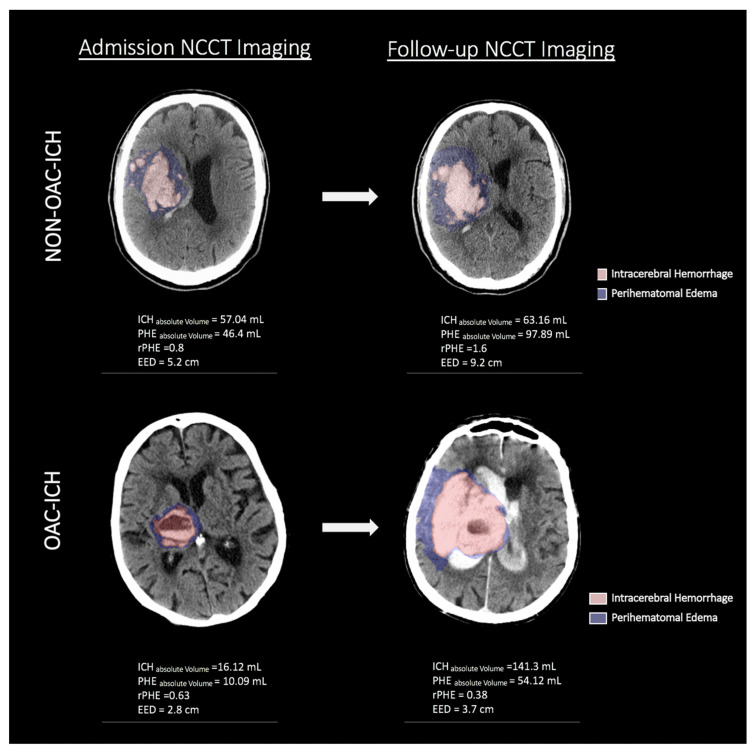
Methods: In a large multicenter approach, computed tomography-derived imaging markers for PHE (absolute PHE, relative PHE (rPHE), edema expansion distance (EED)) were calculated for patients with OAC-ICH and NON-OAC-ICH. Exploratory analysis for non-vitamin-K-antagonist OAC (NOAC) and vitamin-K-antagonists (VKA) was performed. The predictive performance of logistic regression models, employing predictors of poor functional outcome (modified Rankin scale 4-6), was explored.
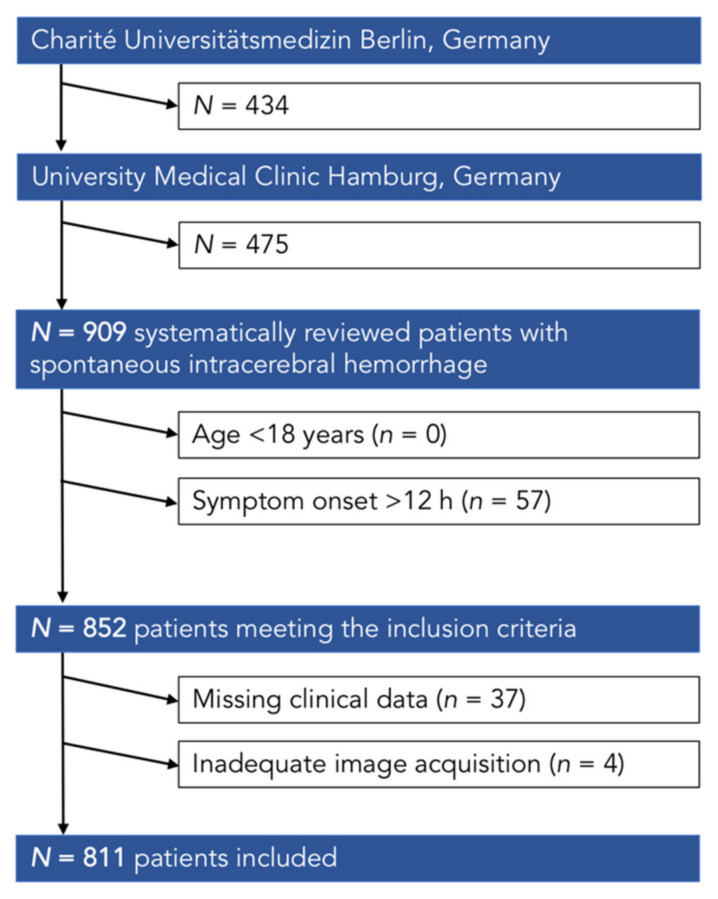
Results: Of 811 retrospectively enrolled patients, 212 (26.14%) had an OAC-ICH. Mean rPHE and mean EED were significantly lower in patients with OAC-ICH compared to NON-OAC-ICH, p-value 0.001 and 0.007; whereas, mean absolute PHE did not differ, p-value 0.091. Mean EED was also significantly lower in NOAC compared to NON-OAC-ICH, p-value 0.05. Absolute PHE was an independent predictor of poor clinical outcome in NON-OAC-ICH (OR 1.02; 95%CI 1.002-1.028; p-value 0.027), but not in OAC-ICH (p-value 0.45).
Conclusion: Quantitative markers of early PHE (rPHE and EED) were lower in patients with OAC-ICH compared to those with NON-OAC-ICH, with significantly lower levels of EED in NOAC compared to NON-OAC-ICH. Increase of early PHE volume did not increase the likelihood of poor outcome in OAC-ICH, but was independently associated with poor outcome in NON-OAC-ICH. The results underline the importance of etiology-specific treatment strategies. Further prospective studies are needed.
Keywords: anticoagulation; cerebral hemorrhage; computed tomography; edema; outcome prediction.
Conflict of interest statement
The authors declare no conflict of interest.
Figures
References
-
- Morotti A., Goldstein J.N. Anticoagulant-associated intracerebral hemorrhage. Brain Hemorrhages. 2020;1:89–94. doi: 10.1016/j.hest.2020.01.001. - DOI
-
- Venkatasubramanian C., Mlynash M., Finley-Caulfield A., Eyngorn I., Kalimuthu R., Snider R.W., Wijman C.A. Natural History of Perihematomal Edema After Intracerebral Hemorrhage Measured by Serial Magnetic Resonance Imaging. Stroke. 2011;42:73–80. doi: 10.1161/STROKEAHA.110.590646. - DOI - PMC - PubMed
LinkOut - more resources
Full Text Sources
