. 2021 May 21;13(11):2539.
doi: 10.3390/cancers13112539.

A Prospective Feasibility Trial to Challenge Patient-Derived Pancreatic Cancer Organoids in Predicting Treatment Response

Affiliations

A Prospective Feasibility Trial to Challenge Patient-Derived Pancreatic Cancer Organoids in Predicting Treatment Response

Alica K Beutel et al. Cancers (Basel). .

Abstract

Real-time isolation, propagation, and pharmacotyping of patient-derived pancreatic cancer organoids (PDOs) may enable treatment response prediction and personalization of pancreatic cancer (PC) therapy. In our methodology, PDOs are isolated from 54 patients with suspected or confirmed PC in the framework of a prospective feasibility trial. The drug response of single agents is determined by a viability assay. Areas under the curves (AUC) are clustered for each drug, and a prediction score is developed for combined regimens. Pharmacotyping profiles are obtained from 28 PDOs (efficacy 63.6%) after a median of 53 days (range 21-126 days). PDOs exhibit heterogeneous responses to the standard-of-care drugs, and are classified into high, intermediate, or low responder categories. Our developed prediction model allows a successful response prediction in treatment-naïve patients with an accuracy of 91.1% for first-line and 80.0% for second-line regimens, respectively. The power of prediction declines in pretreated patients (accuracy 40.0%), particularly with more than one prior line of chemotherapy. Progression-free survival (PFS) is significantly longer in previously treatment-naïve patients receiving a predicted tumor sensitive compared to a predicted tumor resistant regimen (mPFS 141 vs. 46 days; p = 0.0048). In conclusion, generation and pharmacotyping of PDOs is feasible in clinical routine and may provide substantial benefit.

Keywords: drug response prediction; organoids; pancreatic cancer; personalized medicine; pharmacotyping.


Conflict of interest statement

The authors declare no conflict of interest.

Figures
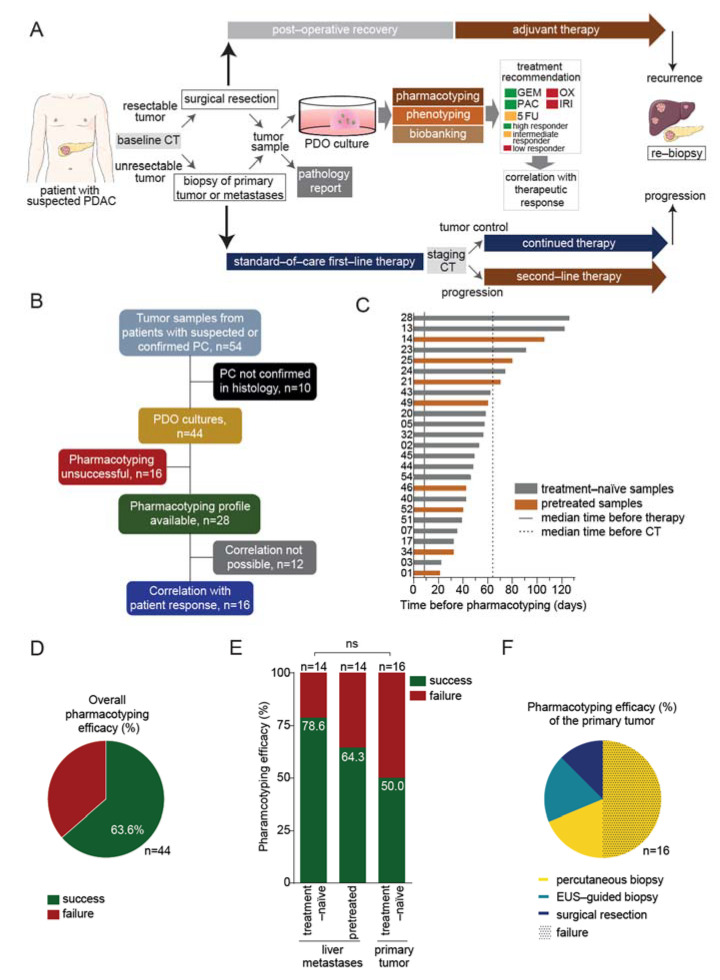
Figure 1
Figure 1
Feasibility of organoid-based precision medicine in clinical routine. (A), Schematic representation of the work-flow. Patient-derived organoids (PDOs) were isolated from surgical specimens or biopsy samples of the primary tumor or liver metastases in pancreatic cancer (PC) patients. PDOs were submitted to pharmacotyping, phenotyping, and biobanking. The in vitro prediction was compared to the therapeutic response in the patient. (B), Schematic representation of the study. (C), Graphic representation showing the time required before PDO pharmacotyping. (D), Representation of the overall PDO pharmacotyping efficacy. (E), Representation of the pharmacotyping efficacy in PDOs isolated from liver metastases of either treatment-naïve or pretreated patients, or from the primary tumor. (F), Pie chart showing the pharmacotyping efficacy of the primary tumor according to the sampling method (percutaneous biopsy, n = 11; endoscopic ultrasound (EUS)-guided biopsy, n = 3; surgical resection, n = 2); dotted pattern depicts pharmacotyping failure. 5-FU, 5-fluorouracil; GEM, gemcitabine; IRI, irinotecan; OX, oxaliplatin; PAC, paclitaxel; CT, computed tomography; ns, not significant.
Figure 2
Figure 2
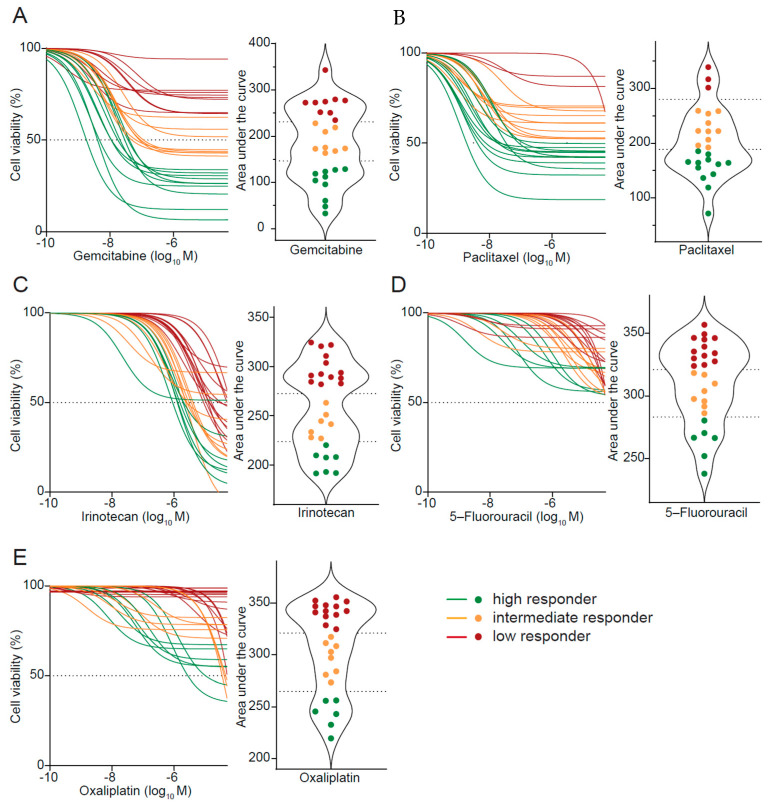
Patient-derived organoids exhibit heterogeneous responses to standard-of-care agents. (AE) Cell viability analyses (left panels) and violin plots (right panels) depict corresponding areas under curves of gemcitabine (A), paclitaxel (B), irinotecan (C), 5-fluorouracil (D), and oxaliplatin (E) treatment in patient-derived organoids (PDOs). Dotted lines (right panels) represent cut-off values as determined by the Jenks Natural Breaks classification method. PDOs were classified into three subgroups: high responder (green), intermediate responder (orange), and low responder (red).
Figure 3
Figure 3
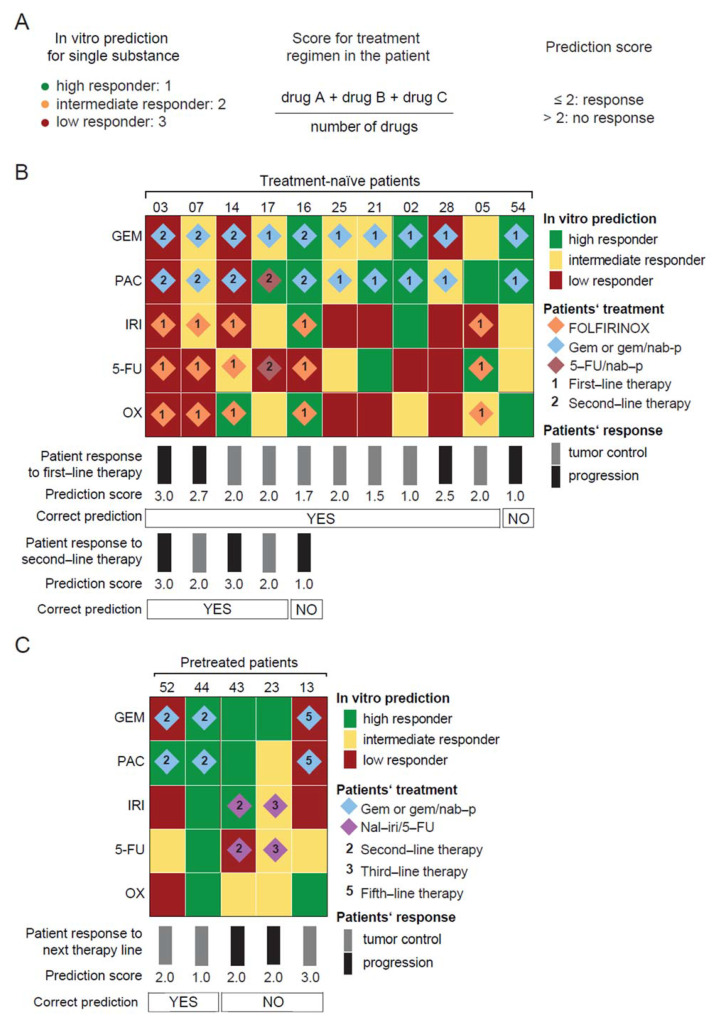
Organoid-based drug efficacy prediction profiles parallel patient therapeutic response. (A), Scoring method to predict the patient therapeutic response of a given combinational regimen based on the in vitro prediction for single substances. PDO-based drug response prediction in (B), treatment-naïve and (C), pretreated PDO samples according to the prediction score shown in (A). For each single chemotherapeutic substance, the clustering of the PDO library into high, intermediate, and low responder subgroups was performed using the Jenks Natural Breaks classification method, as shown in Figure 2. Patients’ treatment regimen, therapy line, and therapeutic response as indicated. 5-FU, 5-fluorouracil; FOLFIRINOX, 5-fluorouracil, leucovorin, irinotecan, and oxaliplatin; GEM, gemcitabine; IRI, irinotecan; nab-p, nanoparticle albumin-bound paclitaxel; nal-iri/5-FU, nanoliposomal irinotecan, 5-fluorouracil, and leucovorin; OX, oxaliplatin; PAC, paclitaxel.
Figure 4
Figure 4
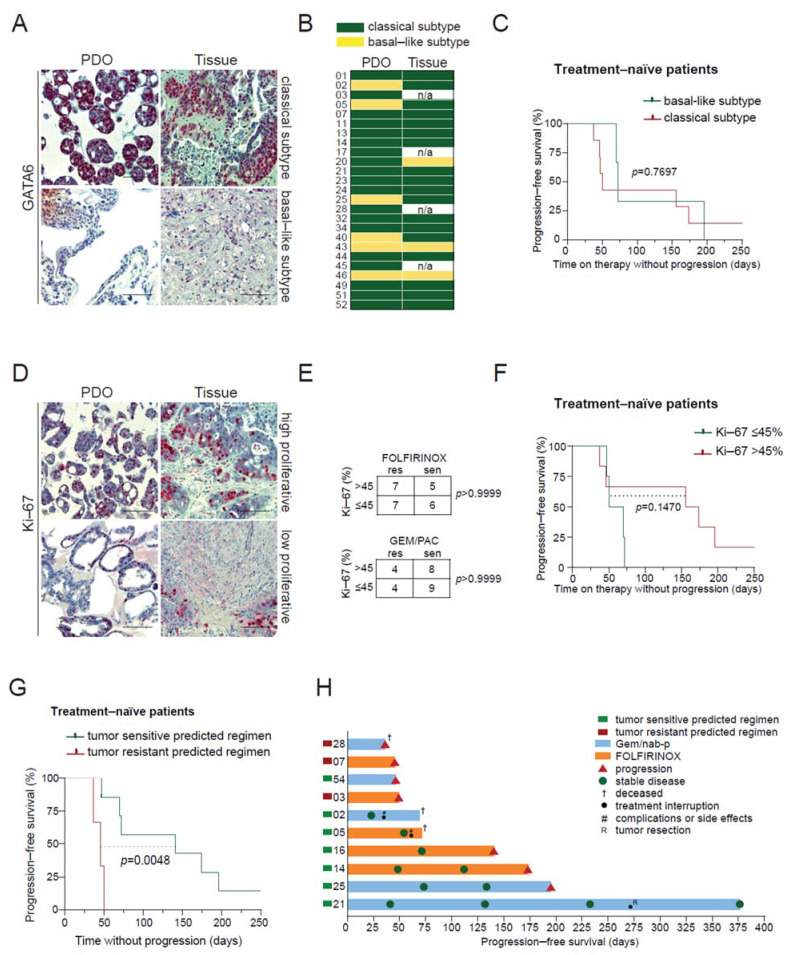
Patient-derived organoid-based drug efficacy prediction and potential clinical impact. (A), Immunohistochemistry staining for GATA6 in patient-derived organoids (PDOs) 34 and 43 and corresponding tumor tissue from liver metastases. (B), Distribution of classical (green) and basal-like (yellow) subtypes across PDOs and corresponding tumor tissues. (C), Kaplan-Meier analysis of progression-free survival (PFS) of treatment-naïve advanced pancreatic cancer (PC) patients according to their classical or basal-like subtype status. (D), Immunohistochemistry staining for Ki-67 in PDOs 34 and 49 and corresponding tumor tissue. A tumor cell Ki-67 positivity ≤ 45% shows low proliferation, while Ki-67 >45% denotes high proliferation. (E), Contingency table showing proliferation index and sensitivity to chemotherapy regimen in vitro. (F), Kaplan-Meier analysis of PFS of treatment-naïve advanced PC patients according to the tumor mitotic index. (G) Kaplan-Meier analysis of PFS of treatment-naïve advanced PC patients who received a tumor sensitive or tumor resistant predicted regimen following our PDO-based model. (H) Swimmer plot of PFS from treatment-naïve patients. Scale bars represent 100 µm. PDO, patient-derived organoids; FOLFIRINOX, 5-fluorouracil, leucovorin, irinotecan, and oxaliplatin; Gem/nab-p, gemcitabine, and nanoparticle albumin-bound paclitaxel; res, resistant; sen, sensitive.
Figure 5
Figure 5
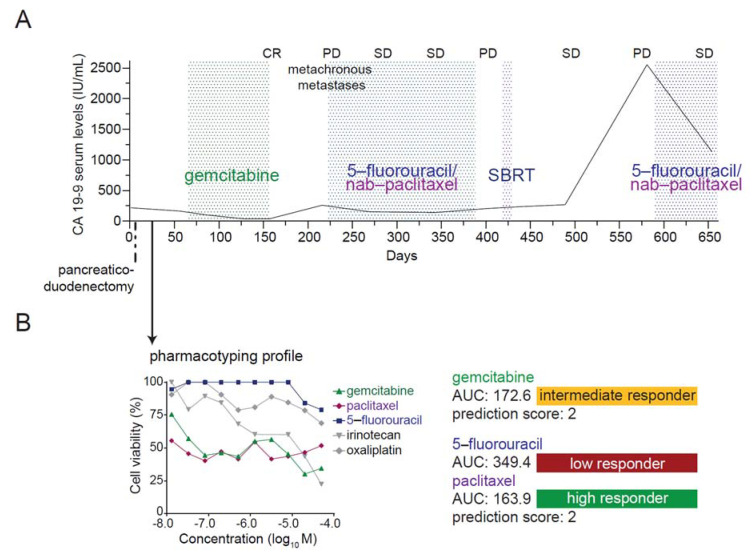
A clinical case demonstrating the feasibility of organoid-tailored therapy. (A), Treatment, diagnosis, and response to therapy and CA 19–9 serum levels of the patient. Time intervals for administered treatments are indicated between dotted lines. Patient-derived organoids (PDOs) were isolated from surgical specimens at the time of primary diagnosis of pancreatic ductal adenocarcinoma. The pharmacotyping profile was available after 32 days. (B), Cell viability analysis of gemcitabine, paclitaxel, irinotecan, 5-fluorouracil (5-FU), and oxaliplatin treatment in PDO 17 with the corresponding area under the curve (AUC) and classification into low, intermediate, or high responder category. CR, complete response; PD, progressive disease; SBRT, stereotactic body radiation therapy; SD, stable disease; AUC, area under the curve.

References

    1. Siegel R.L., Miller K.D., Jemal A. Cancer statistics, 2017. CA A Cancer J. Clin. 2017;67:7–30. doi: 10.3322/caac.21387. - DOI - PubMed
    1. Pishvaian M.J., Blais E.M., Brody J.R., Lyons E., DeArbeloa P., Hendifar A., Mikhail S., Chung V., Sahai V., Sohal D.P.S., et al. Overall survival in patients with pancreatic cancer receiving matched therapies following molecular profiling: A retrospective analysis of the Know Your Tumor registry trial. Lancet Oncol. 2020;21:508–518. doi: 10.1016/S1470-2045(20)30074-7. - DOI - PMC - PubMed
    1. Von Hoff D.D., Ervin T., Arena F.P., Chiorean E.G., Infante J., Moore M., Seay T., Tjulandin S.A., Ma W.W., Saleh M.N., et al. Increased Survival in Pancreatic Cancer with nab-Paclitaxel plus Gemcitabine. N. Engl. J. Med. 2013;369:1691–1703. doi: 10.1056/NEJMoa1304369. - DOI - PMC - PubMed
    1. Conroy T., Desseigne F., Ychou M., Bouché O., Guimbaud R., Bécouarn Y., Adenis A., Raoul J.-L., Gourgou-Bourgade S., De La Fouchardière C., et al. FOLFIRINOX versus Gemcitabine for Metastatic Pancreatic Cancer. N. Engl. J. Med. 2011;364:1817–1825. doi: 10.1056/NEJMoa1011923. - DOI - PubMed
    1. Bachet J.B., Mitry E., Lievre A., Lepere C., Vaillant J.N., Declety G., Parlier H., Emile J.F., Julie C., Rougier P. Second- and third-line chemotherapy in patients with metastatic pancreatic adenocarcinoma: Feasibility and potential benefits in a retrospective series of 117 patients. Gastroentérol. Clin. Biol. 2009;33:1036–1044. doi: 10.1016/j.gcb.2009.03.017. - DOI - PubMed

LinkOut - more resources