


Use of the Er:YAG Laser in Conservative Dentistry: Evaluation of the Microbial Population in Carious Lesions
- PMID: 34064339
- PMCID: PMC8124663
- DOI: 10.3390/ma14092387
Use of the Er:YAG Laser in Conservative Dentistry: Evaluation of the Microbial Population in Carious Lesions
Abstract
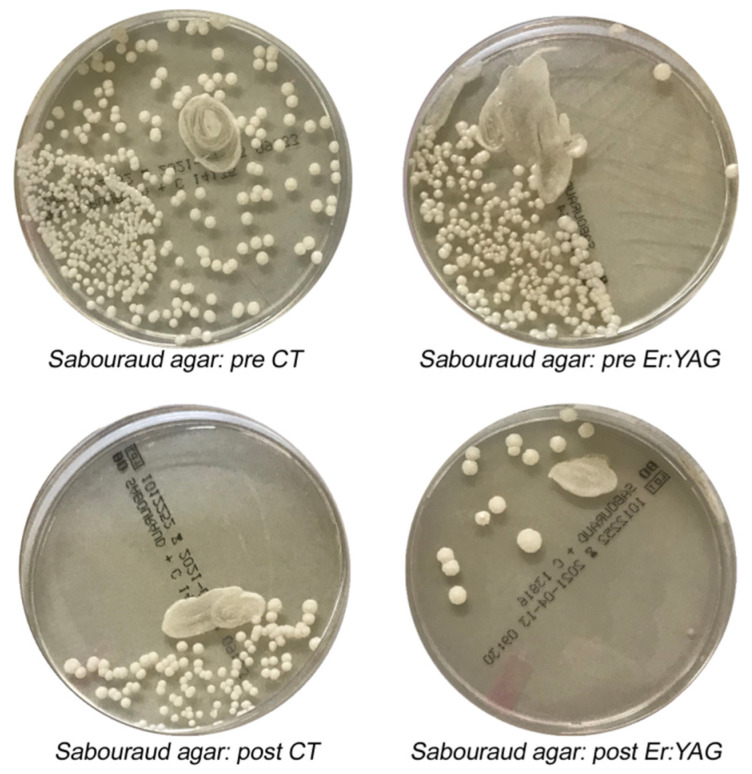
The aim of this study is to investigate the Erbium:Yttrio-Aluminum-Granate (Er:YAG) laser photothermal and mechanical effects on cariogenic species concentration and on the microbial load composition of therapeutic cavities, in order to evaluate the possible micro-organisms reduction and make a comparison with manual and rotating conventional therapy (CT). A clinical trial was designed, including adults with active deep carious lesions on permanent teeth who were divided into two groups, i.e., control group and intervention group treated with CT and Er:YAG therapy, respectively. Before and after any conservative treatment, two oral samples were collected using a small sterile microbrush scrubbed within the base of the dentinal cavity tissue. The percentage of reduction and the colony-forming units (CFUs) count after Er:YAG and conventional treatments were compared for total microorganisms, including Candida spp., Streptococcus spp., and Lactobacillus spp. The microbial reduction varied from 90.2% to 100% and was significantly observed for total microorganisms and Streptococcus spp. (p < 0.05). The Er:YAG laser shows the potential for clinical applications, especially with paediatric and complicated patients, thanks to its minimally invasive properties and its effect on the reduction of microbial load.
Keywords: Er:YAG laser; cariogenic species; conservative dentistry; oral microbiome.
Conflict of interest statement
The authors declare no conflict of interest.
Figures
References
-
- James S.L., Abate D., Abate K.H., Abay S.M., Abbafati C., Abbasi N., Abbastabar H., Abd-Allah F., Abdela J., Abdelalim A. Global, regional, and national incidence, prevalence, and years lived with disability for 328 diseases and injuries for 195 countries, 1990–2016: A systematic analysis. Lancet. 2017;390:1211–1259. doi: 10.1016/S0140-6736(17)32154-2. - DOI - PMC - PubMed
-
- Velazquez-Enriquez U., Scougall-Vilchis R.J., Contreras-Bulnes R., Flores-Estrada J., Uematsu S., Yamaguchi R. Quantitative analysis of S. mutans and S. sobrinus cultivated independently and adhered to polished orthodontic composite resins. J. Appl.Oral. Sci. 2012;20:544–549. doi: 10.1590/S1678-77572012000500009. - DOI - PMC - PubMed
LinkOut - more resources
Full Text Sources
Miscellaneous
