Review
. 2021 May 4;22(9):4862.
doi: 10.3390/ijms22094862.

Tumor Dormancy: Implications for Invasion and Metastasis

Affiliations
Review

Tumor Dormancy: Implications for Invasion and Metastasis

Georgia Gomatou et al. Int J Mol Sci. .

Abstract

Tumor dormancy refers to a critical stage of cancer development when tumor cells are present, but cancer does not progress. It includes both the concept of cellular dormancy, indicating the reversible switch of a cancer cell to a quiescent state, and that of tumor mass dormancy, indicating the presence of neoplastic masses that have reached cell population equilibrium via balanced growth/apoptosis rates. Tumor dormancy provides the conceptual framework, potentially explaining a major challenge in clinical oncology, tumor recurrence, which may occur years after cancer diagnosis. The mechanisms by which tumors are kept dormant, and what triggers their reawakening, are fundamental questions in cancer biology. It seems that a plethora of intracellular pathways and extracellular factors are involved in this process, rewiring the cells to plastically alter their metabolic and proliferative status. This phenomenon is highly dynamic in space and time. Mechanistic insights into both cellular and tumor dormancy have provided the rationale for targeting this otherwise stable period of cancer development, in order to prevent recurrence and maximize therapeutic benefit.

Keywords: cellular dormancy; metastasis; tumor dormancy; tumor recurrence.


Conflict of interest statement

The authors declare no conflict of interest.

Figures
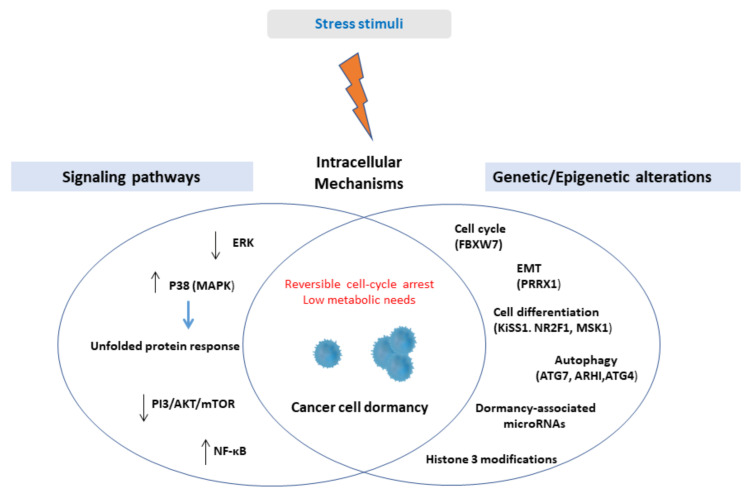
Figure 1
Figure 1
Upon stress stimuli, solitary cancer cells or small clusters of cells might activate cell-intrinsic mechanisms in order to enter a reversible state of non-proliferation and low bioenergetics. Cell-intrinsic mechanisms include genetic and epigenetic alterations associated with crucial cell functions, namely cell proliferation, cell differentiation, epithelial-mesenchymal transition, autophagy, and deregulation of several signaling pathways, among them, the most studied being the upregulation of p38 kinase. Abbreviations: ERK = extracellular signal-regulated kinase, MAPK = mitogen-activated protein kinase, PI3 = phosphatidylinositol 3-kinases, AKT = protein kinase B, mTOR = mammalian target of rapamycin, NF-κΒ = nuclear factor kappa light chain enhancer of activated B cells, EMT = epithelial-mesenchymal transition, FBXW7 = F-box and WD repeat domain containing 7, PRRX1 = paired-related homeobox transcription factor, NR2F1 = nuclear receptor subfamily 2, group F, member 1, MSK1 = mitogen- and stress-activated protein kinase 1, ATG7 = Autophagy-related 7, ARHI = aplasia Ras homolog member I.
Figure 2
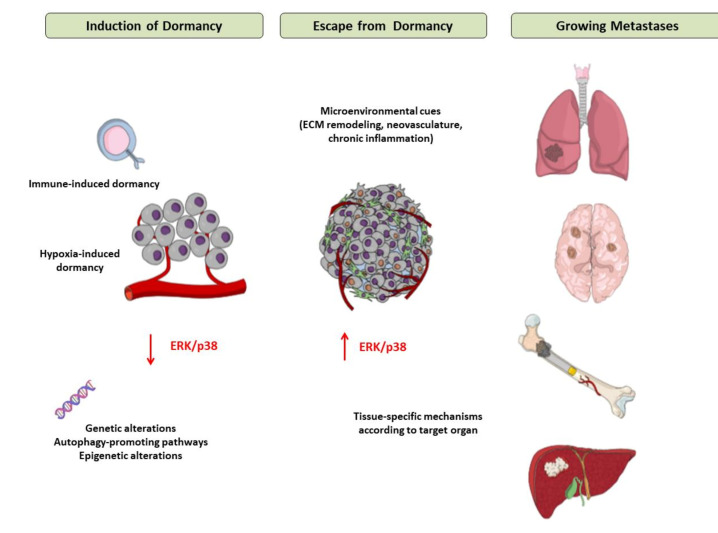
Figure 2
Mechanisms of induction of and escape from tumor dormancy. Tumor cells, when confronting a hostile environment, may enter a dormant state due to the interactions of extracellular factors (mainly hypoxia and immune cytotoxicity) and intracellular pathways. In response to signals that are not fully elucidated yet but appear to involve modifications of tumor microenvironment, such as extracellular matrix remodeling, neovascularization, chronic inflammation and tissue-specific mechanisms in each metastatic site, tumor cells escape from dormancy, start to proliferate and ultimately form macroscopic metastases in target organs. Abbreviations: ECM = Extracellular Matrix, ERK = Extracellular signalregulated kinase.

References

    1. Chaffer C.L., Weinberg R.A. A Perspective on Cancer Cell Metastasis. Science. 2011;331:1559–1564. doi: 10.1126/science.1203543. - DOI - PubMed
    1. Giancotti F.G. Mechanisms Governing Metastatic Dormancy and Reactivation. Cell. 2013;155:750–764. doi: 10.1016/j.cell.2013.10.029. - DOI - PMC - PubMed
    1. Klein A.C. Framework models of tumor dormancy from patient-derived observations. Curr. Opin. Genet. Dev. 2011;21:42–49. doi: 10.1016/j.gde.2010.10.011. - DOI - PubMed
    1. Blows F.M., Driver K.E., Schmidt M.K., Broeks A., Van Leeuwen F.E., Wesseling J., Cheang M.C., Gelmon K., Nielsen T.O., Blomqvist C., et al. Subtyping of Breast Cancer by Immunohistochemistry to Investigate a Relationship between Subtype and Short and Long Term Survival: A Collaborative Analysis of Data for 10,159 Cases from 12 Studies. PLoS Med. 2010;7:e1000279. doi: 10.1371/journal.pmed.1000279. - DOI - PMC - PubMed
    1. Sosa M.S., Bragado P., Aguirre-Ghiso J.A. Mechanisms of disseminated cancer cell dormancy: An awakening field. Nat. Rev. Cancer. 2014;14:611–622. doi: 10.1038/nrc3793. - DOI - PMC - PubMed

MeSH terms