. 2021 May 11;22(10):5066.
doi: 10.3390/ijms22105066.

The AraC-Type Transcriptional Regulator GliR (PA3027) Activates Genes of Glycerolipid Metabolism in Pseudomonas aeruginosa

Affiliations

The AraC-Type Transcriptional Regulator GliR (PA3027) Activates Genes of Glycerolipid Metabolism in Pseudomonas aeruginosa

Karolina Kotecka et al. Int J Mol Sci. .

Abstract

Pseudomonas aeruginosa encodes a large set of transcriptional regulators (TRs) that modulate and manage cellular metabolism to survive in variable environmental conditions including that of the human body. The AraC family regulators are an abundant group of TRs in bacteria, mostly acting as gene expression activators, controlling diverse cellular functions (e.g., carbon metabolism, stress response, and virulence). The PA3027 protein from P. aeruginosa has been classified in silico as a putative AraC-type TR. Transcriptional profiling of P. aeruginosa PAO1161 overexpressing PA3027 revealed a spectacular increase in the mRNA levels of PA3026-PA3024 (divergent to PA3027), PA3464, and PA3342 genes encoding proteins potentially involved in glycerolipid metabolism. Concomitantly, chromatin immunoprecipitation-sequencing (ChIP-seq) analysis revealed that at least 22 regions are bound by PA3027 in the PAO1161 genome. These encompass promoter regions of PA3026, PA3464, and PA3342, showing the major increase in expression in response to PA3027 excess. In Vitro DNA binding assay confirmed interactions of PA3027 with these regions. Furthermore, promoter-reporter assays in a heterologous host showed the PA3027-dependent activation of the promoter of the PA3026-PA3024 operon. Two motifs representing the preferred binding sites for PA3027, one localized upstream and one overlapping with the -35 promoter sequence, were identified in PA3026p and our data indicate that both motifs are required for full activation of this promoter by PA3027. Overall, the presented data show that PA3027 acts as a transcriptional regulator in P. aeruginosa, activating genes likely engaged in glycerolipid metabolism. The GliR name, from a glycerolipid metabolism regulator, is proposed for PA3027 of P. aeruginosa.

Keywords: AraC family; PA3027; Pseudomonas aeruginosa; glycerolipid metabolism; regulon; transcriptional regulator.


Conflict of interest statement

The authors declare no conflict of interest.

Figures

Figure A1
Figure A1
Impact of PA3027 excess on the growth of P. aeruginosa PAO1161. PAO1161 or ΔPA3027 mutant strains carrying empty vector pAMB9.37 tacp or pKKB1.11-tacp-PA3027 (A,B) or empty vector tacp–flag or pKKB1.12 tacp–flagPA3027 (C,D) were grown in L-broth under selection with the indicated concentration of inducer IPTG (0.05–0.5 mM). The red line indicates the growth in the presence of 0.05 mM IPTG, conditions selected for RNA-seq analysis. Data represent mean OD600 from three independent replicates. Standard deviations are not shown for clarity.
Figure A2
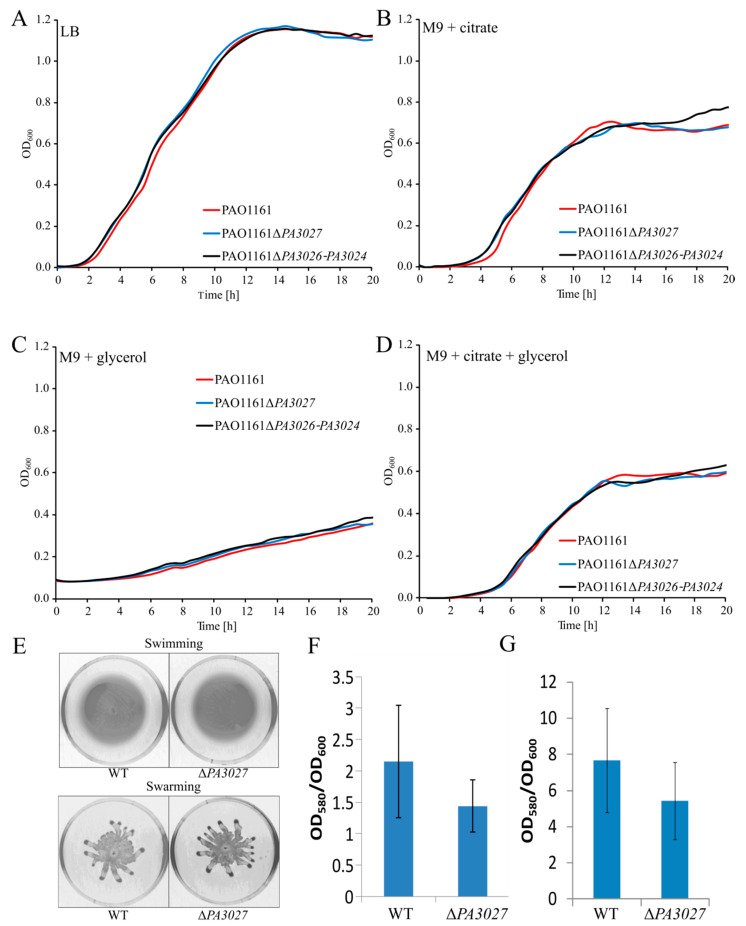
Figure A2
Phenotypic characterization of P. aeruginosa PAO1161 cells lacking PA3027 or PA3026PA3024 operon. (AD) Growth of PAO1161 leu+ and ΔPA3027 mutant on (A) L broth, (B) minimal medium with citrate, (C) minimal medium with glycerol, or (D) minimal medium with citrate and glycerol. Data represent OD600 mean from three independent replicates. (E) Growth of PAO1161 and ΔPA3027 mutant on swimming and swarming medium. (F,G) Biofilm formation of PAO1161 leu and ΔPA3027 mutant on (F) L broth or (G) minimal medium with citrate. Data represent mean from five independent replicates.
Figure A3
Figure A3
The occurrence of PA3023PA3027 gene cluster in bacteria. (A) Clustered genes encoding orthologs of PA3023PA3027 identified in 1748 representative and reference bacterial genomes included in the RefSeq database (release 91) [98] using MultigeneBlast [97]. (B) Phylogenetic tree of PA3027 and its identified orthologues, constructed using CoBaltDB [99].
Figure 1
Figure 1
Properties of PA3027 protein from P. aeruginosa. (A) Genomic context of the PA3027 gene in the P. aeruginosa genome and domain structure of the PA3027 protein. The gene names from PAO1 and PAO1161 strains are presented. Alignment represents comparison of PA3027 HTH domain with corresponding regions of E. coli AraC (GenBank: CAA23508.1), Rob (GenBank: CAD6017604.1), and MarA (GenBank: AAK21293.1). Sequences were aligned using Clustal Omega [36]. Identical residues in all proteins were marked with yellow, in three sequences with blue and in two with grey. The secondary structure elements are marked with boxes based on MarA secondary structure [37]. (B) Structure of PA3027 monomer bound with DNA predicted using COACH and HDOCK [38,39,40]. LBD—ligand binding domain; HTH— helix-turn-helix. (C) Bacterial two-hybrid (BACTH) analysis of PA3027 self-interactions. E. coli BTH101 cya was transformed with the pairs of vectors allowing expression of the indicated fusion proteins. Interactions between proteins were assayed by analysis of the β-galactosidase activity in cell extracts and analysis of colony color upon growth on McConkey medium with 1% maltose. Data indicate mean β-galactosidase activity from at least three replicates ±SD. (D) Size exclusion chromatography (SEC) with multi-angle static light scattering (MALS) analysis for His6–PA3027. Left axis—UV absorption and light scattering (LS), right axis—molecular weight of protein (MW). (E) Oligomerization state of purified His6-PA3027 assayed by crosslinking with increasing concentration of glutaraldehyde. Samples were used in Western blot analysis with anti-His antibodies. For (D,E), one red dot indicates a monomer and two dots indicate a dimer.
Figure 2
Figure 2
Effect of increased PA3027 level on gene expression in P. aeruginosa PAO1161 cells. (A) Enrichment of PseudoCAP functional categories [41] for 539 genes (306 downregulated; 233 upregulated) showing changes in mRNA level in response to PA3027 abundance (fold change ≤ −2 or ≥ 2, FDR adjusted p-value ≤ 0.01). The numbers in brackets show the number of all genes in the PAO1 genome in the indicated PseudoCAP category. One gene could be classified into more than one category or class. Numbers in red or blue bars represent the number of up- or downregulated genes, respectively, in each category. The PseudoCAP categories were grouped into six more general classes. Genes annotated only in PAO1161 strain but not in PAO1 are described as non classified. (B) Volcano plot visualization of the results of differential expression analysis between transcriptomes of PA3027 overproducing cells and control cells. Each dot represents one gene and genes with the most significant changes are colored in red. For clarity genes with p-value < 0.1 are not shown. (C) Validation of RNA-seq results by RT-qPCR analysis. The same RNA used for RNA-seq analysis was used for cDNA synthesis and RT-qPCR analysis. Data represent mean fold change for three samples of PA3027 overproducing cells relative to the mean of the control samples ± SD.
Figure 3
Figure 3
PA3027 binding sites in P. aeruginosa genome. (A) Venn diagram for ChIP-seq peaks obtained for samples of FLAG-PA3027 overproducing cells (F–PA3027+) and negative control (F–EV+). (B) ChIP-seq signal over regions encompassing PA3027 binding sites. The plots show coverage with reads for indicated positions in the PAO1161 genome (kb), normalized per genome coverage (RPGC), and averaged for ChIP replicates. Genes are presented as grey arrows, only names of PAO1 orthologs are shown for clarity. (C,D) The consensus sequence logos of predicted PA3027 binding sites, obtained by MEME software [44,45] using 200 bp around 24 PA3027 peak summits (A) as well as the same 24 PA3027 peak summit regions with an extended to 500 bp 24 region encompassing PA3026 upstream sequences (B). The height of an individual letter represents the relative frequency of that nucleotide at that position. The consensus sequence (up line) and the most common nucleotide at each position (down line) are presented for each motif. The reverse complement presentation of sequence logos are shown below.
Figure 4
Figure 4
PA3027 interaction with DNA assayed in vivo and in vitro. (AC) Putative PA3027 binding motifs in PA3026 (A), PA3464 (B), and PA3342 (C) promoter fragments, used in β-galactosidase activity assays and electrophoretic mobility shift assay (EMSA) analysis. Blue—motif A, violet—motif B, green—pseudoplindrome, grey—“−10” and “−35” promoter regions. (D) The scheme of variants of the PA3026–PA3024 promoter used in the analysis and cloned to pCM132 upstream of a promoter-less lacZ reporter gene. (E) Influence of PA3027 on the activity of PA3026p, PA3464p, and PA3342p. β-galactosidase activity in extracts from E. coli DH5α Δlac cells bearing pCM132 derivatives containing the indicated promoters upstream of lacZ as well as pKKB1.11 (tacp-PA3027), allowing IPTG inducible PA3027 production or empty vector pAMB9.37 (EV). Strains were cultured in medium with or without 0.1 mM IPTG. Data indicate mean β-galactosidase activity ±SD from five cultures. * p-value < 0.05 in student’s two tailed t-test. (F) EMSA using His6–PA3027 and PCR amplified DNA of the indicated promoter regions. The 100 ng Cy5 tagged DNA was incubated with an increasing amount of His6-PA3027. Samples were separated using 10% acrylamide gel and Cy5 fluorescence was visualized. The 331 bp pCM132 fragment was used as a control to rule out non-specific DNA binding.
Figure 5
Figure 5
Schematic representation of the part of central carbon metabolism in P. aeruginosa. The pathways were drawn based on the Pseudomonas database [48] and the literature [49,50,51]. Red and blue indicate increased or decreased gene expression in response to PA3027 overproduction, respectively.

References

    1. Perez-Rueda E., Hernandez-Guerrero R., Martinez-Nuñez M.A., Armenta-Medina D., Sanchez I., Ibarra J.A. Abundance, diversity and domain architecture variability in prokaryotic DNA-binding transcription factors. PLoS ONE. 2018;13:e0195332. doi: 10.1371/journal.pone.0195332. - DOI - PMC - PubMed
    1. Azam M.W., Khan A.U. Updates on the pathogenicity status of Pseudomonas aeruginosa. Drug Discov. Today. 2019;24:350–359. doi: 10.1016/j.drudis.2018.07.003. - DOI - PubMed
    1. Stover C.K., Pham X.Q., Erwin A.L., Mizoguchi S.D., Warrener P., Hickey M.J., Brinkman F.S., Hufnagle W.O., Kowalik D.J., Lagrou M., et al. Complete genome sequence of Pseudomonas aeruginosa PAO1, an opportunistic pathogen. Nature. 2000;406:959–964. doi: 10.1038/35023079. - DOI - PubMed
    1. Gellatly S.L., Hancock R.E.W. Pseudomonas aeruginosa: New insights into pathogenesis and host defenses. Pathog. Dis. 2013;67:159–173. doi: 10.1111/2049-632X.12033. - DOI - PubMed
    1. Huang H., Shao X., Xie Y., Wang T., Zhang Y., Wang X., Deng X. An integrated genomic regulatory network of virulence-related transcriptional factors in Pseudomonas aeruginosa. Nat. Commun. 2019;10:1–13. doi: 10.1038/s41467-019-10778-w. - DOI - PMC - PubMed

MeSH terms