Review
. 2021 May 11;10(5):1164.
doi: 10.3390/cells10051164.

A Biochemical and Structural Understanding of TOM Complex Interactions and Implications for Human Health and Disease

Affiliations
Review

A Biochemical and Structural Understanding of TOM Complex Interactions and Implications for Human Health and Disease

Ashley S Pitt et al. Cells. .

Abstract

The central role mitochondria play in cellular homeostasis has made its study critical to our understanding of various aspects of human health and disease. Mitochondria rely on the translocase of the outer membrane (TOM) complex for the bulk of mitochondrial protein import. In addition to its role as the major entry point for mitochondrial proteins, the TOM complex serves as an entry pathway for viral proteins. TOM complex subunits also participate in a host of interactions that have been studied extensively for their function in neurodegenerative diseases, cardiovascular diseases, innate immunity, cancer, metabolism, mitophagy and autophagy. Recent advances in our structural understanding of the TOM complex and the protein import machinery of the outer mitochondrial membrane have made structure-based therapeutics targeting outer mitochondrial membrane proteins during mitochondrial dysfunction an exciting prospect. Here, we describe advances in understanding the TOM complex, the interactome of the TOM complex subunits, the implications for the development of therapeutics, and our understanding of the structure/function relationship between components of the TOM complex and mitochondrial homeostasis.

Keywords: TOM complex; TOM complex interactions; TOM subunits; mitochondrial cell signaling; mitochondrial quality control.


Conflict of interest statement

The authors declare no conflict of interest.

Figures
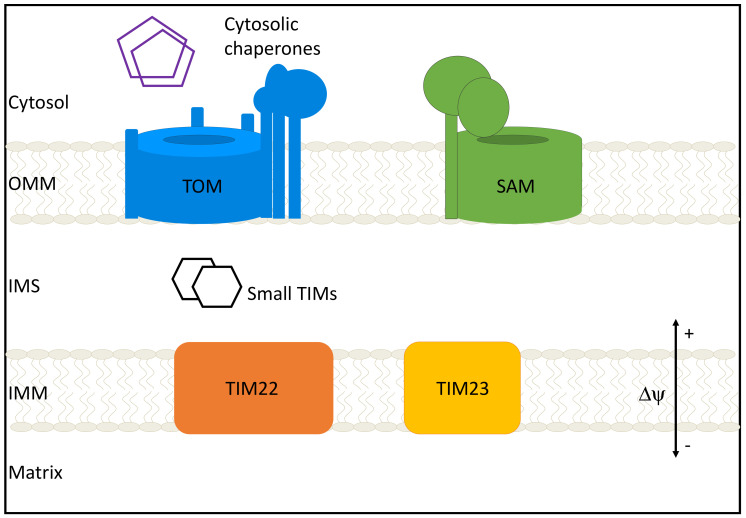
Figure 1
Figure 1
Mitochondrial protein import machinery. The bulk of protein import occurs through the translocase of the outer membrane (TOM) complex. Cytosolic chaperones aid in this process by preventing aggregation of preproteins. After traversing the TOM complex and entering the intermembrane space (IMS), proteins can follow one of several general import pathways: β-barrel proteins are inserted into the outer mitochondrial membrane (OMM) by the sorting and assembly machinery (SAM) complex; Carrier proteins are inserted into the IMM by TIM22; Proteins destined for the inner mitochondrial membrane (IMM) or matrix are imported and integrated by TIM23; small TIMs support protein transfer from IMS to complexes.
Figure 2
Figure 2
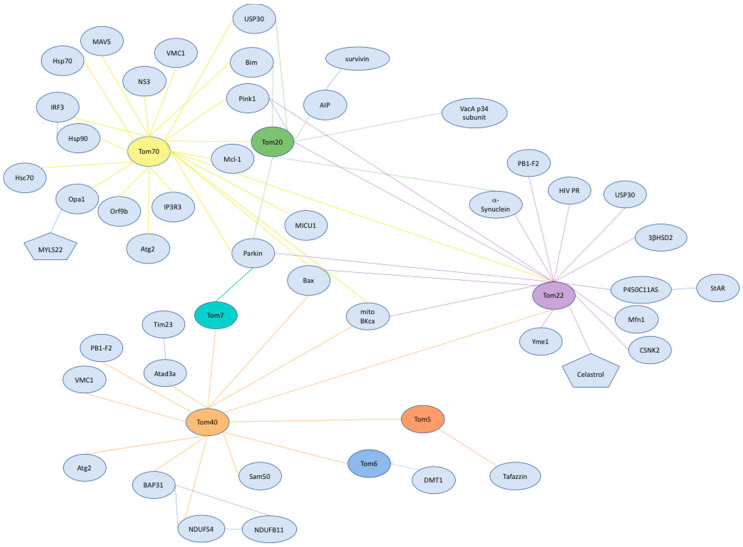
TOM complex interactions. Interaction map of TOM complex subunits demonstrating the vast network that has functions in import, immunity and infection, mitochondria-endoplasmic reticulum contact sites (MERCS), cancer, metabolism, apoptosis, and neurodegenerative diseases. Ovals represent proteins, and pentagons represent small molecules. TOM complex subunits are colored for ease of understanding. Tom40 (orange), Tom22 (purple), Tom5 (vermillion), and Tom6 (light blue), Tom20 (green) and Tom7 (seafoam green).
Figure 3
Figure 3
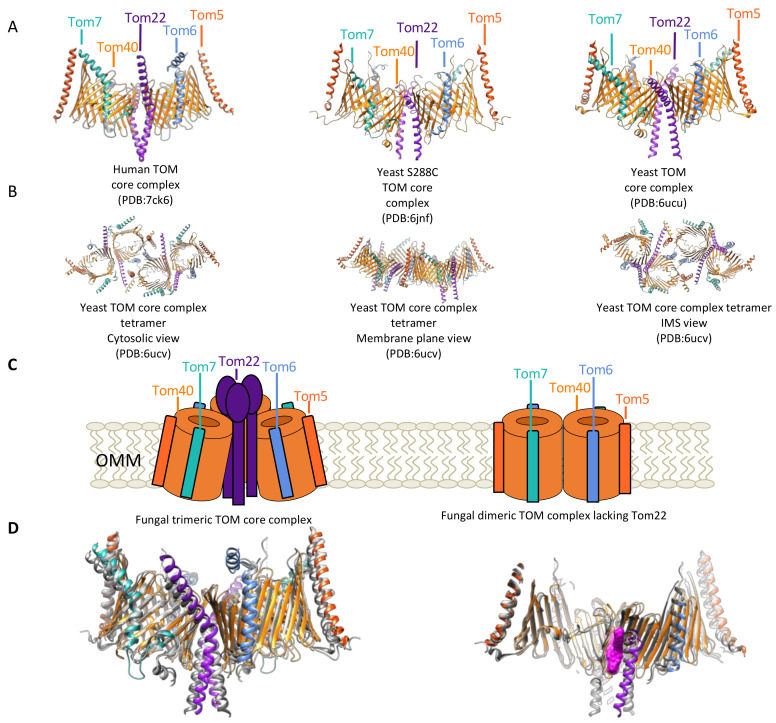
Arrangements of the TOM complex. (A) Structures of the human TOM core complex (left, PDB:7ck6) illustrating high degrees of structural homology with some variations within the subunits and the dimeric form of two separately reported S. cerevisiae TOM core complex structures (middle, PDB:6jnf; right, PDB:6ucu). All three structures show two Tom40 β-barrels (orange), with two Tom22 (purple) helices between the β-barrel, opposite the Tom22 dimers on both β-barrels is a curved Tom5 (vermillion), and on opposite sides of the β-barrel between Tom5 and Tom22 are Tom6 (light blue) and Tom7 (seafoam green). (B) Structures of tetrameric yeast TOM core complex. (left) Cytosolic view of yeast TOM core complex tetramer, illustrating Tom6 role in mediating the formation of the tetramer in yeast. (middle) Membrane plane view of yeast TOM core complex illustrating the tilt of the Tom40 β-barrels and how this results in the curvature of the tetrameric TOM complex. (right) IMS view of yeast TOM core complex showing proximity of IMS domains of β-barrel associated subunits to Tom40 domains that extend into the IMS. Notably, the N-terminal region of Tom40 and Tom5, and the C-terminal region of Tom40 and Tom7 are all in close proximity. (C) (left) Cartoon representation of fungal TOM core complex trimer, (right) fungal Tom40 complex dimer lacking Tom22 based on crosslinking and biochemical data. (D) (left) Superimposition of fungal TOM complexes (gray) and human TOM complex (colored), (right) Superimposition of fungal TOM complexes (gray) and human TOM complex with lipids/detergent in magenta (space-filling model). Superimposition highlights closeness of IMS region of hTom22, extended helical region of hTom6 that runs parallel to the OMM near the cytosol, and extended loop of Tom7 near the IMS.
Figure 4
Figure 4
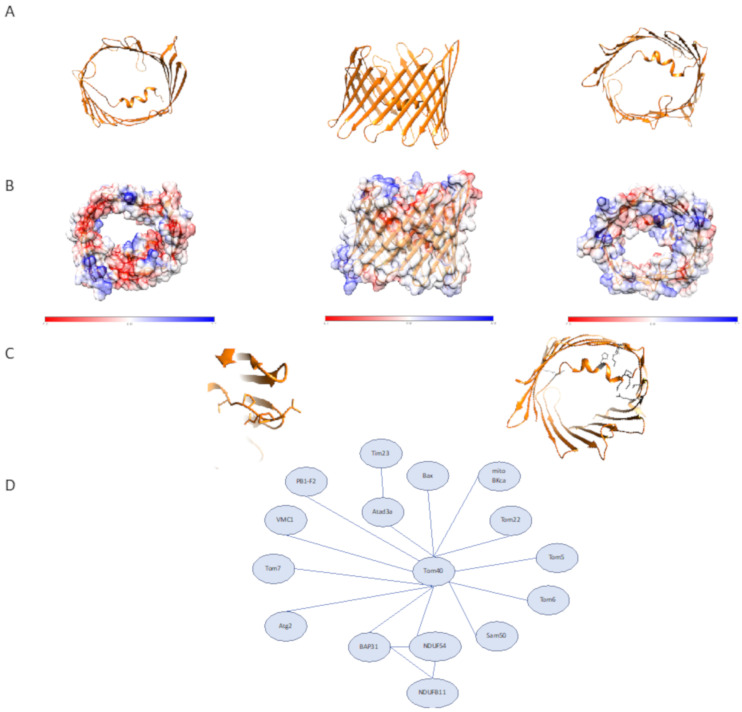
Human Tom40 structural features and interactome. (A) Structure of human Tom40 (PDB:7ck6). (left) Cytosolic view. (middle) Membrane plane view. (right) IMS view (B) Surface electrostatic features of human Tom40. (left) Cytosolic view. (middle) Membrane plane view. (right) IMS view (C) The N-terminal coil of human Tom40. (left) visible coil region preceding the α-helical segment of N-terminal Tom40 region. (right) Interactions between Tom40 lumen and N-terminal region, cytosolic view with relevant residues shown in gray. (D) Tom40 interactions as described. Distances do not represent interaction strength.
Figure 5
Figure 5
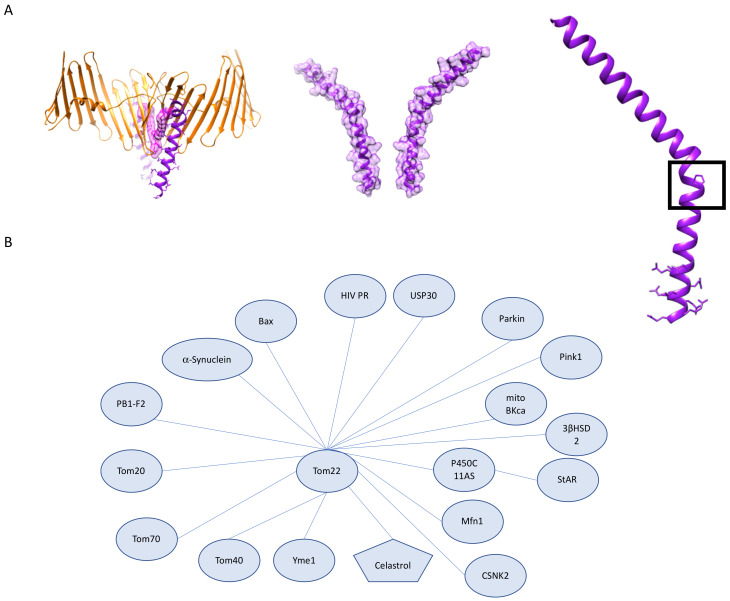
Tom22 structural features and interactome. (A) Structure of human Tom22 (PDB:7ck6). (left) Tom22 interactions with lipid (magenta, space-filling model) and Tom40 β-barrel exterior. (middle) Tom22 dimer (space-filling model). (right) Proline responsible for Tom22 kink shown in black box as well as the Q rich C terminal motif. (B) Tom22 interactions as described. Distances do not represent interaction strength.
Figure 6
Figure 6
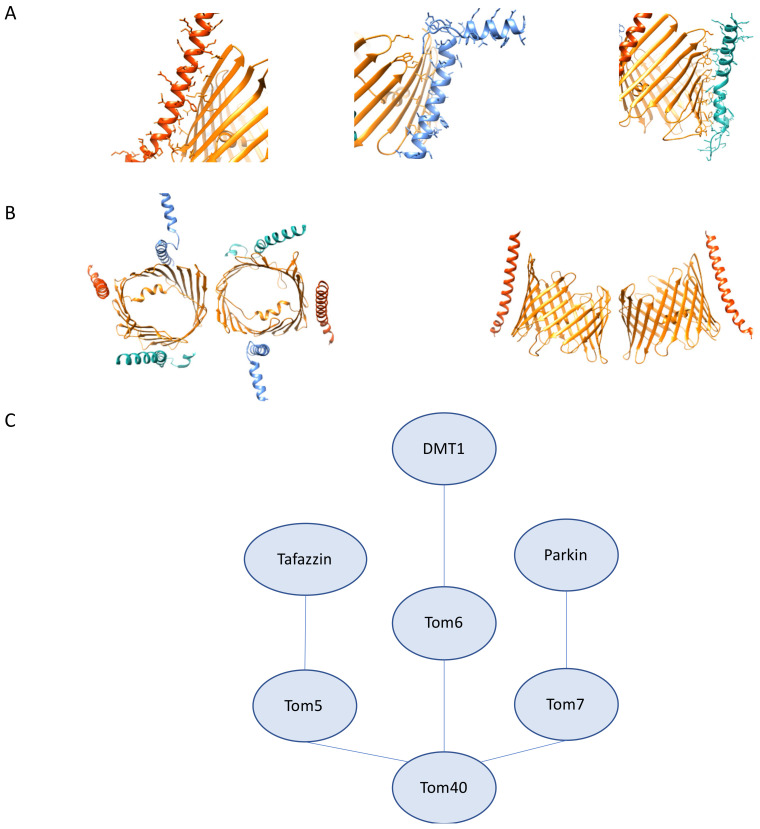
Tom5, Tom6, Tom7 structural features and interactions. (A) High resolution structure of human Tom5, 6, 7 (PDB:7ck6). (left) Tom5 (vermillion) interactions with Tom40 (orange). (middle) Tom6 (light blue) interactions with Tom40 (orange). (right) Tom7 (seafoam green) interactions with Tom40 (orange). (B) (left) Tom5 (vermillion), Tom6 (light blue) and Tom7 (seafoam green) cytosolic view showing arrangement around the β-barrel (right). Curvature of Tom5 along Tom40 (orange). (C) Tom5, Tom6, Tom7 interactions as described. Distances do not represent interaction strength.
Figure 7
Figure 7
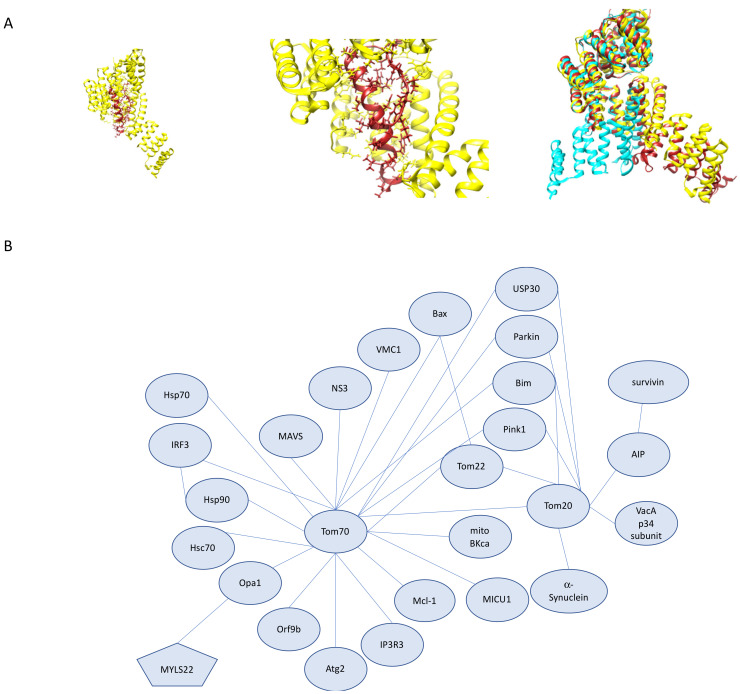
Tom20 and Tom70 Interactions. (A) Structure of human Tom70 bound to SARS-CoV-2 protein Orf9b. (left) Human Tom70 (yellow) binding pocket with Orf9b (red) bound. (middle) Closer view of Orf9b binding pocket with hTom70 (yellow) and Orf9b (red). (right) Superimposition of human Tom70 (yellow), yeast Tom70 (cyan) and yeast Tom71 (brick red). Superimposition highlights the rotation of the N-terminal domain between the fungal structures. (B) Tom70 and Tom20 interactions as described. Distances do not represent interaction strength.

References

    1. Chacinska A., Koehler C.M., Milenkovic D., Lithgow T., Pfanner N. Importing Mitochondrial Proteins: Machineries and Mechanisms. Cell. 2009;138:628–644. doi: 10.1016/j.cell.2009.08.005. - DOI - PMC - PubMed
    1. Lotz C., Lin A.J., Black C.M., Zhang J., Lau E., Deng N., Wang Y., Zong N.C., Choi J.H., Xu T., et al. Characterization, Design, and Function of the Mitochondrial Proteome: From Organs to Organisms. J. Proteome Res. 2014;13:433–446. doi: 10.1021/pr400539j. - DOI - PMC - PubMed
    1. Gottschalk W.K., Lutz M.W., He Y.T., Saunders A.M., Burns D.K., Roses A.D., Chiba-Falek O. The Broad Impact of TOM40 on Neurodegenerative Diseases in Aging. J. Parkinsons Dis. Alzheimers Dis. 2014;1:1. - PMC - PubMed
    1. Cotter D. MitoProteome: Mitochondrial protein sequence database and annotation system. Nucleic Acids Res. 2004;32:463D–467D. doi: 10.1093/nar/gkh048. - DOI - PMC - PubMed
    1. Cherry J.M., Hong E.L., Amundsen C., Balakrishnan R., Binkley G., Chan E.T., Christie K.R., Costanzo M.C., Dwight S.S., Engel S.R., et al. Saccharomyces Genome Database: The genomics resource of budding yeast. Nucleic Acids Res. 2011;40:D700–D705. doi: 10.1093/nar/gkr1029. - DOI - PMC - PubMed

Publication types

MeSH terms

Substances

LinkOut - more resources