


Is There Association between Altered Adrenergic System Activity and Microvascular Endothelial Dysfunction Induced by a 7-Day High Salt Intake in Young Healthy Individuals
- PMID: 34065261
- PMCID: PMC8161165
- DOI: 10.3390/nu13051731
Is There Association between Altered Adrenergic System Activity and Microvascular Endothelial Dysfunction Induced by a 7-Day High Salt Intake in Young Healthy Individuals
Abstract
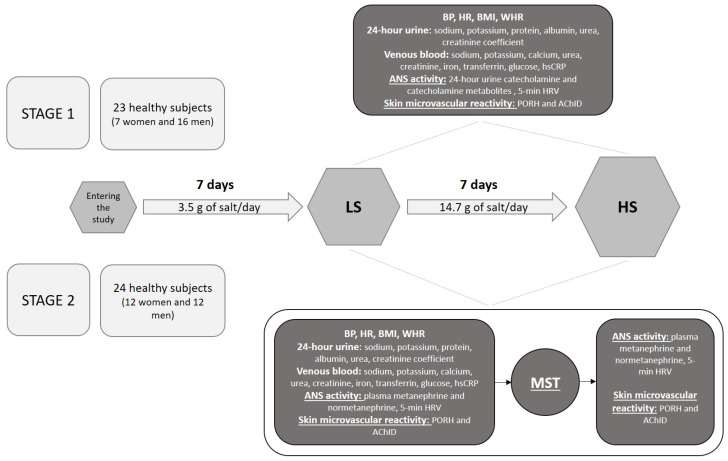
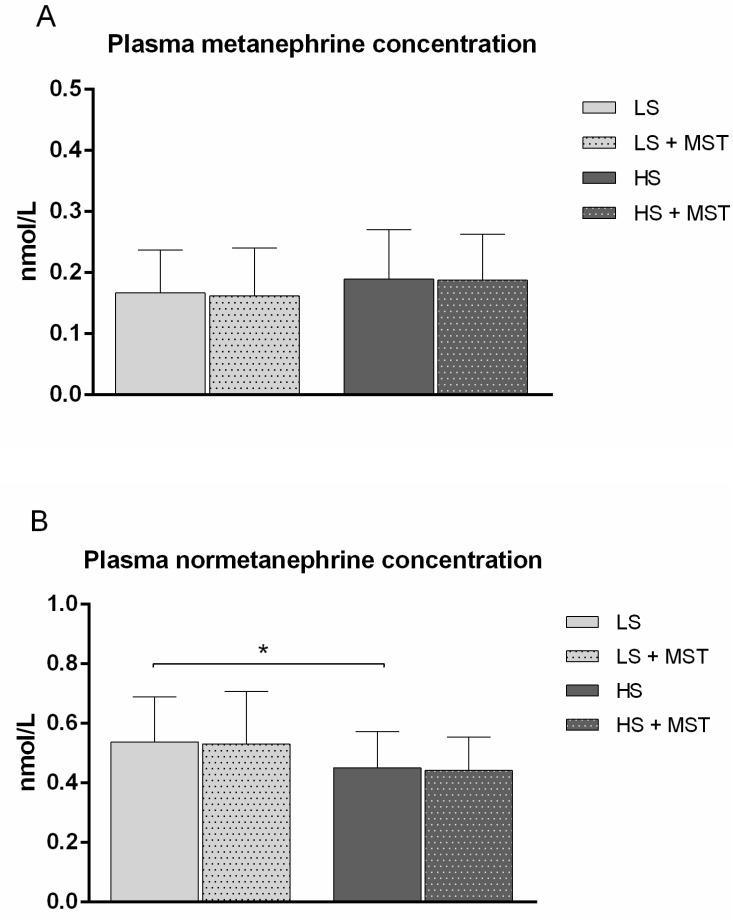
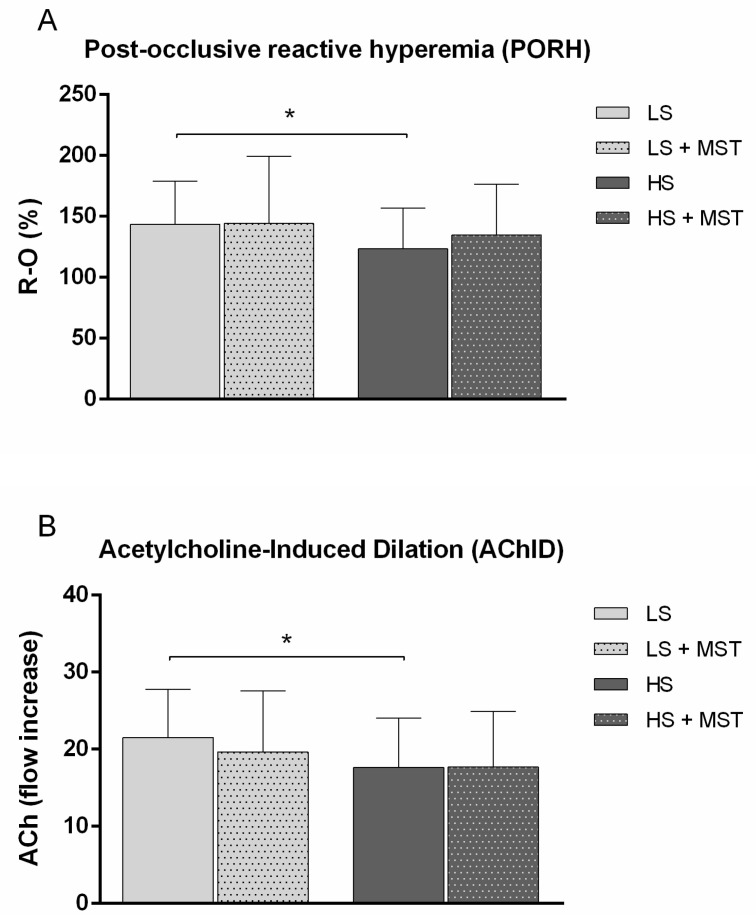
This study aimed to test the effect of a 7-day high-salt (HS) diet on autonomic nervous system (ANS) activity in young healthy individuals and modulation of ANS on microvascular endothelial function impairment. 47 young healthy individuals took 7-day low-salt (LS) diet (3.5 g salt/day) followed by 7-day high-salt (HS) diet (~14.7 g salt/day). ANS activity was assessed by 24-h urine catecholamine excretion and 5-min heart rate variability (HRV). Skin post-occlusive reactive hyperemia (PORH) and acetylcholine-induced dilation (AChID) were assessed by laser Doppler flowmetry (LDF). Separately, mental stress test (MST) at LS and HS condition was conducted, followed by immediate measurement of plasma metanephrines' level, 5-min HRV and LDF microvascular reactivity. Noradrenaline, metanephrine and normetanephrine level, low-frequency (LF) HRV and PORH and AChID significantly decreased following HS compared to LS. MST at HS condition tended to increase HRV LF/HF ratio. Spectral analysis of PORH signal, and AChID measurement showed that MST did not significantly affect impaired endothelium-dependent vasodilation due to HS loading. In this case, 7-day HS diet suppressed sympathetic nervous system (SNS) activity, and attenuated microvascular reactivity in salt-resistant normotensive individuals. Suppression of SNS during HS loading represents a physiological response, rather than direct pathophysiological mechanism by which HS diet affects microvascular endothelial function in young healthy individuals.
Keywords: autonomic nervous system; catecholamine; endothelium; heart rate variability; high-salt diet; sympathetic nervous system.
Conflict of interest statement
The authors declare no conflict of interest.
Figures
References
-
- Jelakovic B., Vrdoljak A., Pecin I., Buzjak V., Karanovic S., Ivkovic V., Dapic K., Domislovic V., Reiner Z. Less salt—More health. Croatian Action on Salt and Health (CRASH) J. Hypertens Res. 2016;2:61–68.
-
- Jelaković B., Reiner Ž. Croatian national programme for reduction of excessive salt intake. Liječnički Vjesn. 2014;136:304–306. - PubMed
-
- Jelakovic B. Salt Intake in Croatia—EHUH 2 Report. [(accessed on 19 May 2021)]; In 41st Symposium Hypertension Highlights in 2020. Available online: https://kongresi.emed.hr/course/info.php?id=149.
Publication types
MeSH terms
Substances
LinkOut - more resources
Full Text Sources
Medical
Research Materials
Miscellaneous
