


Nanoparticles of Bioactive Glass Enhance Biodentine Bioactivity on Dental Pulp Stem Cells
- PMID: 34065440
- PMCID: PMC8161258
- DOI: 10.3390/ma14102684
Nanoparticles of Bioactive Glass Enhance Biodentine Bioactivity on Dental Pulp Stem Cells
Abstract
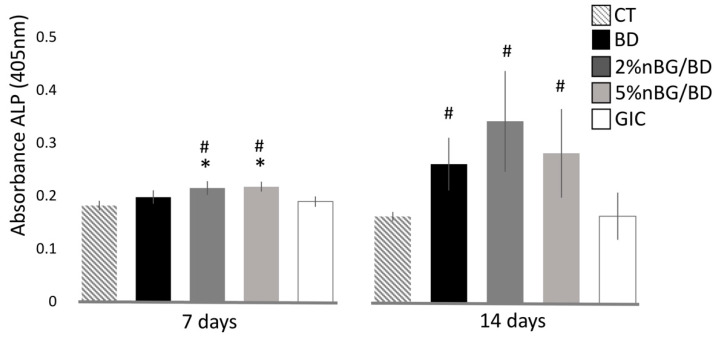
This study aimed to investigate the cytotoxicity and bioactivity of a novel nanocomposite containing nanoparticles of bioactive glass (nBGs) on human dental pulp stem cells (hDPSCs). nBGs were synthesized by the sol-gel method. Biodentine (BD) nanocomposites (nBG/BD) were prepared with 2 and 5% wt of nBG content; unmodified BD and glass ionomer cement were used as references. Cell viability and attachment were evaluated after 3, 7 and 14 days. Odontogenic differentiation was assessed with alkaline phosphatase (ALP) activity after 7 and 14 days of exposure. Cells successfully adhered and proliferated on nBG/BD nanocomposites, cell viability of nanocomposites was comparable with unmodified BD and higher than GIC. nBG/BD nanocomposites were, particularly, more active to promote odontogenic differentiation, expressed as higher ALP activity of hDPSCs after 7 days of exposure, than neat BD or GIC. This novel nanocomposite biomaterial, nBG/BD, allowed hDPSC attachment and proliferation and increased the expression of ALP, upregulated in mineral-producing cells. These findings open opportunities to use nBG/BD in vital pulp therapies.
Keywords: apatite-forming ability; bioactive glass; bioactivity; nanocomposites.
Conflict of interest statement
The authors declare no conflict of interest.
Figures


References
-
- Bourguignon C., Cohenca N., Lauridsen E., Flores M.T., O’Connell A.C., Day P.F., Tsilingaridis G., Abbott P.V., Fouad A.F., Hicks L., et al. International Association of Dental Traumatology guidelines for the management of traumatic dental injuries: 1. Fractures and luxations. Dent. Traumatol. 2020;36:314–330. doi: 10.1111/edt.12578. - DOI - PubMed
LinkOut - more resources
Full Text Sources
