


Increased Plant Quality, Greenhouse Productivity and Energy Efficiency with Broad-Spectrum LED Systems: A Case Study for Thyme (Thymus vulgaris L.)
- PMID: 34065972
- PMCID: PMC8150821
- DOI: 10.3390/plants10050960
Increased Plant Quality, Greenhouse Productivity and Energy Efficiency with Broad-Spectrum LED Systems: A Case Study for Thyme (Thymus vulgaris L.)
Abstract
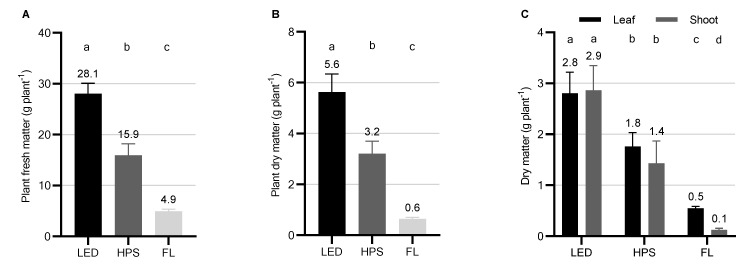
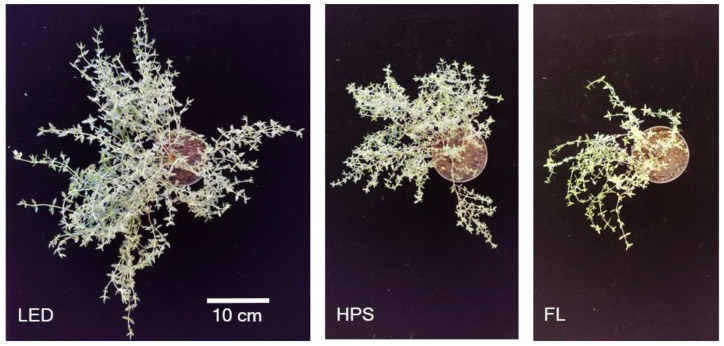
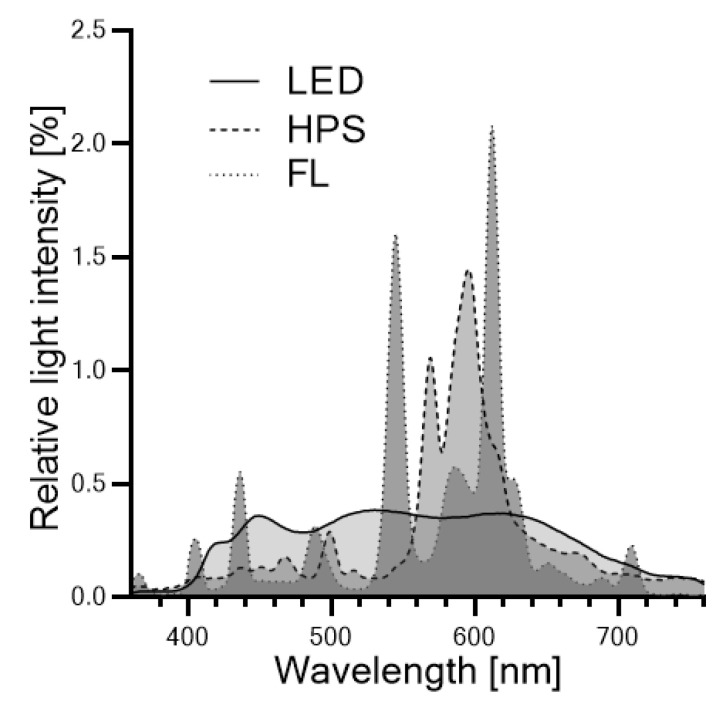
A light-emitting diode (LED) system covering plant-receptive wavebands from ultraviolet to far-red radiation (360 to 760 nm, "white" light spectrum) was investigated for greenhouse productions of Thymus vulgaris L. Biomass yields and amounts of terpenoids were examined, and the lights' productivity and electrical efficiency were determined. All results were compared to two conventionally used light fixture types (high-pressure sodium lamps (HPS) and fluorescent lights (FL)) under naturally low irradiation conditions during fall and winter in Berlin, Germany. Under LED, development of Thymus vulgaris L. was highly accelerated resulting in distinct fresh yield increases per square meter by 43% and 82.4% compared to HPS and FL, respectively. Dry yields per square meter also increased by 43.1% and 88.6% under LED compared to the HPS and FL lighting systems. While composition of terpenoids remained unaffected, their quantity per gram of leaf dry matter significantly increased under LED and HPS as compared to FL. Further, the power consumption calculations revealed energy savings of 31.3% and 20.1% for LED and FL, respectively, compared to HPS. In conclusion, the implementation of a broad-spectrum LED system has tremendous potential for increasing quantity and quality of Thymus vulgaris L. during naturally insufficient light conditions while significantly reducing energy consumption.
Keywords: biomass efficacy; daily light integral; energy consumption; light-emitting diode; plant morphology; volatile organic compounds.
Conflict of interest statement
The authors declare no conflict of interest.
Figures
References
-
- Faust J.E., Logan J. Daily light integral: A research review and high-resolution maps of the United States. HortScience. 2018;53:1250–1257. doi: 10.21273/HORTSCI13144-18. - DOI
-
- Korczynski P.C., Logan J., Faust J.E. Mapping monthly distribution of daily light integrals across the contiguous United States. HortTechnology. 2002;12:12–16. doi: 10.21273/HORTTECH.12.1.12. - DOI
-
- Pramuk L.A., Runkle E.S. Photosynthetic daily light integral during the seedling stage influences subsequent growth and flowering of Celosia, Impatiens, Salvia, Tagetes and Viola. HortScience. 2005;40:1336–1339. doi: 10.21273/HORTSCI.40.5.1336. - DOI
-
- Kong Y., Llewellyn D., Zheng Y. Response of growth, yield, and quality of pea shoots to supplemental light-emitting diode lighting during winter greenhouse production. Can. J. Plant Sci. 2017;98:732–740. doi: 10.1139/cjps-2017-0276. - DOI
-
- Matysiak B., Kowalski A. White, blue and red LED lighting on growth, morphology and accumulation of flavonoid compounds in leafy greens. Zemdirbyste. 2019;106:281–286. doi: 10.13080/z-a.2019.106.036. - DOI
Grants and funding
LinkOut - more resources
Full Text Sources
