. 2021 May 12;10(5):962.
doi: 10.3390/plants10050962.

So Much for Glucosinolates: A Generalist Does Survive and Develop on Brassicas, but at What Cost?

Affiliations

So Much for Glucosinolates: A Generalist Does Survive and Develop on Brassicas, but at What Cost?

Verena Jeschke et al. Plants (Basel). .

Abstract

While plants produce complex cocktails of chemical defences with different targets and efficacies, the biochemical effects of phytotoxin ingestion are often poorly understood. Here, we examine the physiological and metabolic effects of the ingestion of glucosinolates (GSLs), the frontline chemical defenses of brassicas (crucifers), on the generalist herbivore Helicoverpa armigera. We focus on kale and cabbage, two crops with similar foliar GSL concentrations but strikingly different GSL compositions. We observed that larval growth and development were well correlated with the nutritional properties of the insect diets, with low protein contents appearing to exacerbate the negative effects of GSLs on growth, pupation and adult eclosion, parameters that were all delayed upon exposure to GSLs. The different GSLs were metabolized similarly by the insect, indicating that the costs of detoxification via conjugation to glutathione (GSH) were similar on the two plant diets. Nevertheless, larval GSH contents, as well as some major nutritional markers (larval protein, free amino acids, and fat), were differentially affected by the different GSL profiles in the two crops. Therefore, the interplay between GSL and the nitrogen/sulfur nutritional availability of different brassicas strongly influences the effectiveness of these chemical defenses against this generalist herbivore.

Keywords: Brassicaceae; Helicoverpa armigera; generalist herbivore; glucosinolates; isothiocyanates; plant chemical defenses.


Conflict of interest statement

The authors declare no conflict of interest. The funders had no role in the design of the study; in the collection, analyses, or interpretation of data; in the writing of the manuscript, or in the decision to publish the results.

Figures
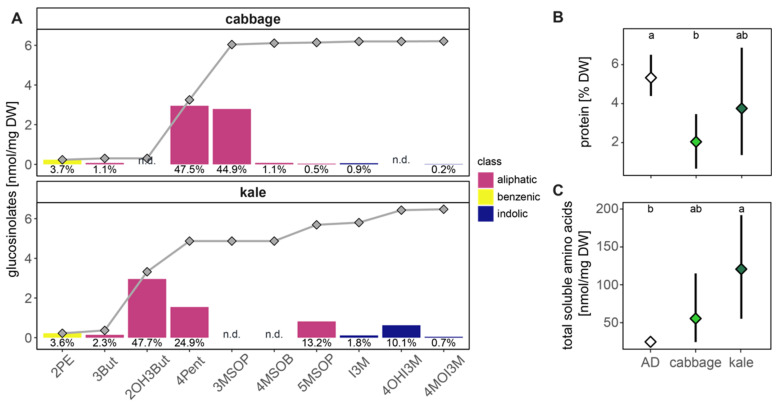
Figure 1
Figure 1
Glucosinolate (A), protein (B) and soluble amino acid content (C) of the food plants and artificial diet (AD). (A) Absolute amounts of single glucosinolates [nmol/mg DW] detected in cabbage (n = 6) and kale (n = 5) are plotted as bars, the colour refers to the class of the glucosinolate: benzenic, aliphatic or indolic. The contribution of that structure to the total glucosinolate amount is printed as percentage below the corresponding bar. The dots represent the accumulated means of glucosinolates. (B) Soluble protein [% DW] of the diets (p = 0.031) and (C) total soluble amino acids [nmol/mg DW] (p = 0.011) plotted as mean ± 95% confidence interval. Tukey letter denoted a statistical difference of 0.05. Mean, standard deviations and statistical details for all analytes are in Table S1. AD = artificial, diet, DW = dry weight, n.d = not detected; glucosinolate side chains: 2PE = 2-phenylethyl, 3But = 3-butenyl, 2OH3But = 2-hydroxy-3-butenyl, 4Pent = 4-pentenyl, 3MSOP = 3-(methylsulfinyl)propyl, 4MSOB = 4-(methylsulfinyl)butyl, 5MSOP = 5-(methylsulfinyl)pentyl, I3M = indol-3-ylmethyl, 4OHI3M = 4-hydroxy-indol-3-ylmethyl, 4MOI3M = 4-methoxyindol-3-ylmethyl.
Figure 2
Figure 2
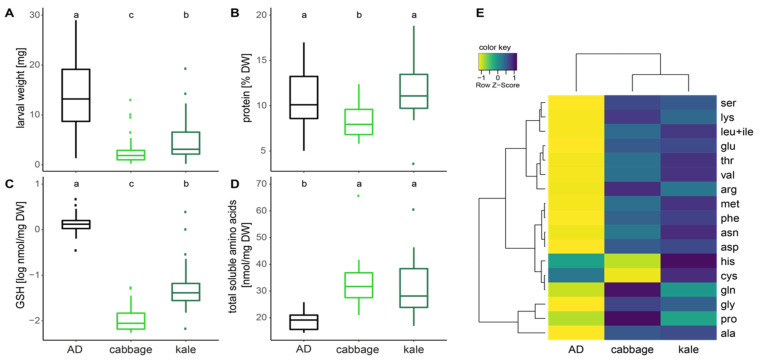
Larval weight and body nutritional composition when fed on artificial diet and food plants with different GSL contents. (A) Larval fresh weight at 4–5 days (III instar) in mg (p < 0.001, n = 80–152); Figure S2 depicts the corresponding values for dry weight. (B) Protein in % of dry weight (p = 0.001, n = 20); (C) GSH concentrations in log of nmol/mg dry weight (p < 0.001, n = 20); (D) Total soluble amino acids in nmol/mg dry weight (p < 0.001, n = 20); (E) Heatmap of the mean [nmol/mg DW] of detected soluble amino acids, with yellow to green corresponding to small values and green-blue to dark blue to high values. Data were scaled across rows, comparing amounts of these amino acids between diet treatment groups. Statistical differences for A-D were assessed using a nested ANOVA mixed affect model, letters denote statistical difference at p = 0.05 level tested with Tukey post hoc test. Means, standard deviations and statistical details for A-D and individual amino acids (E) are in Table S2. AD, artificial diet; DW, dry weight; ▪ indicate outliers in the box-and-whiskers plots.
Figure 3
Figure 3
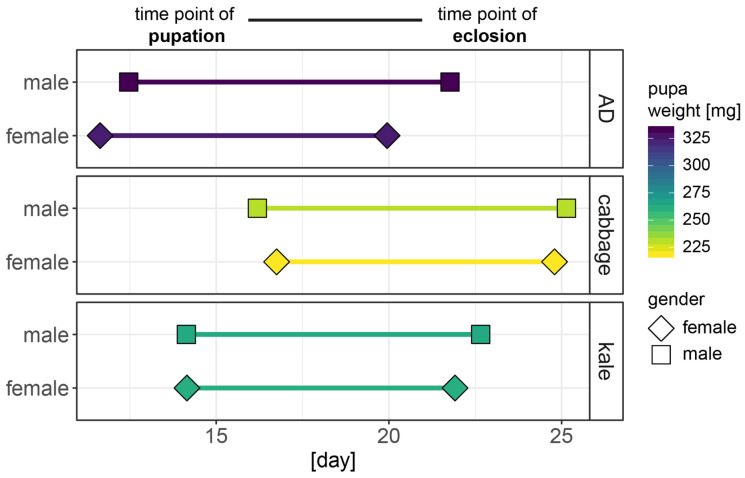
Time to pupation or completion of the larval stage (left data point) and time to adult eclosion (right data point) in days since hatching. The line represents the overall time as a pupa, the colour highlights the pupal weight (taken 24 h after start of pupation). Males are depicted as boxes, females as diamonds, n = 44–92. Means ± SE and statistical information can be found in Figure S4 and Table S3.
Figure 4
Figure 4
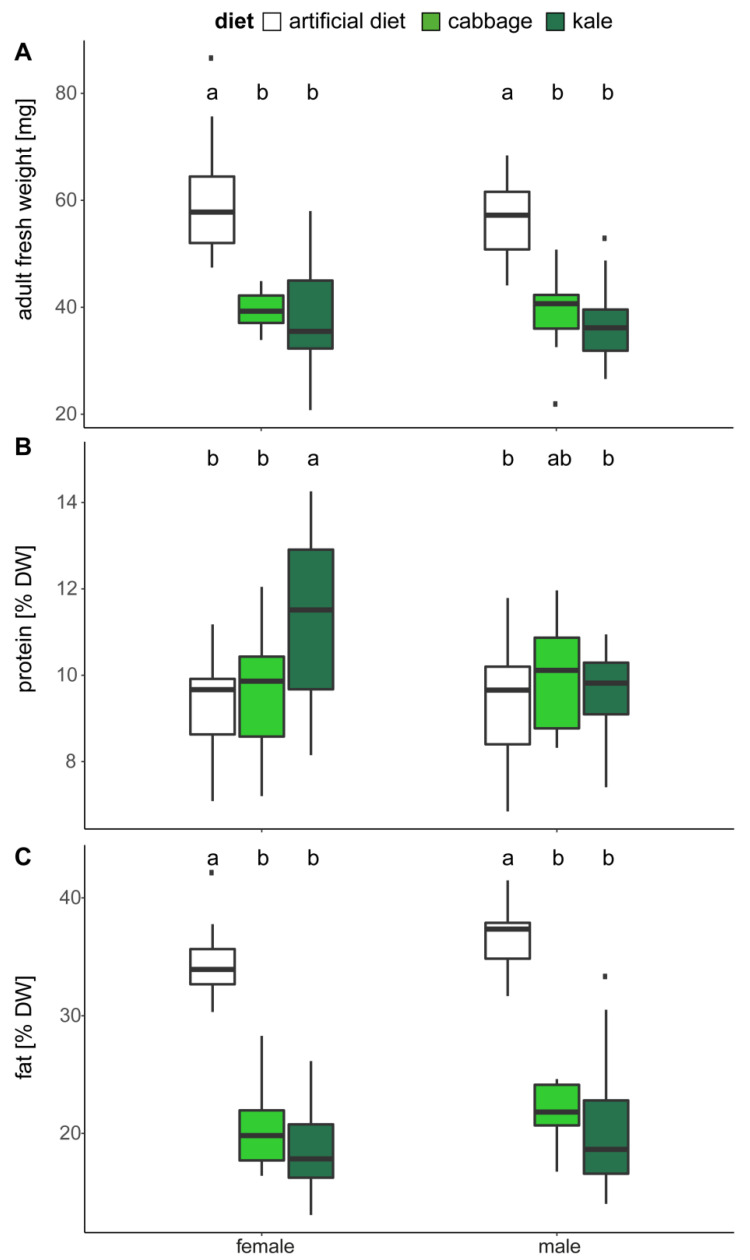
Adult body composition after eclosion. (A) Adult fresh weight is strongly affected by the larval diet (p(diet) < 0.001, p(gender) = 0.286, p(diet×gender) = 0.752). (B) The amount of protein (per dry weight) is differentially affected by diet for females and males (p(diet) = 0.002, p(gender) = 0.033, p(diet×gender) = 0.008). (C) The amount of fat (per dry weight) is mainly affected by larval diet (p(diet) < 0.001, p(gender) = 0.041, p(diet×gender) = 0.885). Mean, standard deviation and statistical details are in Table S4. Statistical differences were assessed using nested ANOVA with mixed effect model, letters denote statistical differences at the p = 0.05 level tested with Tukey posthoc test; ▪ indicate outliers in in the box-and-whiskers plots.
Figure 5
Figure 5
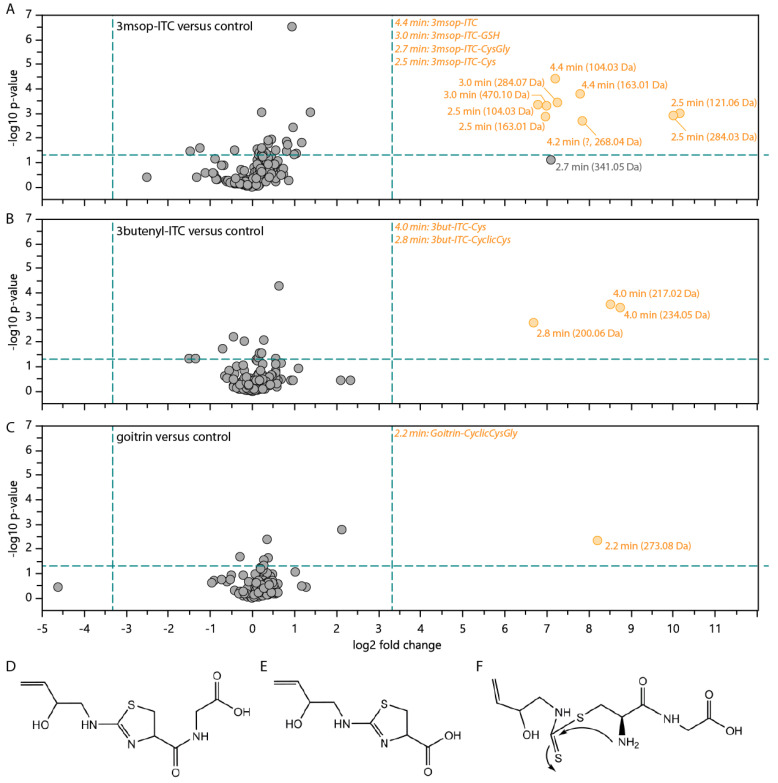
Glucosinolate hydrolysis products are metabolized via the mercapturic acid pathway and intramolecular cyclizations by H. armigera larvae. (AC) Volcano plots of extracted LC-MS/MS features from non-targeted UHPLC-HRMS analyses indicate that the major metabolites of 3msop-ITC (A), 3but-ITC (B), and goitrin (C) are all formed by conjugation to glutathione (GSH), further hydrolysis of the amino acid constituents of GSH to give CysGly and Cys conjugates, and intramolecular cyclizations to give cyclic conjugates. The proposed goitrin metabolite (D) corresponds to the MS feature at 2.2 min in (C), while a signal corresponding to the proposed metabolite (E) was detectable in manually extracted ion chromatograms from faeces extracts but was too small to be extracted automatically by the software. The proposed formation of these cyclic metabolites is shown in (F).

References

    1. Burow M., Losansky A., Müller R., Plock A., Kliebenstein D.J., Wittstock U. The Genetic Basis of Constitutive and Herbivore-Induced ESP-Independent Nitrile Formation in Arabidopsis. Plant Physiol. (Bethesda) 2009;149:561–574. doi: 10.1104/pp.108.130732. - DOI - PMC - PubMed
    1. Halkier B.A., Gershenzon J. Biology and biochemistry of glucosinolates. Ann. Rev. Plant Biol. 2006;57:303–333. doi: 10.1146/annurev.arplant.57.032905.105228. - DOI - PubMed
    1. Matile P. The mustard oil bomb. Compartmentation of the myrosinase system. Biochem. Physiol. Pflanz. 1980;175:722–731. doi: 10.1016/S0015-3796(80)80059-X. - DOI
    1. Wittstock U., Burow M. Tipping the Scales—Specifier Proteins in Glucosinolate Hydrolysis. IUBMB Life. 2007;59:744–751. doi: 10.1080/15216540701736277. - DOI - PubMed
    1. Hopkins R.J., Dam N.M.V., Loon J.J.A.V. Role of Glucosinolates in Insect-Plant Relationships and Multitrophic Interactions. Ann. Rev. Entomol. 2009;54:57–83. doi: 10.1146/annurev.ento.54.110807.090623. - DOI - PubMed

LinkOut - more resources