


The Effectiveness of an Annual Nationally Delivered Workplace Step Count Challenge on Changing Step Counts: Findings from Four Years of Delivery
- PMID: 34066211
- PMCID: PMC8150609
- DOI: 10.3390/ijerph18105140
The Effectiveness of an Annual Nationally Delivered Workplace Step Count Challenge on Changing Step Counts: Findings from Four Years of Delivery
Abstract
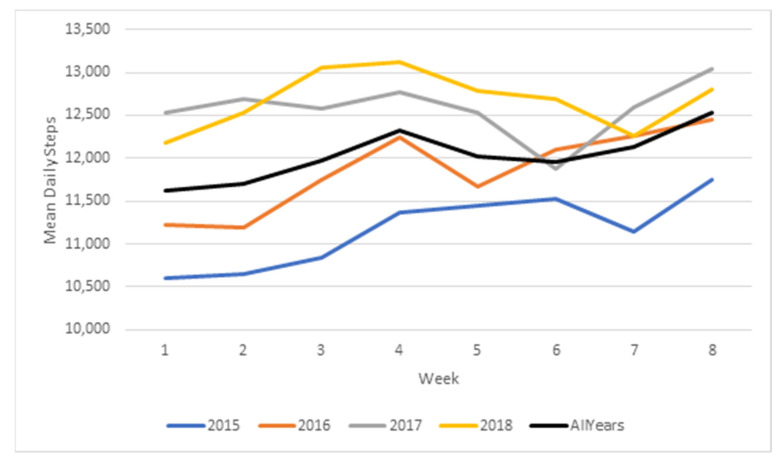
Paths for All's 8-week online Workplace Step Count Challenge (SCC) is a flagship program of Scotland's National Walking Strategy. The aim of this study was to examine changes in step counts throughout the duration of the SCC, across four years of delivery. Participants were those who registered for the 2015-2018 SCCs, and reported demographic data at registration. Participants self-reported their device-measured step count for each day of the SCC. Following data screening, mean daily steps for each week were calculated. Linear mixed models (R nlme procedure), controlling for the within subject nature of the step count measure, were used to explore changes in steps over time. Gender and age group (<45 years; ≥45 years) were entered into a subsequent model. Separate models were created for each year of the SCC and for all years combined. Participants (n = 10,183) were predominantly women (76.8%), aged <45 (54.6%) and ≥45 years. In general, steps increased each week compared to week 1 (p < 0.001), with a significant increase evident at all but seven of 28 data points. Across the four years of SCC, the increase in steps at week 8 compared to week 1 ranged from 506 to 1223 steps per day, making a substantial contribution to the recommended physical activity levels for health. There was no consistent age or gender effect. The findings provide support for the continued investment in such workplace interventions.
Keywords: occupational health; physical activity; walking; workplace.
Conflict of interest statement
C.G. is also an employee of Paths for All and therefore has a potential conflict of interest. However, although C.G. has facilitated access to the data, contributed to sections of the manuscript, and reviewed and approved the final manuscript, he was not involved in the analysis or interpretation of the findings. All other authors declare they have no conflict of interest.
Figures
References
-
- Chekroud S.R., Gueorguieva R., Zheutlin A.B., Paulus M., Krumholz H.M., Krystal J.H., Chekroud A.M. Association between physical exercise and mental health in 1.2 million individuals in the USA between 2011 and 2015: A cross-sectional study. Lancet Psychiat. 2018;5:739–746. doi: 10.1016/S2215-0366(18)30227-X. - DOI - PubMed
-
- Lear S.A., Hu W., Rangarajan S., Gasevic D., Leong D., Iqbal R., Casanova A., Swaminathan S., Anjana R.M., Kumar R., et al. The effect of physical activity on mortality and cardiovascular disease in 130,000 people from 17 high-income, middle-income, and low-income countries: The PURE study. Lancet. 2017;390:2643–2654. doi: 10.1016/S0140-6736(17)31634-3. - DOI - PubMed
-
- Department of Health and Social Care UK Chief Medical Officers’ Physical Activity Guidelines. [(accessed on 21 May 2020)];2019 Available online: https://assets.publishing.service.gov.uk/government/uploads/system/uploa....
MeSH terms
LinkOut - more resources
Full Text Sources
Research Materials
