


Human Activity Recognition for People with Knee Osteoarthritis-A Proof-of-Concept
- PMID: 34066265
- PMCID: PMC8152007
- DOI: 10.3390/s21103381
Human Activity Recognition for People with Knee Osteoarthritis-A Proof-of-Concept
Abstract
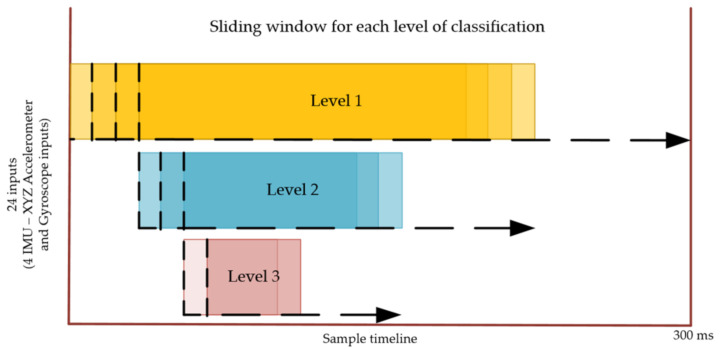
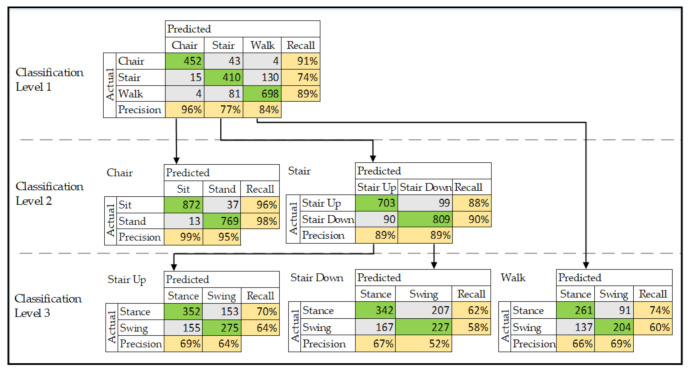
Clinicians lack objective means for monitoring if their knee osteoarthritis patients are improving outside of the clinic (e.g., at home). Previous human activity recognition (HAR) models using wearable sensor data have only used data from healthy people and such models are typically imprecise for people who have medical conditions affecting movement. HAR models designed for people with knee osteoarthritis have classified rehabilitation exercises but not the clinically relevant activities of transitioning from a chair, negotiating stairs and walking, which are commonly monitored for improvement during therapy for this condition. Therefore, it is unknown if a HAR model trained on data from people who have knee osteoarthritis can be accurate in classifying these three clinically relevant activities. Therefore, we collected inertial measurement unit (IMU) data from 18 participants with knee osteoarthritis and trained convolutional neural network models to identify chair, stairs and walking activities, and phases. The model accuracy was 85% at the first level of classification (activity), 89-97% at the second (direction of movement) and 60-67% at the third level (phase). This study is the first proof-of-concept that an accurate HAR system can be developed using IMU data from people with knee osteoarthritis to classify activities and phases of activities.
Keywords: human activity recognition; inertial measurement units; knee osteoarthritis; machine learning; physical activity monitoring.
Conflict of interest statement
The authors declare no conflict of interest. The funders had no role in the design of the study; in the collection, analyses, or interpretation of data; in the writing of the manuscript; or in the decision to publish the results.
Figures
References
-
- Vos T., Barber R.M., Bell B., Bertozzi-Villa A., Biryukov S., Bolliger I., Charlson F., Davis A., Degenhardt L., Dicker D., et al. Global, regional, and national incidence, prevalence, and years lived with disability for 301 acute and chronic diseases and injuries in 188 countries, 1990–2013: A systematic analysis for the Global Burden of Disease Study 2013. Lancet. 2015;386:743–800. doi: 10.1016/S0140-6736(15)60692-4. - DOI - PMC - PubMed
-
- Wilkie R., Peat G., Thomas E., Croft P. Factors associated with restricted mobility outside the home in community-dwelling adults ages fifty years and older with knee pain: An. example of use of the International Classification of Functioning to investigate participation restriction. Arthritis Care Res. 2007;57:1381–1389. doi: 10.1002/art.23083. - DOI - PubMed
MeSH terms
Grants and funding
LinkOut - more resources
Full Text Sources
Miscellaneous
