


Treatment of Poultry Slaughterhouse Wastewater (PSW) Using a Pretreatment Stage, an Expanded Granular Sludge Bed Reactor (EGSB), and a Membrane Bioreactor (MBR)
- PMID: 34066722
- PMCID: PMC8151326
- DOI: 10.3390/membranes11050345
Treatment of Poultry Slaughterhouse Wastewater (PSW) Using a Pretreatment Stage, an Expanded Granular Sludge Bed Reactor (EGSB), and a Membrane Bioreactor (MBR)
Abstract
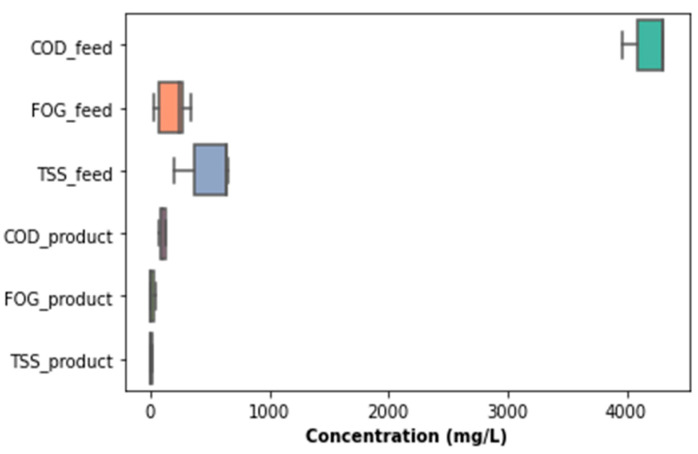
This study presents the biological treatment of poultry slaughterhouse wastewater (PSW) using a combination of a biological pretreatment stage, an expanded granular sludge bed reactor (EGSB), and a membrane bioreactor (MBR) to treat PSW. This PSW treatment was geared toward reducing the concentration of contaminants present in the PSW to meet the City of Cape Town (CoCT) discharge standards and evaluate an alternative means of treating medium- to high-strength wastewater at low cost. The EGSB used in this study was operated under mesophilic conditions and at an organic loading rate (OLR) of 69 to 456 mg COD/L·h. The pretreatment stage of this laboratory-scale (lab-scale) plant played an important role in the pretreatment of the PSW, with removal percentages varying between 20% and 50% for total suspended solids (TSS), 20% and 70% for chemical oxygen demand (COD), and 50% and 83% for fats, oil, and grease (FOG). The EGSB further reduced the concentration of these contaminants to between 25% and 90% for TSS, 20% and 80% for COD, and 20% and >95% for FOG. The last stage of this process, i.e., the membrane bioreactor (MBR), contributed to a further decrease in the concentration of these contaminants with a peak removal performance of >95% for TSS and COD and 80% for the FOG. Overall, the system (pretreatment-EGSB-MBR) exceeded 97% for TSS and COD removal and 97.5% for FOG removal. These results culminated in a product (treated wastewater) meeting the discharge standards.
Keywords: chemical oxygen demand (COD); expanded granular sludge bed reactor (EGSB); fats, oil, and grease (FOG); membrane bioreactor (MBR); poultry slaughterhouse wastewater (PSW); total suspended solids (TSS).
Conflict of interest statement
The authors declare no conflict of interest.
Figures







References
-
- Mpentshu Y. Master’s Thesis. Cape Peninsula University of Technology; Cape Town, South Africa: 2018. Biosurfactant Producing Biofilms for the Enhancement of Nitrification and Subsequent Aerobic Denitrification.
-
- Kasiri S., Mah F., Zhang C., Haveroen M., Ellsworth S., Ulrich A. Anaerobic Processes. Volume 84 Wiley; Hoboken, NJ, USA: 2012.
-
- Bustillo-Lecompte C., Mehrvar M. Slaughterhouse wastewater: Treatment, management and resource recovery. Phys. Chem. Wastewater Treat. Resour. Recover. 2017 doi: 10.5772/65499. - DOI
-
- Rinquest Z., Basitere M., Ntwampe S.K.O., Njoya M. Poultry slaughterhouse wastewater treatment using a static granular bed reactor coupled with single stage nitrification-denitrification and ultrafiltration systems. J. Water Process Eng. 2019;29:100778. doi: 10.1016/j.jwpe.2019.02.018. - DOI
-
- Njoya M. Ph.D. Thesis. Cape Peninsula University of Technology; Cape Town, South Africa: 2019. Anaerobic Digestion of High Strength Wastewater in High Rate Anaerobic Bioreactor Systems: Case of Poultry Slaughterhouse Wastewater (PSW)
Grants and funding
LinkOut - more resources
Full Text Sources
Other Literature Sources
Miscellaneous
