


Being the Pillar for Children with Rare Diseases-A Systematic Review on Parental Quality of Life
- PMID: 34066738
- PMCID: PMC8125857
- DOI: 10.3390/ijerph18094993
Being the Pillar for Children with Rare Diseases-A Systematic Review on Parental Quality of Life
Abstract
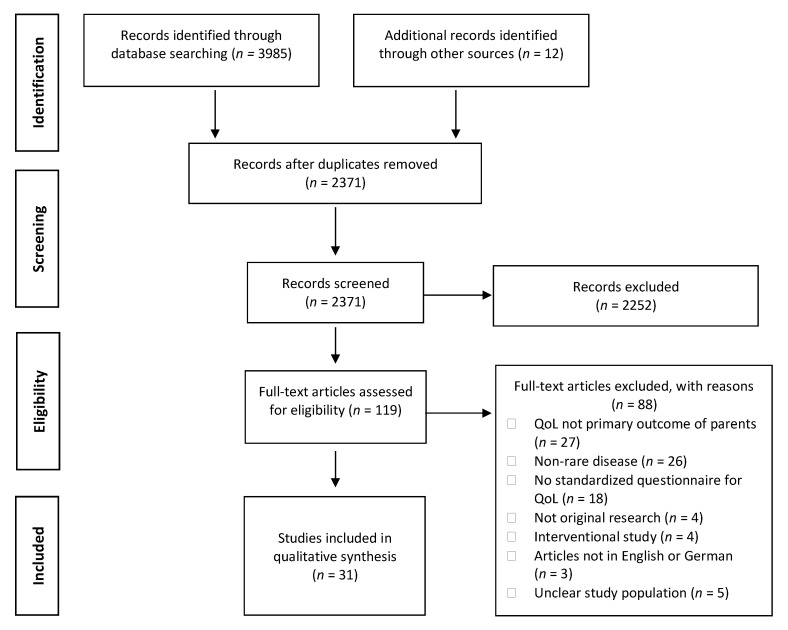
Parents caring for children with rare diseases fear the long-term progression of the child's disease. The current study aims to systematically investigate the quality of life (QoL) in parents of children with different rare diseases. We performed a systematic literature search including quantitative studies on QoL of parents caring for children and adolescents with rare diseases in five databases (APA PsycArticles, APA PsycInfo, MEDLINE, PSYNDEXplus, and PubMed) published between 2000-2020. Of the 3985 titles identified, 31 studies met the inclusion criteria and were selected for narrative review. Studies were included if they investigated predictors of parental QoL or reported QoL compared to normative samples, parents of healthy children, or children with other chronic diseases. We used the Newcastle-Ottawa Scale to assess methodological quality. The systematic review revealed that parents of children with rare diseases experience reduced QoL compared to parents with healthy children and norm values. Psychosocial factors, beyond disease-specific predictors, were shown to influence parental QoL substantially and may thus present an essential aspect within interventions for this highly burdened group. Health care professionals should consider and address the impairment of parental QoL due to the child's rare disease. We discuss insights into existing research gaps and improvements for subsequent work.
Keywords: caregivers; parents; quality of life; rare diseases; systematic review.
Conflict of interest statement
The authors declare that the research was conducted in the absence of any commercial or financial relationships that could be construed as potential conflicts of interest.
Figures
References
-
- EURORDIS Rare Diseases: Understanding this Public Health Priority. [(accessed on 8 October 2019)]; Available online: http://beta.eurordis.org/IMG/pdf/princeps_document-EN.pdf.
-
- European Commission Rare Diseases European Commission, European Union. [(accessed on 20 January 2020)]; Available online: http://europa.eu.int/comm/health/ph_threats/non_com/rare_diseases_en.htm.
Publication types
MeSH terms
LinkOut - more resources
Full Text Sources
Medical
Miscellaneous
