Review
. 2021 May 7;10(9):2000.
doi: 10.3390/jcm10092000.

Sleep Well and Recover Faster with Less Pain-A Narrative Review on Sleep in the Perioperative Period

Affiliations
Review

Sleep Well and Recover Faster with Less Pain-A Narrative Review on Sleep in the Perioperative Period

Reetta M Sipilä et al. J Clin Med. .

Abstract

Sleep disturbance, pain, and having a surgical procedure of some kind are all very likely to occur during the average lifespan. Postoperative pain continues to be a prevalent problem and growing evidence supports the association between pain and sleep disturbances. The bidirectional nature of sleep and pain is widely acknowledged. A decline in sleep quality adds a risk for the onset of pain and also exacerbates existing pain. The risk factors for developing insomnia and experiencing severe pain after surgery are quite similar. The main aim of this narrative review is to discuss why it is important to be aware of sleep disturbances both before and after surgery, to know how sleep disturbances should be assessed and monitored, and to understand how better sleep can be supported by both pharmacological and non-pharmacological interventions.

Keywords: anxiety; insomnia; postsurgical pain; sleep.


Conflict of interest statement

The authors declare no conflict of interest. EK has served on the advisory board of Pfizer and Orion Pharma.

Figures
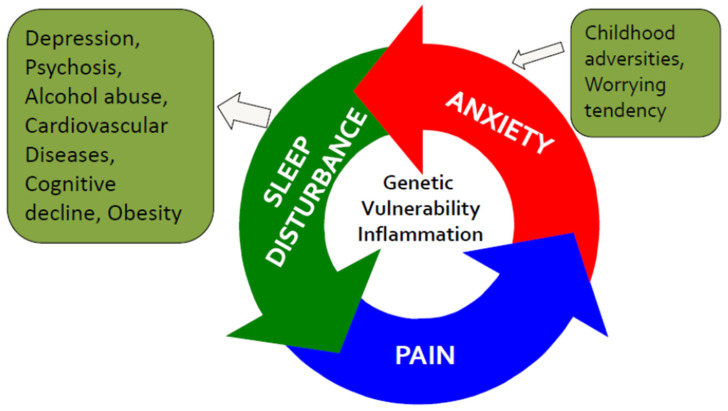
Figure 1
Figure 1
The vicious circle of the association between pain, anxiety, and disturbed sleep. Early-life exposure to stressful events is a vulnerability factor for anxiety, sleep disturbances, and pain in adulthood.
Figure 2
Figure 2
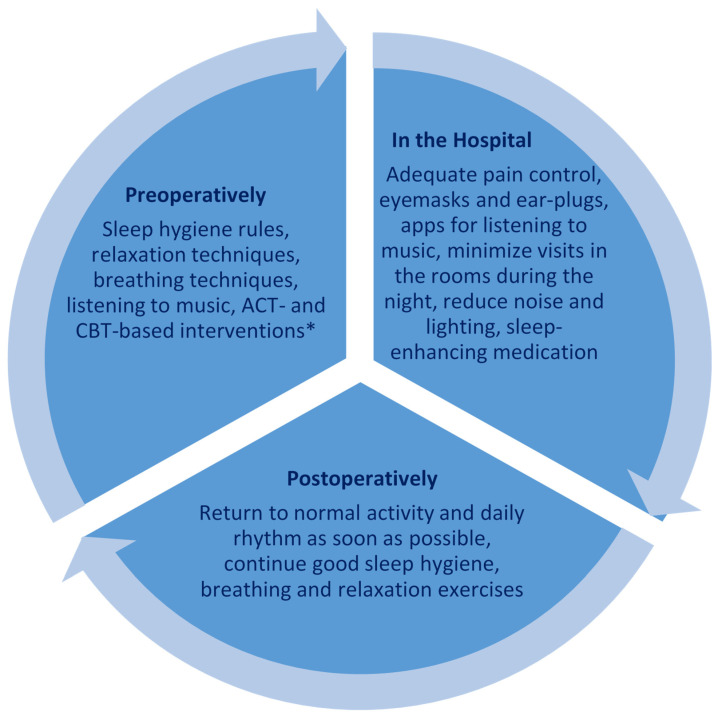
How to improve sleep quality pre- and postoperatively. Non-pharmacological interventions to support sleep preoperatively should be continued postoperatively. Abbreviations: CBT = Cognitive Behavioral Therapy; ACT = Acceptance and Commitment Therapy. * Need to be initiated about 6–8 weeks before surgery.

References

    1. Leger D., Poursain B., Neubauer D., Uchiyama M. An international survey of sleeping problems in the general population. Curr. Med. Res. Opin. 2008;24:307–317. doi: 10.1185/030079907X253771. - DOI - PubMed
    1. Morin C.M., LeBlanc M., Daley M., Gregoire J.P., Merette C. Epidemiology of insomnia: Prevalence, self-help treatments, consultations, and determinants of help-seeking behaviors. Sleep Med. 2006;7:123–130. doi: 10.1016/j.sleep.2005.08.008. - DOI - PubMed
    1. Breivik H., Collett B., Ventafridda V., Cohen R., Gallacher D. Survey of chronic pain in Europe: Prevalence, impact on daily life, and treatment. Eur. J. Pain. 2006;10:287–333. doi: 10.1016/j.ejpain.2005.06.009. - DOI - PubMed
    1. Mantyselka P.T., Turunen J.H., Ahonen R.S., Kumpusalo E.A. Chronic pain and poor self-rated health. JAMA. 2003;290:2435–2442. doi: 10.1001/jama.290.18.2435. - DOI - PubMed
    1. Gerbershagen H.J., Pogatzki-Zahn E., Aduckathil S., Peelen L.M., Kappen T.H., van Wijck A.J., Kalkman C.J., Meissner W. Procedure-specific risk factor analysis for the development of severe postoperative pain. Anesthesiology. 2014;120:1237–1245. doi: 10.1097/ALN.0000000000000108. - DOI - PubMed

LinkOut - more resources