. 2021 May 7;10(5):742.
doi: 10.3390/antiox10050742.

Bioprocessed Brewers' Spent Grain Improves Nutritional and Antioxidant Properties of Pasta

Affiliations

Bioprocessed Brewers' Spent Grain Improves Nutritional and Antioxidant Properties of Pasta

Rosa Schettino et al. Antioxidants (Basel). .

Abstract

Brewers' spent grain (BSG), the by-product of brewing, was subjected to a xylanase treatment followed by fermentation with Lactiplantibacillus plantarum PU1. Bioprocessed BSG has been used as ingredient to obtain a fortified semolina pasta which can be labeled as "high fiber" and "source of protein" according to the European Community Regulation No. 1924/2006. Compared to native BSG, the use of bioprocessed BSG led to higher protein digestibility and quality indices (essential amino acid index, biological value, protein efficiency ratio, nutritional index), as well as lower predicted glycemic index. Bioprocessing also improved the technological properties of fortified pasta. Indeed, brightfield and confocal laser scanning microscopy revealed the formation of a more homogeneous protein network, resulting from the degradation of the arabinoxylan structure of BSG, and the release of the components entrapped into the cellular compartments. The extensive cell wall disruption contributed to the release of phenols, and conferred enhanced antioxidant activity to the fortified pasta. The persistence of the activity was demonstrated after in vitro-mimicked digestion, evaluating the protective effects of the digested pasta towards induced oxidative stress in Caco-2 cells cultures. The fortified pasta showed a peculiar sensory profile, markedly improved by the pre-treatment, thus confirming the great potential of bioprocessed BSG as health-promoting food ingredient.

Keywords: Brewers’ spent grain; antioxidant activity; enzymes; fiber; lactic acid bacteria; nutritional values; pasta; sensory analysis.


Conflict of interest statement

The authors declare no conflict of interest.

Figures
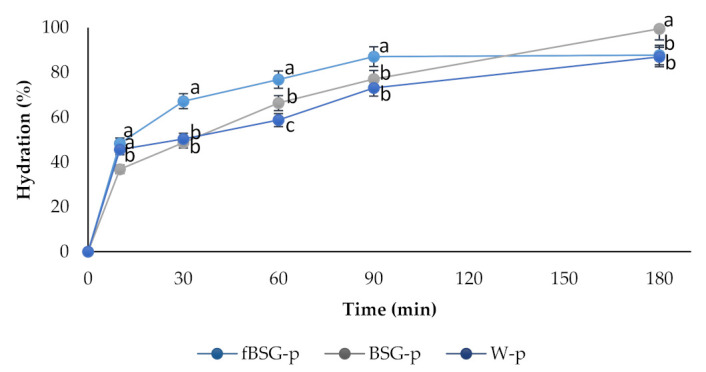
Figure 1
Figure 1
Kinetics of water absorption of pasta at 25 °C. BSG-p, pasta containing native brewers’ spent grains (15% wt/wt in replacement of semolina); fBSG-p, pasta containing fermented brewers’ spent grains (15% wt/wt in replacement of semolina); W-p, pasta made with durum wheat semolina. Data are the means of three independent analyses. a–c Values with different superscript letters within the same time, differ significantly (p < 0.05). Bars of standard deviations are also represented.
Figure 2
Figure 2
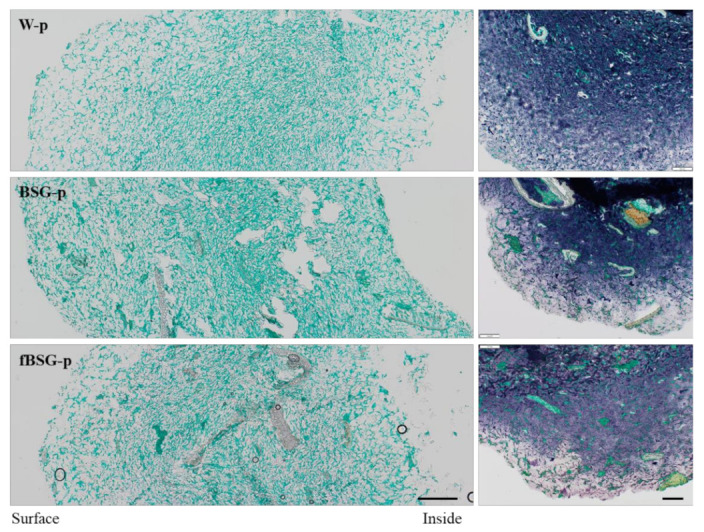
Brightfield microscopy analysis of pasta containing fermented and native brewers’ spent grain: BSG-p, pasta containing native brewers’ spent grain (15% wt/wt in replacement of semolina); fBSG-p, pasta containing fermented brewers’ spent grain (15% wt/wt in replacement of semolina); W-p, pasta made with durum wheat semolina. Proteins are shown in green and starch is shown in blue. Fibers are unstained. Scale bar left panel 200 µm and right panel 100 µm.
Figure 3
Figure 3
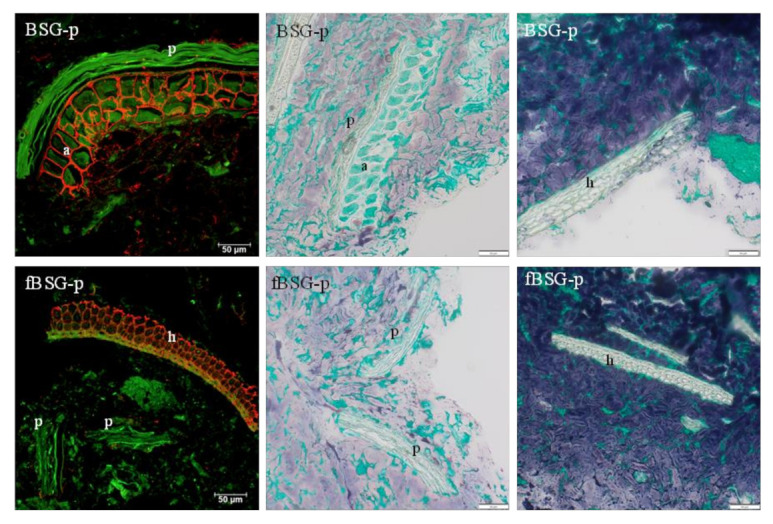
CLSM (left) and brightfield (middle, right) micrographs of pasta containing fermented and native brewers’ spent grain: BSG-p, pasta containing native brewers’ spent grain; fBSG-p, pasta containing fermented brewers’ spent grain. In CLSM micrographs arabinoxylan is shown in red and autofluorescence (cell walls, protein) is shown in green. Bright field micrographs show starch in blue and protein in green. h= hull (palea and lemma), a = aleurone, p = pericarp. Scale bars 50 µm.
Figure 4
Figure 4
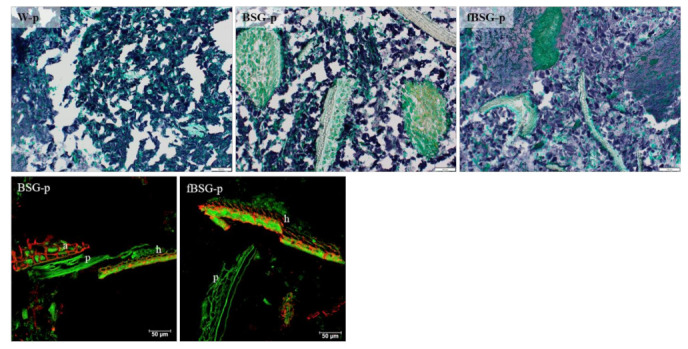
Brightfield and CLSM microscopy analysis performed on the in vitro-digested pasta containing fermented and native brewers’ spent grain: BSG-p, pasta containing native brewers’ spent grain; fBSG-p, pasta containing fermented brewers’ spent grain. W-p, pasta made with durum wheat semolina. Upper row: Bright field micrographs. Proteins are stained green and starch is stained blue. Scale bar 100 µm. Lower row: CLSM micrographs. Arabinoxylan is shown in red and autofluorescence (cell walls, protein) in green. h = hull (palea and lemma), a = aleurone, p = pericarp. Scale bars 50 µm.
Figure 5
Figure 5
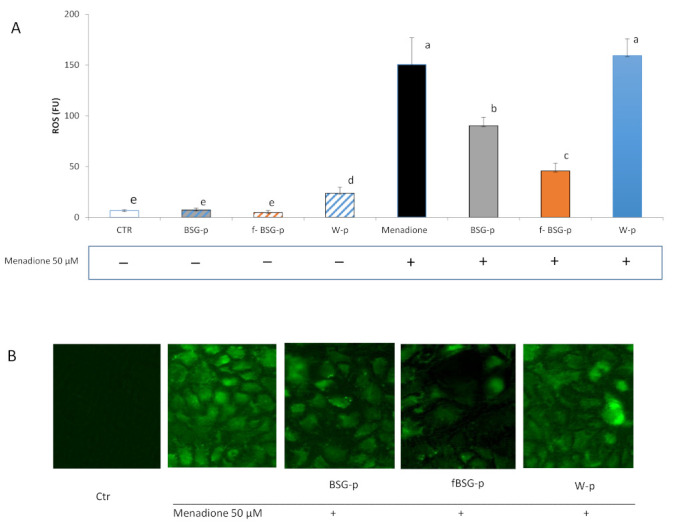
Intracellular reactive oxygen species (ROS) (fluorescence intensity units, FU) (A) and representative fluorescent microscopic images (B). Green fluorescent signal denotes ROS detection by the CellROX® Green reagent. ROS induction was detected utilizing CellROX® Green reagent coupled with the SpectraMax® MiniMax™ Imaging cytometer as described in the Materials and Methods. Caco-2 cells were treated with wheat pasta (W-p), pasta containing native (BSG-p), and fermented (fBSG) brewers’ spent grain (BSG) or not treated (Ctr). To induce oxidative stress, Caco-2 cells were treated with 50 µM Menadione. Data are the means (± SD) of three independent experiments analyzed in triplicate. Data were subjected to one-way ANOVA followed by Tukey’s procedure at p < 0.05. Bars with different superscript letters differ significantly (p < 0.05).
Figure 6
Figure 6
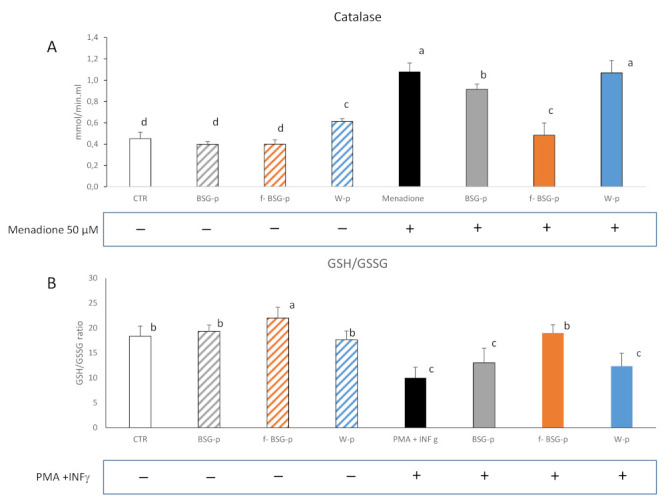
Catalase activity (A) and ratio of reduced and oxidized glutathione (GSH/GSSG) (B). Caco-2 cells were treated with wheat pasta (W-p), pasta containing native (BSG-p), and fermented (fBSG) brewers spent grain (BSG). To induce oxidative stress, Caco-2 cells were treated with a mixture of PMA INF- γ (8000 U/mL) and PMA (0.1 mg/mL). Data are the means (± SD) of three independent experiments analyzed in triplicate. Data were subjected to one-way ANOVA followed by Tukey’s procedure at p < 0.05. Bars with different superscript letters differ significantly (p < 0.05).
Figure 7
Figure 7
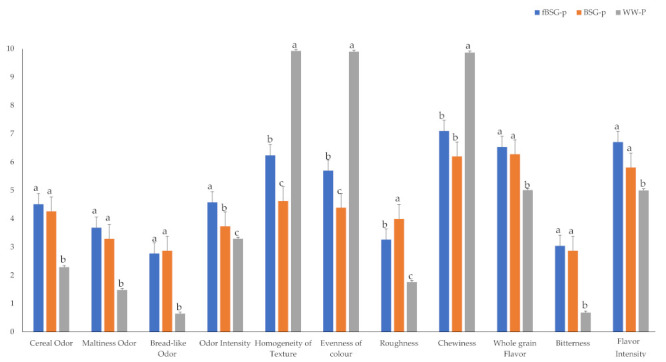
Sensory analysis of pasta containing fermented and native brewers’ spent grain: BSG-p, pasta containing native brewers’ spent grain; fBSG-p, pasta containing fermented brewers’ spent grain; WW-p, commercial pasta made with whole wheat (Pasta di Stigliano, Italy). The 11 sensory attributes were evaluated (on a scale 0–10, Y axis) by a sensory panel of 10 trained assessors in triplicate. Data were subjected to one-way ANOVA followed by Tukey’s procedure at p < 0.05. Bars with different letters differ significantly (p < 0.05).

References

    1. Global Beer Production Worldwide 1998–2019. [(accessed on 12 October 2020)]; Available online: https://www.statista.com/statistics/270275/worldwide-beer-production/
    1. Mussatto S.I., Dragone G., Roberto I.C. Brewers’ spent grain: Generation, characteristics and potential applications. J. Cereal Sci. 2006;43:1–14. doi: 10.1016/j.jcs.2005.06.001. - DOI
    1. Lao E.J., Dimoso N., Raymond J., Mbega E.R. The prebiotic potential of brewers’ spent grain on livestock’s health: A review. Trop. Anim. Health Prod. 2020;52:461–472. doi: 10.1007/s11250-019-02120-9. - DOI - PubMed
    1. Mussatto S.I. Brewer’s spent grain: A valuable feedstock for industrial applications. J. Sci. Food Agric. 2014;94:1264–1275. doi: 10.1002/jsfa.6486. - DOI - PubMed
    1. Fărcaş A., Tofană M., Socaci S., Mudura E., Scrob S., Salanţă L., Mureşan V. Brewers’ spent grain—A new potential ingredient for functional foods. J. Agroaliment. Process. Technol. 2014;20:137–141.

LinkOut - more resources