. 2021 May 17;9(5):516.
doi: 10.3390/vaccines9050516.

Knowledge, Attitudes and Perceptions of COVID-19 Vaccination among Healthcare Workers of an Inner-City Hospital in New York

Affiliations

Knowledge, Attitudes and Perceptions of COVID-19 Vaccination among Healthcare Workers of an Inner-City Hospital in New York

Federico Ciardi et al. Vaccines (Basel). .

Abstract

Introduction: New York City is one of the areas most affected by the COVID-19 pandemic in the United States. Healthcare workers are among those at high risk of contracting the virus, and a vital source of information and trust in vaccines to the community. Methods: This study was conducted about attitudes towards COVID-19 vaccination among healthcare workers at a public hospital in New York City during the beginning of COVID-19 vaccination. 428 hospital employees responded. Results: Several factors were significantly associated with vaccine attitudes, including demographics such as gender (p = 0.002), age (p = 0.005), race (p < 0.001) and home location (p < 0.001), role within the hospital (p < 0.001), knowledge about the virus (p < 0.001) and confidence in and expectations about personal protective equipment and behaviors (p < 0.001). Structural equation modeling revealed that the most predictive factors were prior vaccine attitudes and concern with the speed of testing and approval of the vaccines (p < 0.001). Multivariate analysis reinforced these, while also identifying perceived personal risk as significant (p = 0.033). Conclusions: Several modifiable factors that reflect confidence in science, scientific knowledge, personal risk perception, experience and medical authority are correlated with vaccine attitudes, indicating that a holistic educational approach to improve trust in science is likely to be effective in long-term reduction in vaccine hesitancy.

Keywords: COVID-19; healthcare workers; vaccine attitudes; vaccine hesitancy.


Conflict of interest statement

The authors declare no conflict of interest.

Figures
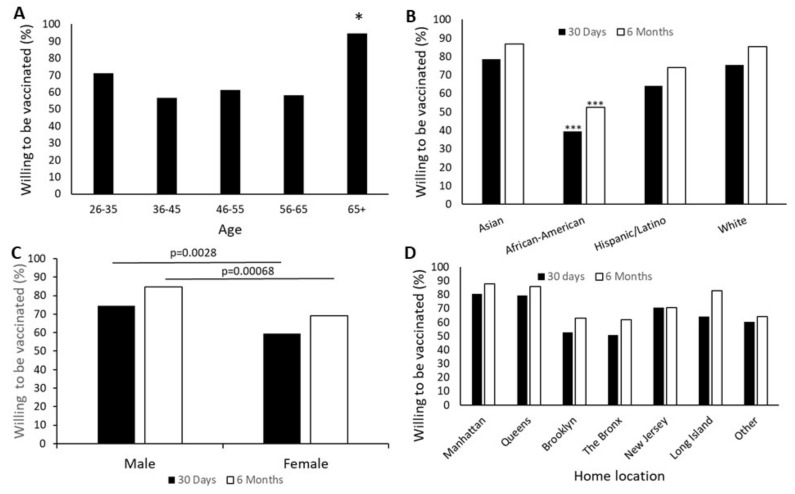
Figure 1
Figure 1
Demographic influences on vaccine acceptance. Willingness to be vaccinated was evaluated using the questions “In the next 30 days…” or “In the next 6 months…” with responses being “I plan to vaccinate myself” or “I will not vaccinate myself.” (A) Significantly more subjects over the age of 65 were planning to be vaccinated within 30 days than any other group (Overall, χ2 = 14.65, p = 0.005, comparison of 65+ to each other group (*) p < 0.030). This difference disappeared when the time frame was extended to six months. (B) African American participants were significantly less likely to plan on vaccination than any other ethnic group within either 30 days or six months (*** p < 0.0003), (C) Women were less likely than men to accept vaccination within either time frame (p < 0.001). (D) Location of a person’s home was statistically meaningful in COVID-19 vaccination intention during both time frames (χ2 > 26, p < 0.0003). n = 428.
Figure 2
Figure 2
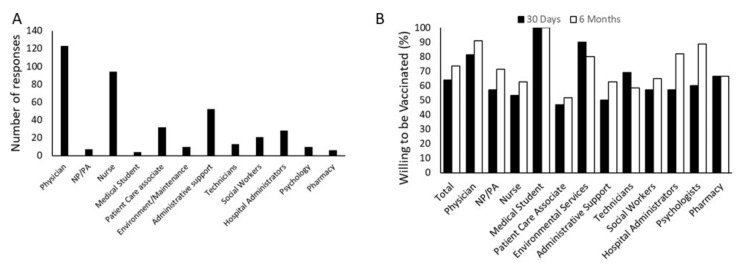
Influence of hospital role on vaccine acceptance. (A) Survey responses were unevenly distributed among hospital employees, with an abundance of physicians and nurses. However, multiple roles in all aspects of hospital employment are represented. (NP/PA-Nurse practitioner or Physician’s assistant) (B) Willingness to be vaccinated was evaluated by the response to the questions “In the next 30 days…” or “In the next 6 months…” with responses being “I plan to vaccinate myself” or “I will not vaccinate myself.” The respondent’s role in the hospital significantly affects their plan to be vaccinated within both 30 days (χ2 = 35.69, p < 0.001) and six months (χ2 = 40.22, p < 0.001) N = 426.
Figure 3
Figure 3
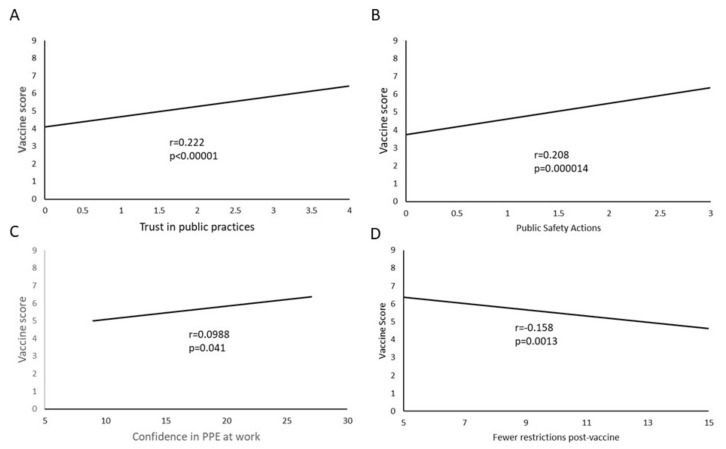
Personal Protective equipment (PPE) practices correlate with vaccine attitudes. (A) Participants with high trust in PPE and behavioral actions in public also have more intention to be vaccinated as measured by the COVID-19 vaccine attitude score. (B) Participants who use masks and behavioral modifications in public also have higher intention to be vaccinated. (C) Confidence in PPE and behavioral modification to keep the participants and colleagues safe from infection in the hospital is mildly correlated with increased intent to vaccinate. (D) Intent to vaccinate is correlated with the expectation that protective equipment and practices will need to be continued even after vaccination. Sample size for each was N = 428. Only trendlines are shown for each of the dot plots to decrease noise.
Figure 4
Figure 4
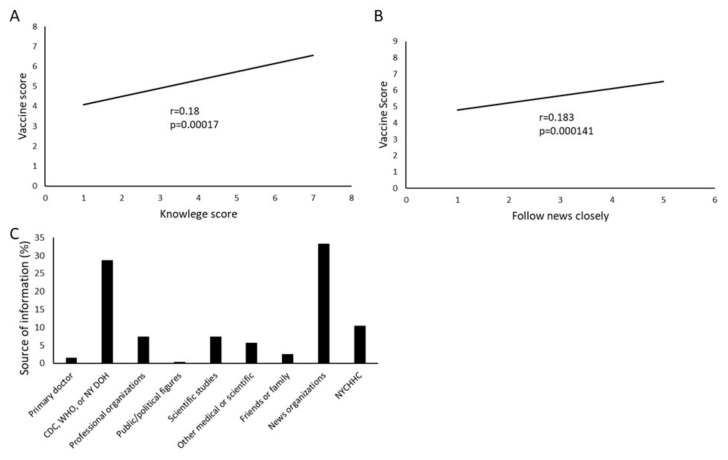
COVID-19 knowledge and vaccine attitudes. (A) Scores on the COVD-19 knowledge section of the survey strongly correlate with the COVID vaccine score, indicating a higher intent to vaccinate. (B) Similarly, closely following news of COVID-19 correlated with willingness to be vaccinated. (C) Sources of information varied widely, with news organizations the most common, followed by government sources. (NYCHHC-New York City Health and Hospitals). N = 428. Only trendlines are shown for each of the dot plots to clearly show the correlations.
Figure 5
Figure 5
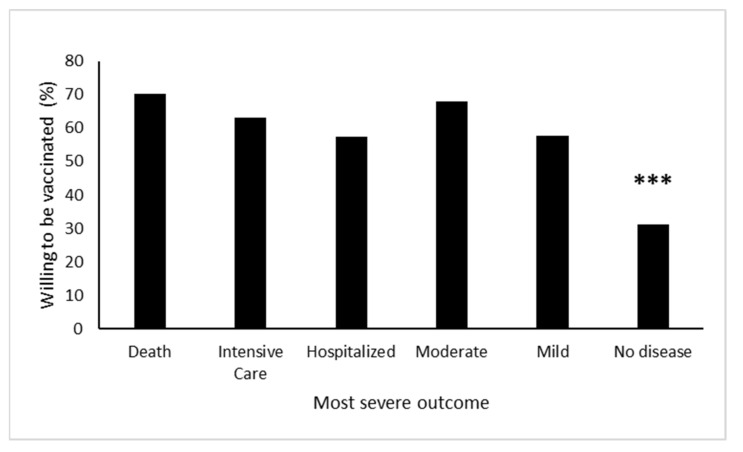
Experience with COVID-19 is associated with intent to vaccinate. Respondents who had personal experience with someone with COVID-19 disease were significantly more likely to report being willing to be vaccinated in the next 30 days (*** χ2 = 19.26, p < 0.001). No significant differences were found between any groups who had personal experience with disease patients. The respondents were asked to list the most severe outcome if they knew more than one person with COVID-19.
Figure 6
Figure 6
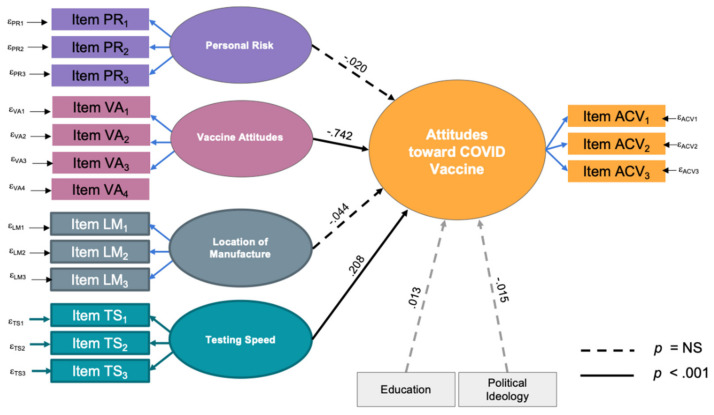
Structural equation model. Four variables, each represented by three survey items, were tested for model fit, and then analyzed for prediction of the output variable, attitudes toward COVID vaccination. Each rectangle represents a survey item as described in Table 2. Solid lines show statistically significant predictive ability while dashed lines show nonsignificant associations. Negative overall vaccine attitudes and a strong perception of too-rapid vaccine testing were predictive of worse attitudes towards receiving a COVID-19 vaccine. Education and political ideology were tested as covariates and did not show significant prediction of COVID-19 vaccine attitudes.

References

    1. COVID-19 Map—Johns Hopkins Coronavirus Resource Center. [(accessed on 27 February 2021)]; Available online: https://coronavirus.jhu.edu/map.html.
    1. WHO Draft Landscape and Tracker of COVID-19 Candidate Vaccines. [(accessed on 27 February 2021)]; Available online: https://www.who.int/publications/m/item/draft-landscape-of-covid-19-cand....
    1. Ten Threats to Global Health in 2019. [(accessed on 3 March 2021)]; Available online: https://www.who.int/news-room/spotlight/ten-threats-to-global-health-in-....
    1. Johnson D.K., Mello E.J., Walker T.D., Hood S.J., Jensen J.L., Poole B.D. Combating Vaccine Hesitancy with Vaccine-Preventable Disease Familiarization: An Interview and Curriculum Intervention for College Students. Vaccines. 2019;7:39. doi: 10.3390/vaccines7020039. - DOI - PMC - PubMed
    1. Funk C., Tyson A. Intent to Get a COVID-19 Vaccine Rises to 60% as Confidence in Research and Development Process Increases. Pew Research Center. [(accessed on 16 May 2021)];2020 Dec 3; Available online: https://www.pewresearch.org/science/2020/12/03/intent-to-get-a-covid-19-...

LinkOut - more resources