


Sexual Harassment by Patients, Clients, and Residents: Investigating Its Prevalence, Frequency and Associations with Impaired Well-Being among Social and Healthcare Workers in Germany
- PMID: 34068346
- PMCID: PMC8153261
- DOI: 10.3390/ijerph18105198
Sexual Harassment by Patients, Clients, and Residents: Investigating Its Prevalence, Frequency and Associations with Impaired Well-Being among Social and Healthcare Workers in Germany
Abstract
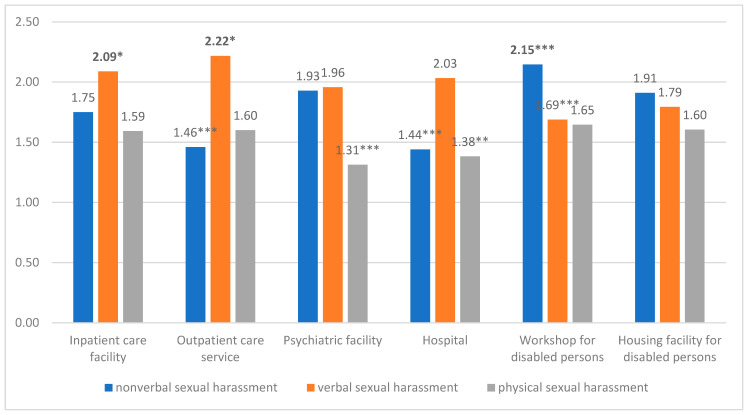
Social and healthcare workers are at high risk of experiencing sexual harassment in the workplace. Although sexual harassment is detrimental to people's well-being, only a few studies have systematically investigated social and healthcare workers' experiences of different forms of sexually harassing behaviors by patients, clients, and residents in Germany. This study aimed to address this gap by determining the prevalence rates and frequency of nonverbal, verbal, and physical sexual harassment by patients, clients, and residents against social and healthcare workers. In addition, we examined the associations of sexual harassment with workers' well-being and described employees' awareness of offers of organizational support for sexual harassment prevention and aftercare. Data were collected from n = 901 employees working in a total of 61 facilities, including inpatient and outpatient care, psychiatric facilities, hospitals, and facilities for persons with disabilities. While the prevalence, frequency, and predominant forms of sexual harassment differed across sectors, the results indicated that nonverbal, verbal and physical sexual harassment were highly prevalent in social and healthcare work, with both men and women being affected. Furthermore, we found that sexual harassment was positively related to impaired well-being (e.g., depressiveness and psychosomatic complaints). In terms of support offers for sexual harassment prevention and aftercare, we found that approximately one-third of social and healthcare workers were not aware of any offers at their facilities. In addition to highlighting the problem of sexual harassment by patients, clients, and residents in social and healthcare settings, this study provides recommendations for the development of interventions and suggests several avenues for future research.
Keywords: healthcare; prevention and aftercare; sexual harassment; social services; well-being.
Conflict of interest statement
The authors declare no conflict of interest.
Figures
References
-
- McDonald P. Workplace sexual harassment 30 years on: A review of the literature. Int. J. Manag. Rev. 2012;14:1–17. doi: 10.1111/j.1468-2370.2011.00300.x. - DOI
-
- Yagil D. When the customer is wrong: A review of research on aggression and sexual harassment in service encounters. Aggress. Violent Behav. 2008;13:141–152. doi: 10.1016/j.avb.2008.03.002. - DOI
-
- Cortina L.M., Berdahl J.L. Sexual Harassment in Organizations: A Decade of Research in Review. In: Barling J., Cooper C.L., editors. The SAGE Handbook of Organizational Behavior. Volume 1. SAGE Publications Ltd.; Los Angeles, CA, USA: London, UK: New Delhi, India: Singapore: 2008. pp. 469–497.
MeSH terms
LinkOut - more resources
Full Text Sources
Medical
Miscellaneous
