Review
. 2021 May 10;11(5):426.
doi: 10.3390/life11050426.

Chronothyroidology: Chronobiological Aspects in Thyroid Function and Diseases

Affiliations
Review

Chronothyroidology: Chronobiological Aspects in Thyroid Function and Diseases

Giuseppe Bellastella et al. Life (Basel). .

Abstract

Chronobiology is the scientific discipline which considers biological phenomena in relation to time, which assumes itself biological identity. Many physiological processes are cyclically regulated by intrinsic clocks and many pathological events show a circadian time-related occurrence. Even the pituitary-thyroid axis is under the control of a central clock, and the hormones of the pituitary-thyroid axis exhibit circadian, ultradian and circannual rhythmicity. This review, after describing briefly the essential principles of chronobiology, will be focused on the results of personal experiences and of other studies on this issue, paying particular attention to those regarding the thyroid implications, appearing in the literature as reviews, metanalyses, original and observational studies until 28 February 2021 and acquired from two databases (Scopus and PubMed). The first input to biological rhythms is given by a central clock located in the suprachiasmatic nucleus (SCN), which dictates the timing from its hypothalamic site to satellite clocks that contribute in a hierarchical way to regulate the physiological rhythmicity. Disruption of the rhythmic organization can favor the onset of important disorders, including thyroid diseases. Several studies on the interrelationship between thyroid function and circadian rhythmicity demonstrated that thyroid dysfunctions may affect negatively circadian organization, disrupting TSH rhythm. Conversely, alterations of clock machinery may cause important perturbations at the cellular level, which may favor thyroid dysfunctions and also cancer.

Keywords: biological rhythms; chronobiology; rhythm disruption; thyroid diseases.


Conflict of interest statement

The authors declare no conflict of interest.

Figures
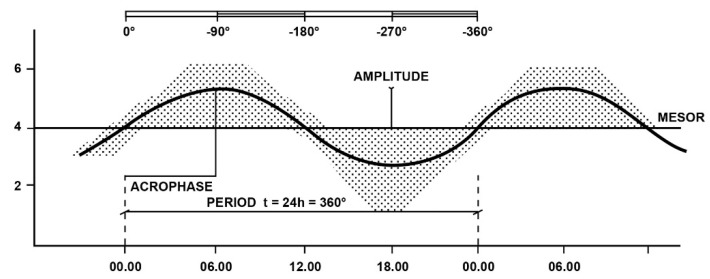
Figure 1
Figure 1
Schematic representation of a circadian virtual rhythm and its parameters (period, zenith or acrophase, mean level or mesor, amplitude), obtained by fitting a sinusoidal curve to a naïf pattern of data by the “least squares” method: Period of 24 h = 360° ([13], reproduced with permission of the Editor).
Figure 2
Figure 2
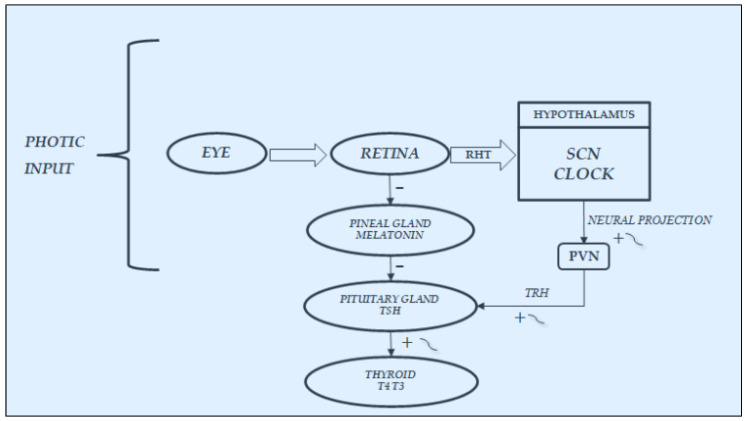
Synchronization by light input of the rhythmic variations in hypothalamic–pituitary–thyroid secretions: It acts directly, through the retino-hypothalmic tract (RHT), by exciting the light-entrainable circadian pacemaker located in the suprachiasmatic nucleus (SCN) of the hypothalamus, which then outputs the circadian signal via neural projection, exciting the rhythmic secretion of thyrotropin-releasing hormone (TRH) and consequently of thyrotropin (TSH) and thyroid hormones(T4:thyroxine; T3:triiodotyronine). Light acts also indirectly, by modulating with an inhibiting effect the variations in melatonin secretion at retina and pineal gland levels, thus further stimulating the secretions of the hypothalamic–pituitary–thyroid axis.
Figure 3
Figure 3
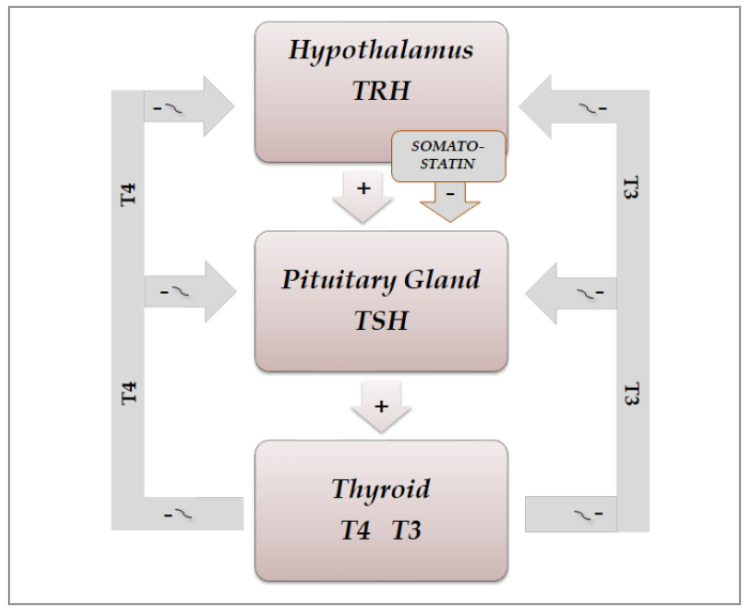
Schematic representation of physiological organization of rhythmic hypothalamic–pituitary–thyroid secretions: TRH(thyrotropin-releasing hormone) and somatostatin from the hypothalamus exert a stimulating and inhibiting action, respectively, on the pituitary secretion of TSH(thyrotropin), which in turn stimulates the thyroid gland to produce T4(thyroxine) and T3(triiodotyronine). Thyroid hormones regulate, by a negative feedback, the secretion of TRH and TSH, by acting both at hypothalamus and pituitary level.
Figure 4
Figure 4
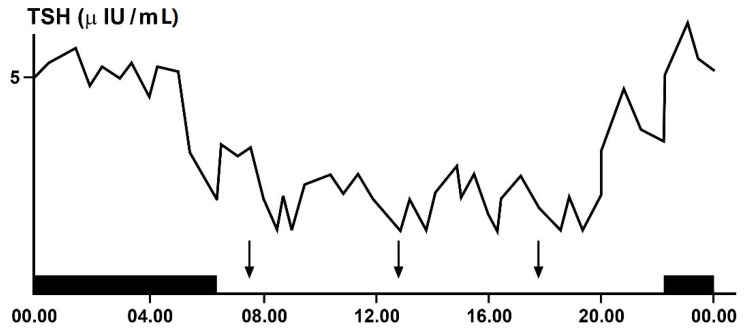
Circadian and ultradian variations in plasma TSH (thyrotropin)concentrations obtained by frequent samples over 24 h in a single healthy adult volunteer. The black bar indicates the period of sleep, the arrows the time of the meals.
Figure 5
Figure 5
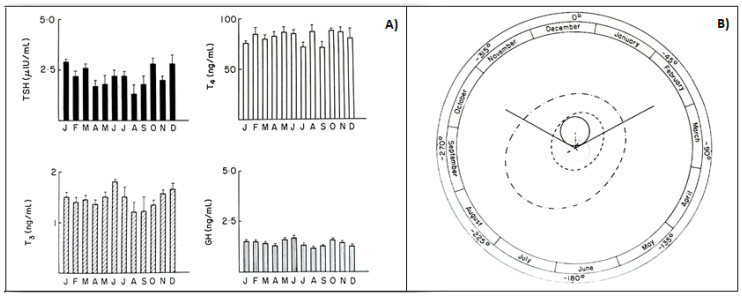
(A) Monthly mean (±SD) of TSH, T4, T3, GH values in prepubertal subjects. (B) Single cosinor display of circannual variations in these hormone concentrations and their characteristics, visualized by polar cosinor plot. A significant rhythm was validated only for TSH, as revealed by its ellipse (continuous tract), which does not cover the pole (zero: center), and with acrophase in December, as indicated by the arrow starting from the center and directed towards December (confidence limits October–February) [68].

References

    1. Touitou Y., Haus E., editors. Biologic Rhythms in Clinical and Laboratory Medicine. Springer; Berlin/Heidelberg, Germany: 1992. Biological rhythms from biblical to modern times; pp. 1–5.
    1. Allada R., Bass J. Circadian mechanisms in Medicine. N. Engl. J. Med. 2021;384:550–561. doi: 10.1056/NEJMra1802337. - DOI - PMC - PubMed
    1. Burki T. Nobel Prize awarded for discoveries in circadian rhythm. Lancet. 2017;390:e31. doi: 10.1016/S0140-6736(17)32661-2. - DOI - PubMed
    1. Darwin C., Darwin F. The Power of Movement in Plants. John Murray; London, UK: 1880. pp. 407–408.
    1. Halberg F., Katinas G.S., Chiba Y., Garcia-Sainz M., Keovatis T.G., Kunkel H., Montalbetti N., Reinberg A., Scharf R., Simpson H. Chronobiologic glossary of the International Society for the study of biological rhythms. Int. J. Chronobiol. 1973;1:31–63. - PubMed

LinkOut - more resources