


Horizontal-to-Vertical Spectral Ratio of Ambient Vibration Obtained with Hilbert-Huang Transform
- PMID: 34068660
- PMCID: PMC8126136
- DOI: 10.3390/s21093292
Horizontal-to-Vertical Spectral Ratio of Ambient Vibration Obtained with Hilbert-Huang Transform
Abstract
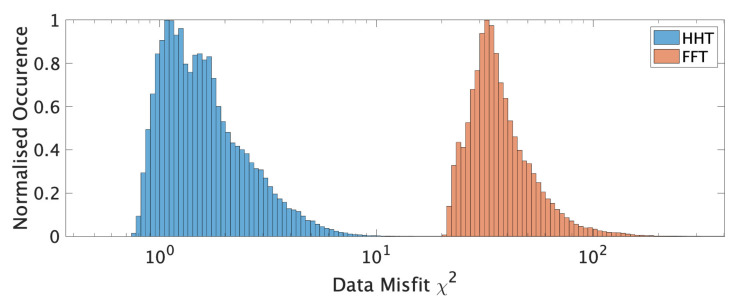
The Horizontal-to-Vertical Spectral Ratio (HVSR) of ambient vibration measurements is a common tool to explore near surface shear wave velocity (Vs) structure. HVSR is often applied for earthquake risk assessments and civil engineering projects. Ambient vibration signal originates from the combination of a multitude of natural and man-made sources. Ambient vibration sources can be any ground motion inducing phenomena, e.g., ocean waves, wind, industrial activity or road traffic, where each source does not need to be strictly stationary even during short times. Typically, the Fast Fourier Transform (FFT) is applied to obtain spectral information from the measured time series in order to estimate the HVSR, even though possible non-stationarity may bias the spectra and HVSR estimates. This problem can be alleviated by employing the Hilbert-Huang Transform (HHT) instead of FFT. Comparing 1D inversion results for FFT and HHT-based HVSR estimates from data measured at a well studied, urban, permanent station, we find that HHT-based inversion models may yield a lower data misfit χ2 by up to a factor of 25, a more appropriate Vs model according to available well-log lithology, and higher confidence in the achieved model.
Keywords: HVSR; data processing; non-stationary.
Conflict of interest statement
The authors declare no conflict of interest. The funders had no role in the design of the study; in the collection, analyses or interpretation of data; in the writing of the manuscript, or in the decision to publish the results.
Figures





References
-
- Nakamura Y. A method for dynamic characteristics estimation of subsurface using microtremor on the ground surface. Railw. Tech. Res. Inst. Q. Rep. 1989;30:25–33.
-
- Bonnefoy-Claudet S., Cornou C., Bard P.Y., Cotton F., Moczo P., Kristek J., Fäh D. H/V ratio: A tool for site effects evaluation. Results from 1-D noise simulations. Geophys. J. Int. 2006;167:827–837. doi: 10.1111/j.1365-246X.2006.03154.x. - DOI
-
- Lunedei E., Malischewsky P. Perspectives on European Earthquake Engineering and Seismology. Springer; Berlin/Heidelberg, Germany: 2015. A Review and Some New Issues on the Theory of the H/V Technique for Ambient Vibrations (Chapter 15) pp. 371–394.
-
- Ugalde A., Egozcue J.J., Ranero C.R. A new autoregressive moving average modeling of H/V spectral ratios to estimate the ground resonance frequency. Eng. Geol. 2021;280 doi: 10.1016/j.enggeo.2020.105957. - DOI
-
- García-Jerez A., Seivane H., Navarro M., Martínez-Segura M., Piña-Flores J. Joint analysis of Rayleigh-wave dispersion curves and diffuse-field HVSR for site characterization: The case of El Ejido town (SE Spain) Soil Dyn. Earthq. Eng. 2019;121:102–120.
Grants and funding
LinkOut - more resources
Full Text Sources
