


Virulence Determinants of Colistin-Resistant K. pneumoniae High-Risk Clones
- PMID: 34068937
- PMCID: PMC8155863
- DOI: 10.3390/biology10050436
Virulence Determinants of Colistin-Resistant K. pneumoniae High-Risk Clones
Abstract
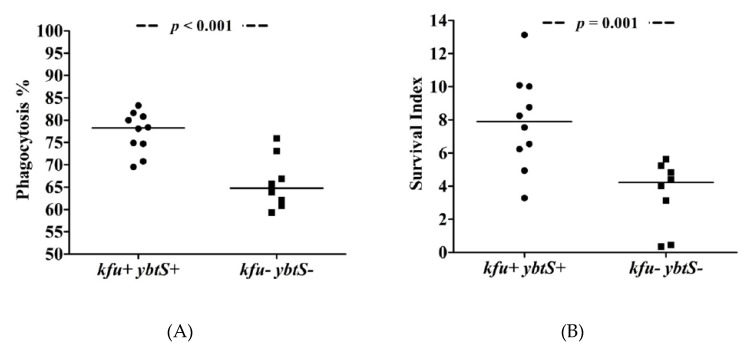
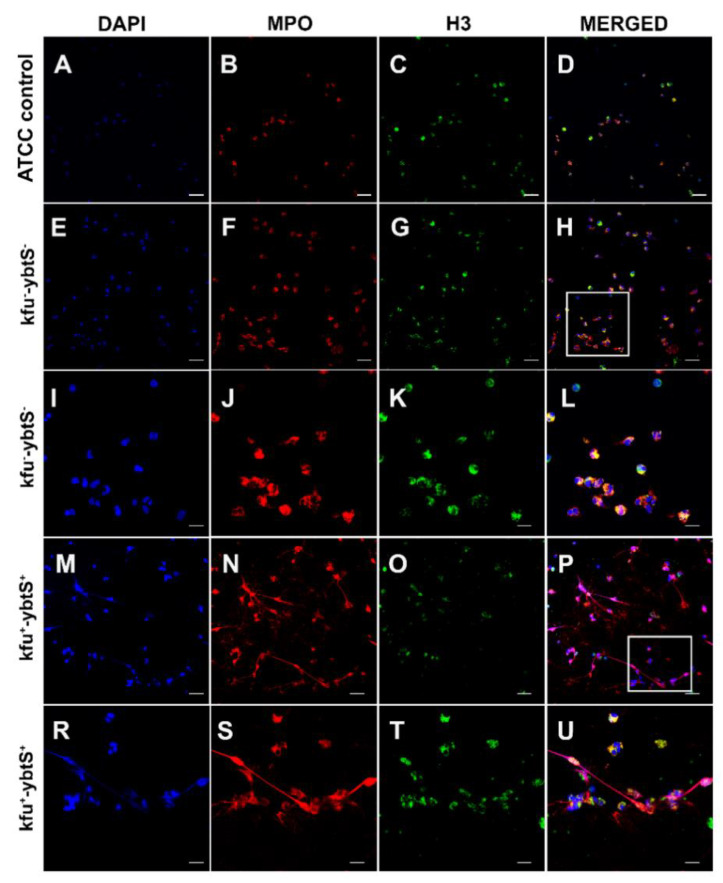
We proposed the hypothesis that high-risk clones of colistin-resistant K. pneumoniae (ColR-Kp) possesses a high number of virulence factors and has enhanced survival capacity against the neutrophil activity. We studied virulence genes of ColR-Kp isolates and neutrophil response in 142 patients with invasive ColR-Kp infections. The ST101 and ST395 ColR-Kp infections had higher 30-day mortality (58%, p = 0.005 and 75%, p = 0.003). The presence of yersiniabactin biosynthesis gene (ybtS) and ferric uptake operon associated gene (kfu) were significantly higher in ST101 (99%, p ≤ 0.001) and ST395 (94%, p < 0.012). Being in ICU (OR: 7.9; CI: 1.43-55.98; p = 0.024), kfu (OR:27.0; CI: 5.67-179.65; p < 0.001) and ST101 (OR: 17.2; CI: 2.45-350.40; p = 0.01) were found to be predictors of 30-day mortality. Even the neutrophil uptake of kfu+-ybtS+ ColR-Kp was significantly higher than kfu--ybtS- ColR-Kp (phagocytosis rate: 78% vs. 65%, p < 0.001), and the kfu+-ybtS+ ColR-Kp survived more than kfu--ybtS- ColR-Kp (median survival index: 7.90 vs. 4.22; p = 0.001). The kfu+-ybtS+ ColR-Kp stimulated excessive NET formation. Iron uptake systems in high-risk clones of colistin-resistant K. pneumoniae enhance the success of survival against the neutrophil phagocytic defense and stimulate excessive NET formation. The drugs targeted to iron uptake systems would be a promising approach for the treatment of colistin-resistant high-risk clones of K. pneumoniae infections.
Keywords: K. pneumoniae; colistin resistance; iron uptake; net formation; phagocytosis.
Conflict of interest statement
The authors declare no conflict of interest.
Figures
References
-
- Lee C.R., Lee J.H., Park K.S., Jeon J.H., Kim Y.B., Cha C.J., Jeong B.C., Lee S.H. Antimicrobial Resistance of Hypervirulent Klebsiella pneumoniae: Epidemiology, Hypervirulence-Associated Determinants, and Resistance Mechanisms. Front. Cell Infect. Microbiol. 2017;7:483. doi: 10.3389/fcimb.2017.00483. - DOI - PMC - PubMed
-
- Mammina C., Bonura C., Aleo A., Fasciana T., Brunelli T., Pesavento G., Degl’Innocenti R., Nastasi A. Sequence type 101 (ST101) as the predominant carbapenem-non-susceptible Klebsiella pneumoniae clone in an acute general hospital in Italy. Int. J. Antimicrob. Agents. 2012;39:543–545. doi: 10.1016/j.ijantimicag.2012.02.012. - DOI - PubMed
LinkOut - more resources
Full Text Sources
