


Listeria monocytogenes Cold Shock Proteins: Small Proteins with A Huge Impact
- PMID: 34068949
- PMCID: PMC8155936
- DOI: 10.3390/microorganisms9051061
Listeria monocytogenes Cold Shock Proteins: Small Proteins with A Huge Impact
Abstract
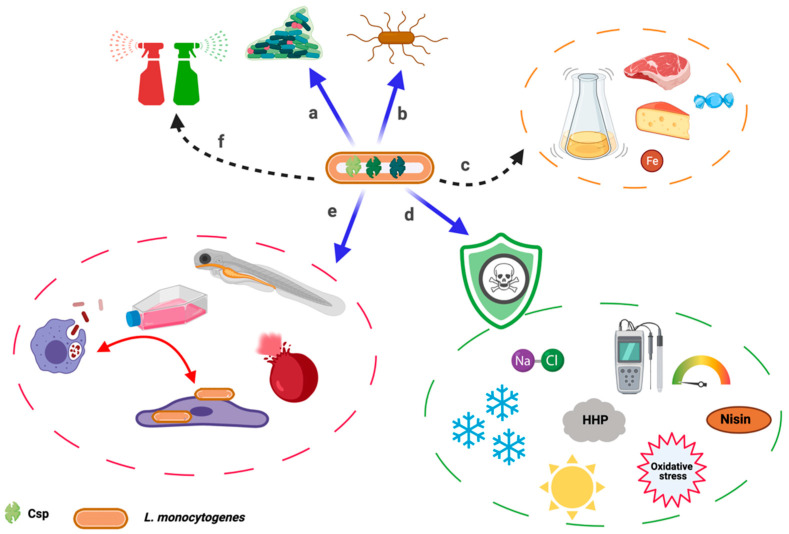
Listeria monocytogenes has evolved an extensive array of mechanisms for coping with stress and adapting to changing environmental conditions, ensuring its virulence phenotype expression. For this reason, L. monocytogenes has been identified as a significant food safety and public health concern. Among these adaptation systems are cold shock proteins (Csps), which facilitate rapid response to stress exposure. L. monocytogenes has three highly conserved csp genes, namely, cspA, cspB, and cspD. Using a series of csp deletion mutants, it has been shown that L. monocytogenes Csps are important for biofilm formation, motility, cold, osmotic, desiccation, and oxidative stress tolerance. Moreover, they are involved in overall virulence by impacting the expression of virulence-associated phenotypes, such as hemolysis and cell invasion. It is postulated that during stress exposure, Csps function to counteract harmful effects of stress, thereby preserving cell functions, such as DNA replication, transcription and translation, ensuring survival and growth of the cell. Interestingly, it seems that Csps might suppress tolerance to some stresses as their removal resulted in increased tolerance to stresses, such as desiccation for some strains. Differences in csp roles among strains from different genetic backgrounds are apparent for desiccation tolerance and biofilm production. Additionally, hierarchical trends for the different Csps and functional redundancies were observed on their influences on stress tolerance and virulence. Overall current data suggest that Csps have a wider role in bacteria physiology than previously assumed.
Keywords: Listeria monocytogenes; biofilm; cold; cold shock protein; osmotic; stress tolerance; virulence.
Conflict of interest statement
The authors declare no conflict of interest.
Figures

References
-
- Buchanan R.L., Gorris L.G.M., Hayman M.M., Jackson T.C., Whiting R.C. A review of Listeria monocytogenes: An update on outbreaks, virulence, dose-response, ecology, and risk assessments. Food Control. 2017;75:1–13. doi: 10.1016/j.foodcont.2016.12.016. - DOI
-
- Marder E.P., Griffin P.M., Cieslak P.R., Dunn J., Hurd S., Jervis R., Lathrop S., Muse A., Ryan P., Smith K., et al. Preliminary incidence and trends of infections with pathogens transmitted commonly through food. Foodborne Diseases Active Surveillance Network, 10 U.S. Sites, 2006–2017. MMWR Morb. Mortal. Wkly. Rep. 2018;67:324–328. doi: 10.15585/mmwr.mm6711a3. - DOI - PMC - PubMed
-
- EFSA and ECDC (European Food Safety Authority and European Centre for Disease Prevention and Control) The European Union One Health 2018 Zoonoses Report. [(accessed on 2 April 2021)];EFSA J. 2019 17:5926. Available online: https://efsa.onlinelibrary.wiley.com/doi/epdf/10.2903/j.efsa.2019.5926. - DOI - PMC - PubMed
-
- EFSA Panel on Biological Hazards (BIOHAZ) Ricci A., Allende A., Bolton D., Chemaly M., Davies R., Escámez P.S.F., Girones R., Herman L., Koutsoumanis K., et al. Scientific Opinion on the Listeria monocytogenes contamination of ready-to-eat foods and the risk for human health in the EU. EFSA J. 2018;16:e05134. doi: 10.2903/j.efsa.2018.5134. - DOI - PMC - PubMed
Publication types
LinkOut - more resources
Full Text Sources
