


Diffusion Magnetic Resonance Imaging-Based Biomarkers for Neurodegenerative Diseases
- PMID: 34069159
- PMCID: PMC8155849
- DOI: 10.3390/ijms22105216
Diffusion Magnetic Resonance Imaging-Based Biomarkers for Neurodegenerative Diseases
Abstract
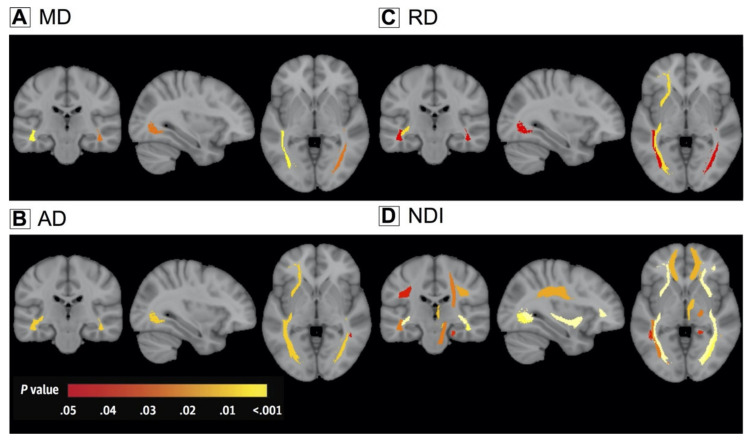
There has been an increasing prevalence of neurodegenerative diseases with the rapid increase in aging societies worldwide. Biomarkers that can be used to detect pathological changes before the development of severe neuronal loss and consequently facilitate early intervention with disease-modifying therapeutic modalities are therefore urgently needed. Diffusion magnetic resonance imaging (MRI) is a promising tool that can be used to infer microstructural characteristics of the brain, such as microstructural integrity and complexity, as well as axonal density, order, and myelination, through the utilization of water molecules that are diffused within the tissue, with displacement at the micron scale. Diffusion tensor imaging is the most commonly used diffusion MRI technique to assess the pathophysiology of neurodegenerative diseases. However, diffusion tensor imaging has several limitations, and new technologies, including neurite orientation dispersion and density imaging, diffusion kurtosis imaging, and free-water imaging, have been recently developed as approaches to overcome these constraints. This review provides an overview of these technologies and their potential as biomarkers for the early diagnosis and disease progression of major neurodegenerative diseases.
Keywords: Alzheimer’s disease; Parkinson’s disease; amyotrophic lateral sclerosis; biomarker; diffusion kurtosis imaging; diffusion tensor imaging; free-water imaging; neurite orientation dispersion and density imaging.
Conflict of interest statement
The authors declare no conflict of interest.
Figures





References
Publication types
MeSH terms
Substances
Grants and funding
LinkOut - more resources
Full Text Sources
Medical
