


Therapeutic Effects of Urethral Sphincter Botulinum Toxin A Injection on Dysfunctional Voiding with Different Videourodynamic Characteristics in Non-Neurogenic Women
- PMID: 34069448
- PMCID: PMC8159094
- DOI: 10.3390/toxins13050362
Therapeutic Effects of Urethral Sphincter Botulinum Toxin A Injection on Dysfunctional Voiding with Different Videourodynamic Characteristics in Non-Neurogenic Women
Abstract
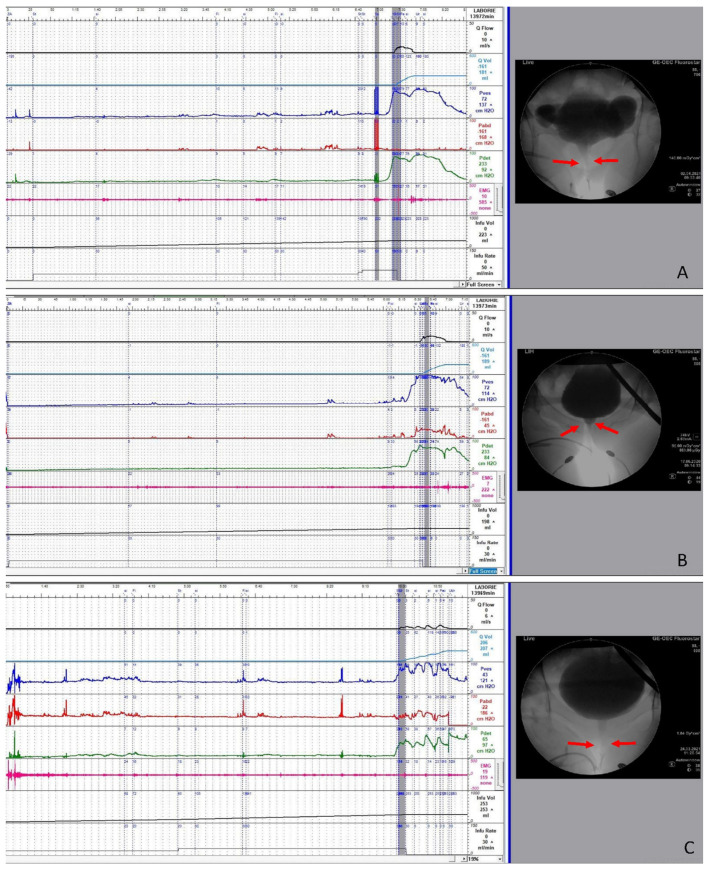
Although female dysfunctional voiding (DV) is common in urological practice, it is difficult to treat. This study evaluated the therapeutic efficacy of urethral botulinum toxin A (BoNT-A) on non-neurogenic female DV. Based on the videourodynamic study (VUDS), the DV was classified into three subgroups according to the obstructive site. A successful treatment outcome was defined as an improvement of voiding efficiency by 10% and reported global response assessment by ≥1. The study compared therapeutic efficacy, baseline urodynamic parameters, and changes in urodynamic parameters between the treatment success and failure groups and among three DV subgroups. Predictive factors for successful treatment were also investigated. A total of 81 women with DV were categorized into three groups: 55 (67.9%) had mid-urethral DV, 19 (23.5%) had distal urethral DV, and 7 (8.6%) had combined BN dysfunction and mid-urethral DV after BN transurethral incision. The treatment outcome was successful for 55 (67.9%) patients and failed for 26 (32.1%). Successfully treated patients had a significant decrease of detrusor pressure, post-void residual volume, and bladder outlet obstruction index, as well as an increase in voiding efficiency at follow-up versus the treatment failure group. The logistic regression of urodynamic parameters and clinical variables revealed that a greater volume of first sensation of filling predicts a successful BoNT-A treatment outcome (p = 0.047). The urethral BoNT-A injection is effective in treating non-neurogenic women with DV, with a success rate of 67.9%. The videourodynamic characteristics of DV may differ among patients but does not affect the treatment outcome.
Keywords: onabotulinumtoxinA; therapeutic outcome; urethra; voiding.
Conflict of interest statement
The authors declare no conflict of interest.
Figures
Comment in
-
Trauma, and Genital and Urethral Reconstruction.J Urol. 2021 Dec;206(6):1509-1511. doi: 10.1097/JU.0000000000002215. Epub 2021 Sep 7. J Urol. 2021. PMID: 34492197 No abstract available.
References
-
- Blaivas J.G. Pathophysiology of lower urinary tract dysfunction. Urol. Clin. N. Am. 1985;12:215–224. - PubMed
-
- Nitti V.W., Fiske J. Cystometrogram versus cystometrogram plus voiding pressure-flow studies in women with lower urinary tract symptoms. J. Urol. 1999;161:201. doi: 10.1097/00005392-199904010-00807. - DOI
MeSH terms
Substances
LinkOut - more resources
Full Text Sources
Medical
