Review
. 2021 May 19;13(10):2475.
doi: 10.3390/cancers13102475.

The Role of Ceramide Metabolism and Signaling in the Regulation of Mitophagy and Cancer Therapy

Affiliations
Review

The Role of Ceramide Metabolism and Signaling in the Regulation of Mitophagy and Cancer Therapy

Megan Sheridan et al. Cancers (Basel). .

Abstract

Sphingolipids are bioactive lipids responsible for regulating diverse cellular functions such as proliferation, migration, senescence, and death. These lipids are characterized by a long-chain sphingosine backbone amide-linked to a fatty acyl chain with variable length. The length of the fatty acyl chain is determined by specific ceramide synthases, and this fatty acyl length also determines the sphingolipid's specialized functions within the cell. One function in particular, the regulation of the selective autophagy of mitochondria, or mitophagy, is closely regulated by ceramide, a key regulatory sphingolipid. Mitophagy alterations have important implications for cancer cell proliferation, response to chemotherapeutics, and mitophagy-mediated cell death. This review will focus on the alterations of ceramide synthases in cancer and sphingolipid regulation of lethal mitophagy, concerning cancer therapy.

Keywords: apoptosis; cancer; ceramide; mitophagy; sphingolipids.


Conflict of interest statement

The authors declare no conflict of interest.

Figures
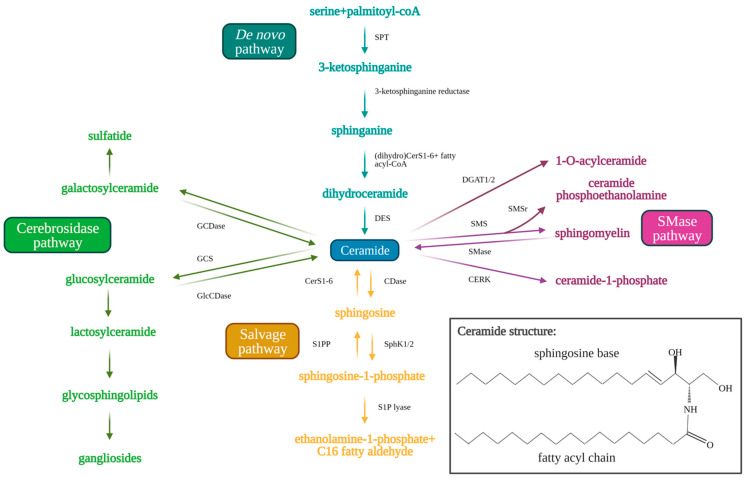
Figure 1
Figure 1
Sphingolipid metabolism pathway. Ceramide acts as the central molecule of the sphingolipid metabolism pathway. Ceramide may be synthesized through either the de novo (blue text and arrows) or the salvage pathway (orange text and arrows). Synthesis of ceramide through the de novo pathway occurs through serine palmitoyltransferase (SPT), 3-ketosphinganine reductase, (dihydro)CerS1-6 (which determine fatty acyl chain length), and finally dihydroceramide desaturase (DES). Ceramide synthesis through the salvage pathway occurs through conversion of sphingosine-1-phosphate by S1P-phosphatase (S1PP) and (dihydro)CerS1-6. Ceramide may be metabolized to produce sphingosine 1-phosphate by ceramidases (CDases) and sphingosine kinase 1/2 (SphK1/2). Sphingosine-1-phosphate can be hydrolyzed by sphingosine 1-phosphate lyase (S1P lyase) to ethanolamine 1-phosphate and C16 fatty aldehyde. Ceramide may also be used as a substrate for the generation of complex sphingolipids via conversion to glucosylceramide (GlcCer) by glucosylceramide synthase (GCS) (green arrows and text). Glucosylceramidase (GlcCDase) and galactosylceramidase (GCDase) (cerebrosides) catalyze conversion of complex sphingolipids back to ceramide. Ceramide may also be used as a substrate for sphingomyelin through sphingomyelin synthase (SMS) or ceramide 1-phosphate through ceramide kinase (CERK). Sphingomyelin can similarly be broken down by sphingomyelinase (SMase) to produce ceramide once again. Created with BioRender.com (accessed on 11 May 2021).
Figure 2
Figure 2
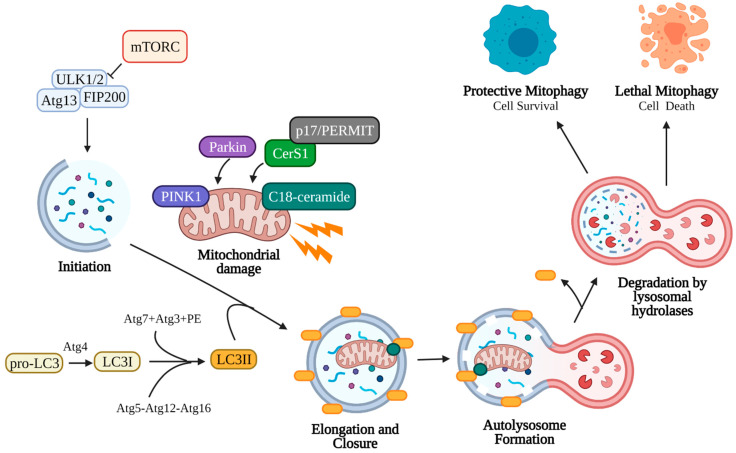
Canonical mitophagy pathway. Damaged mitochondria signal the need for removal by retaining PINK1 on the outer mitochondrial membrane, which recruits cytosolic Parkin and p62. Parkin ubiquitinates outer mitochondrial membrane proteins, allowing p62 recruitment and direct binding to LC3II. LC3II is an essential component of the autophagosome double-membrane and regulates its elongation and curvature. LC3II is formed following cleavage of the C-terminal by Atg4, and LC3I is subsequently conjugated to phosphatidylethanolamine (PE) by Atg7, Atg3, and the Atg5-Atg12-Atg16 complex. Elongation of the autophagosomal membrane occurs around the mitochondria until it is fully engulfed. The autophagosome is then trafficked to the lysosome, where the outer autophagosomal membrane fuses with the lysosome. Internal components, including the mitochondria, are degraded and recycled by lysosomal hydrolases (cathepsin B, D, L). Mitophagy may assist the cell in reducing stress (protective mitophagy resulting in cell survival) or in inducing cell death (lethal mitophagy). Created with BioRender.com (accessed on 11 May 2021).
Figure 3
Figure 3
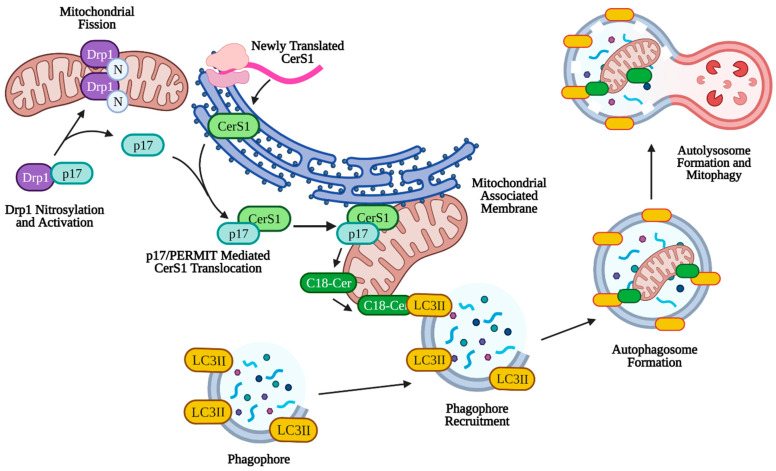
p17/PERMIT-mediated mitophagy. C18-ceramide induced mitophagy is facilitated by p17/PERMIT translocation of CerS1 to the mitochondria. Drp1 is activated by S-nitrosylation at C644, which releases p17/PERMIT and initiates mitochondrial fission. P17/PERMIT associates with newly translated CerS1 at the mitochondrial-associated membrane and is translocated via a mitochondrial signaling sequence (amino acids L21–R25). CerS1 is then able to produce C18-ceramide, which coats the outer mitochondrial membrane and directly binds autophagosomal LC3II, facilitating mitophagy. Created with BioRender.com (accessed on 11 May 2021).

References

    1. Siegel R.L., Miller K.D., Jemal A. Cancer statistics, 2020. CA Cancer J. Clin. 2020;70:7–30. doi: 10.3322/caac.21590. - DOI - PubMed
    1. Ward E.M., Sherman R.L., Henley S.J., Jemal A., Siegel D.A., Feuer E.J., Firth A.U., Kohler B.A., Scott S., Ma J., et al. Annual report to the nation on the status of cancer, featuring cancer in men and women age 20–49 years. JNCI J. Natl. Cancer Inst. 2019;111:1279–1297. doi: 10.1093/jnci/djz106. - DOI - PMC - PubMed
    1. Thrift A.P., Gudenkauf F.J. Melanoma incidence among non-Hispanic whites in all 50 US states from 2001 through 2015. JNCI J. Natl. Cancer Inst. 2020;112:533–539. doi: 10.1093/jnci/djz153. - DOI - PMC - PubMed
    1. Young M.M., Kester M., Wang H.-G. Sphingolipids: Regulators of crosstalk between apoptosis and autophagy. J. Lipid Res. 2013;54:5–19. doi: 10.1194/jlr.R031278. - DOI - PMC - PubMed
    1. Jiang W., Ogretmen B. Autophagy paradox and ceramide. Biochim. Biophys. Acta. 2014;1841:783–792. doi: 10.1016/j.bbalip.2013.09.005. - DOI - PMC - PubMed

LinkOut - more resources