. 2021 May 19;11(5):1462.
doi: 10.3390/ani11051462.

Morphological and Histological Features of the Vomeronasal Organ in African Pygmy Hedgehog (Atelerix albiventris)

Affiliations

Morphological and Histological Features of the Vomeronasal Organ in African Pygmy Hedgehog (Atelerix albiventris)

Daisuke Kondoh et al. Animals (Basel). .

Abstract

The vomeronasal organ (VNO) detects specific chemicals such as pheromones and kairomones. Hedgehogs (Eulipotyphla: Erinaceidae) have a well-developed accessory olfactory bulb that receives projections from the VNO, but little is known about the hedgehog VNO. Here, we studied the histological features of the VNO in five individual African pygmy hedgehogs by hematoxylin-eosin, periodic acid-Schiff, and Alcian blue stains. The hedgehog VNO comprises a hyaline cartilage capsule, soft tissue and epithelial lumen, and it branches from the site just before the incisive duct opening into the nasal cavity. The soft tissues contain several small mucous (or mucoserous) glands and a large serous gland, and many venous sinuses all around the lumen. The VNO lumen is round to oval throughout the hedgehog VNO, and the sensory epithelium lines almost the entire rostral part and medial wall of the middle part. These findings indicate that the VNO is functional and plays an important role in the hedgehog. Notably, the VNO apparently has a characteristic flushing mechanism with serous secretions like those of gustatory glands, which the hedgehog might frequently use to recognize the external environment.

Keywords: chemosensory system; exocrine glands; hedgehogs; kairomones; olfaction; pheromones; serous secretion; vomeronasal organ.


Conflict of interest statement

The authors declare no conflict of interest.

Figures

Figure 1
Figure 1
Hedgehog vomeronasal organ (VNO) location and opening. (A) Left lateral view of nasal septum (ns) after removing lateral walls. Dashed circle, VNO. (B) Ventral view of palate near incisive papilla (ip). Arrowhead, incisive ducts opening between the left and right incisive papillae. (CF) Series of histological sections of incisive duct (id) from rostral (C) to caudal (F). Hematoxylin-eosin stain. Arrow and arrowhead, opening site of incisive duct into nasal (nc) and oral (oc) cavities, respectively; b, bone; c, hyaline cartilage. *, Opening of VNO. (G) Scheme of VNO opening. Bars, 5 mm (A,B) and 500 μm (CF).
Figure 2
Figure 2
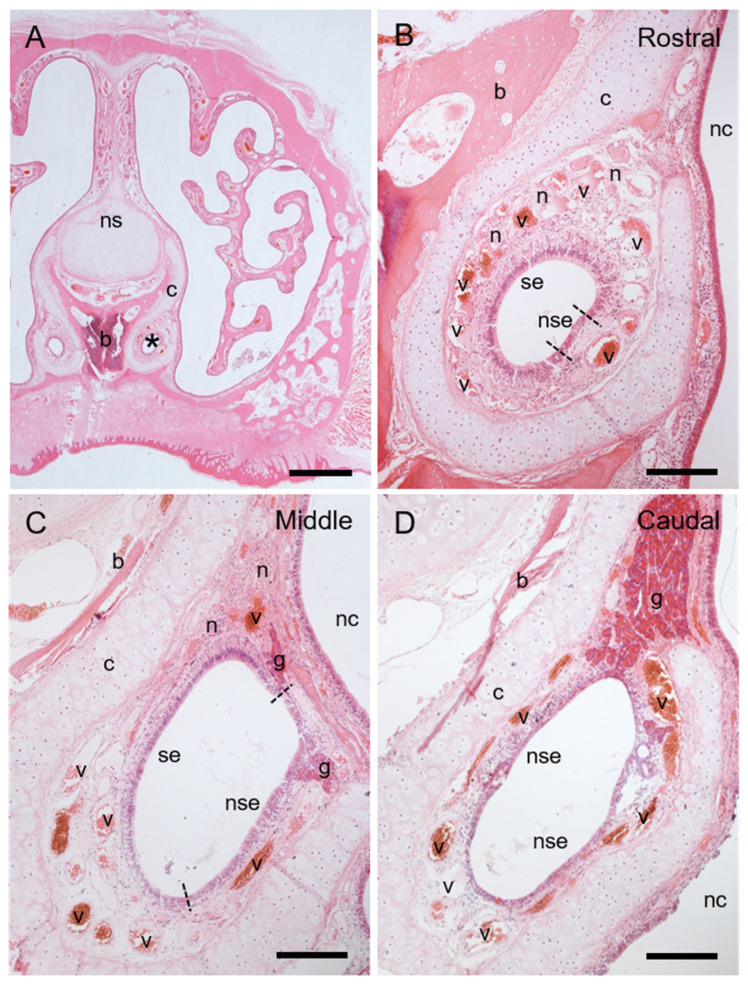
Histological components of hedgehog VNO. (A) Transversal image of rostral region of nasal cavity. Hematoxylin-eosin stain. * VNO attached to vomer bone (b) at base of nasal septum (ns). (BD) Whole images of rostral (B), middle (C), and caudal (D) areas of VNO; b, bone; c, hyaline cartilage; g, glands; n, nerve bundles; nc, nasal cavity; nse, non-sensory epithelium; se, sensory epithelium; v, veins. Dashed lines, border between sensory and non-sensory epithelia. Bars, 1 mm (A) and 200 μm (BD).
Figure 3
Figure 3
Histological features of glands in lateral region in middle of hedgehog VNO. (A) Hematoxylin-eosin stain. Each gland is composed of a small number of acini (arrows). (B) Periodic acid-Schiff (PAS) stain. These small vomeronasal glands are positive for PAS. (C) Alcian blue stain. These glands are negative for Alcian blue. Bars, 50 μm.
Figure 4
Figure 4
Histological features of large gland in dorsal region of caudal area of hedgehog VNO. (A) Hematoxylin-eosin stain. Arrows, significant secretory ducts. l, lumen of VNO; nc, nasal cavity. (B) Higher magnification of gland acini. Glandular cells contain many granules that are intensely stained with eosin. (C) Periodic acid-Schiff (PAS) stain. * PAS-negative acini. Arrowheads, a few acini near lumen of VNO positive for PAS. (DF) Near caudal end of VNO lumen. (D) Hematoxylin-eosin stain. Arrow, secretory duct opening. (E) PAS stain. This gland is mostly negative for PAS. Dashed box, corresponding to insertion showing PAS-positive goblet cells in respiratory epithelium covering nasal cavity. (F) Alcian blue stain. This gland is negative for Alcian blue. Bars, 100 (A,CF) and 20 (B) μm.
Figure 5
Figure 5
Histological features of sensory and non-sensory epithelia in hedgehog VNO. (A) Sensory epithelium. rc, nuclei of receptor cells; sc, nuclei of supporting cells. Arrowheads, basal cells. (B) Non-sensory epithelium. Hematoxylin-eosin stain. Bars, 20 μm.
Figure 6
Figure 6
Schematic illustration of histological components of hedgehog VNO based on Figure 2. Left side, rostral; upper side, dorsal. l, lumen of VNO; mg, mucous glands; n, vomeronasal nerve bundles; nse, non-sensory epithelium; se, sensory epithelium; sg, serous gland; ste, stratified squamous epithelium; v, venous sinuses. In middle of VNO, sensory and non-sensory epithelia cover respectively medial and lateral walls of lumen.

References

    1. Fortes-Marco L., Lanuza E., Martinez-Garcia F. Of pheromones and kairomones: What receptors mediate innate emotional responses? Anat. Rec. 2013;296:1346–1363. doi: 10.1002/ar.22745. - DOI - PubMed
    1. Allison A.C. The morphology of the olfactory system in the vertebrates. Biol. Rev. 1953;28:195–244. doi: 10.1111/j.1469-185X.1953.tb01376.x. - DOI
    1. Dellmann H.D. Textbook of Veterinary Histology. 4th ed. Lea & Febiger; Philadelphia, PA, USA: 1993. pp. 140–141.
    1. Meredith M., O’Connell R.J. Efferent control of stimulus access to the hamster vomeronasal organ. J. Phygiol. 1979;286:301–316. doi: 10.1113/jphysiol.1979.sp012620. - DOI - PMC - PubMed
    1. Meredith M., Marques D.M., O’Connell R.O., Stern F.L. Vomeronasal pump: Significance for male hamster sexual behavior. Science. 1980;207:1224–1226. doi: 10.1126/science.7355286. - DOI - PubMed

LinkOut - more resources