


The Significance of Prostate Specific Antigen Persistence in Prostate Cancer Risk Groups on Long-Term Oncological Outcomes
- PMID: 34070052
- PMCID: PMC8158093
- DOI: 10.3390/cancers13102453
The Significance of Prostate Specific Antigen Persistence in Prostate Cancer Risk Groups on Long-Term Oncological Outcomes
Abstract
Objective: To assess the significance of prostate-specific antigen (PSA) persistence at the first measurement after radical prostatectomy (RP) on long-term outcomes in different prostate cancer risk groups.
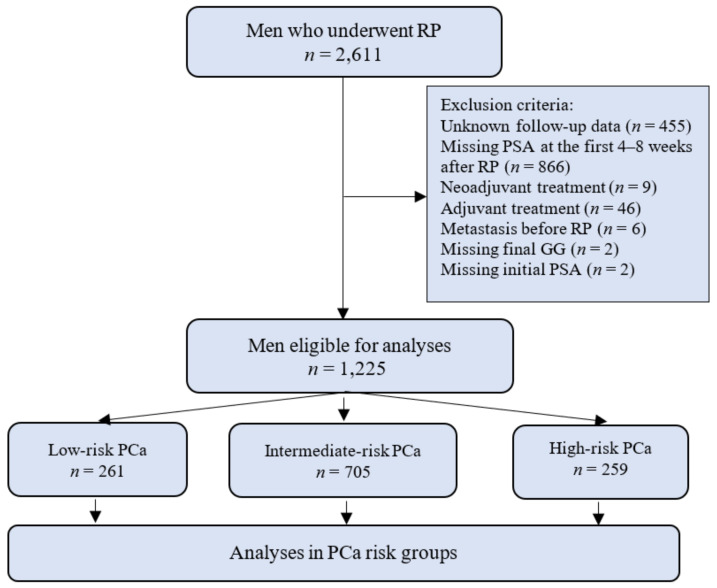
Methods: Persistent PSA was defined as ≥0.1 ng/mL at 4-8 weeks after RP. Patients were stratified into low-, intermediate- and high-risk groups, according to the preoperative PSA, pathological stage, grade group and lymph nodes status. The ten-year cumulative incidence of biochemical recurrence (BCR), metastases, cancer-specific mortality (CSM) and overall mortality (OM) were calculated in patients with undetectable and persistent PSA in different PCa-risk groups. Multivariate regression analyses depicted the significance of PSA persistence on each study endpoint.
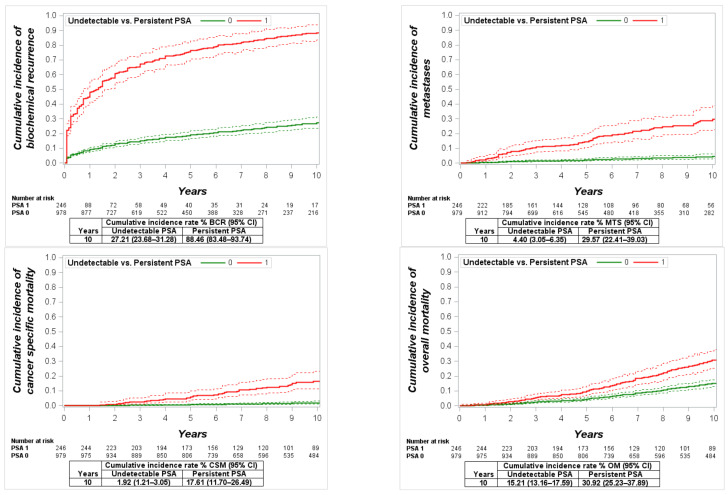
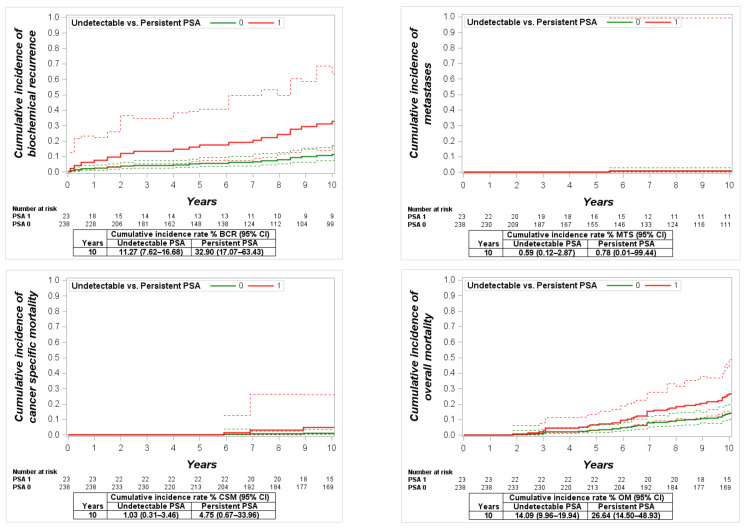
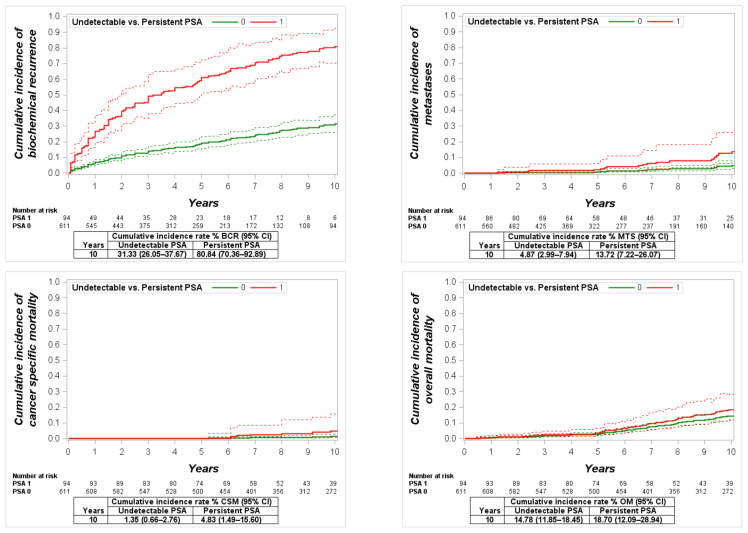
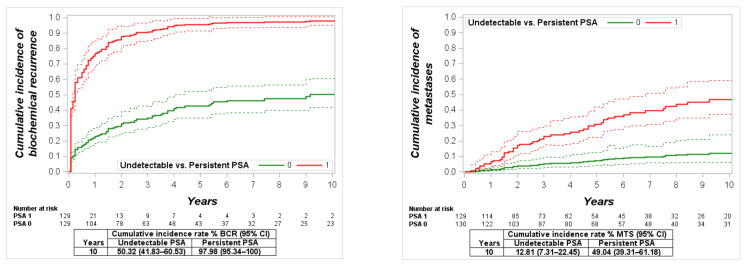
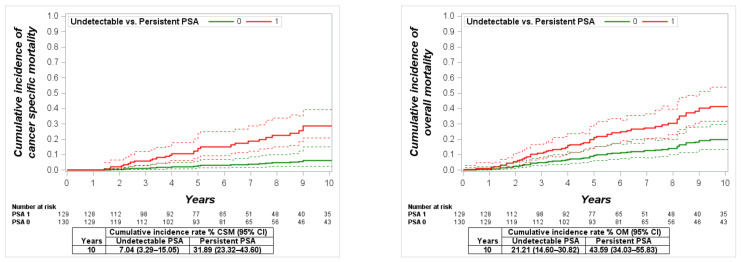
Results: Of all 1225 men, in 246 (20.1%), PSA persistence was detected. These men had an increased risk of BCR (hazard ratio (HR) 4.2, p < 0.0001), metastases (HR: 2.7, p = 0.002), CRM (HR: 5.5, p = 0.002) and OM (HR: 1.8, p = 0.01) compared to the men with undetectable PSA. The same significance of PSA persistence on each study endpoint was found in the high-risk group (HR: 2.5 to 6.2, p = 0.02 to p < 0.0001). In the intermediate-risk group, PSA persistence was found as a predictor of BCR (HR: 3.9, p < 0.0001), while, in the low-risk group, PSA persistence was not detected as a significant predictor of outcomes after RP.
Conclusions: Persistent PSA could be used as an independent predictor of worse long-term outcomes in high-risk PCa patients, while, in intermediate-risk patients, this parameter significantly predicts only biochemical recurrence and has no impact on the outcomes in low-risk PCa patients.
Keywords: PSA persistence; outcomes; prostate cancer; radical prostatectomy; risk groups.
Conflict of interest statement
The authors declare no conflict of interest.
Figures
References
-
- Moris L., Cumberbatch M.G., Van Den Broeck T., Gandaglia G., Fossati N., Kelly B., Pal R., Briers E., Cornford P., De Santis M., et al. Benefits and Risks of Primary Treatments for High-risk Localized and Locally Advanced Prostate Cancer: An International Multidisciplinary Systematic Review. Eur. Urol. 2020;77:614–627. doi: 10.1016/j.eururo.2020.01.033. - DOI - PubMed
-
- Mottet N., Bellmunt J., Bolla M., Briers E., Cumberbatch M.G., De Santis M., Fossati N., Gross T., Henry A.M., Joniau S., et al. EAU-ESTRO-SIOG Guidelines on Prostate Cancer. Part 1: Screening, Diagnosis, and Local Treatment with Curative Intent. Eur. Urol. 2017;71:618–629. doi: 10.1016/j.eururo.2016.08.003. - DOI - PubMed
LinkOut - more resources
Full Text Sources
Research Materials
Miscellaneous
