


Central Nervous System Involvement in Trichinellosis: A Systematic Review
- PMID: 34070586
- PMCID: PMC8227095
- DOI: 10.3390/diagnostics11060945
Central Nervous System Involvement in Trichinellosis: A Systematic Review
Abstract
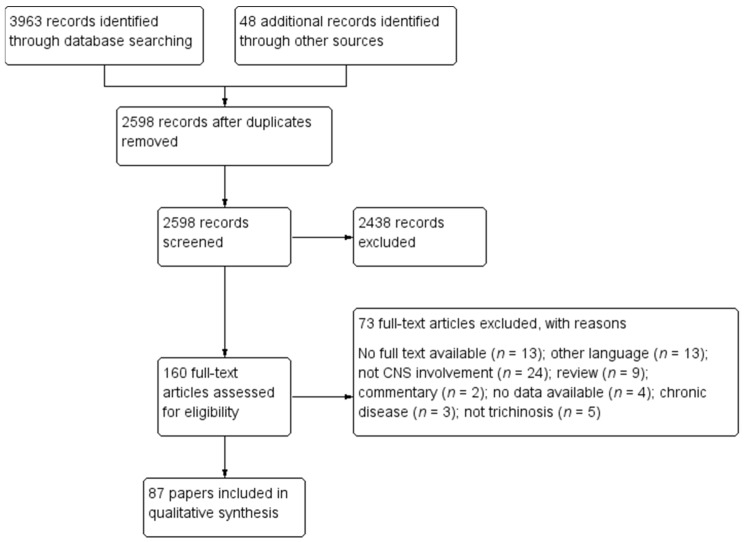
We reviewed the evidence on features of central nervous system (CNS) involvement in trichinellosis, systematically searching five databases (to January 2021). We categorized clinical features based on their diagnostic value as warning signs for severe CNS infection (with outcome death) or non-specific signs (outcome improvement). They were suggestive of severe infection if they substantially raised death probability. The review included 87 papers published from 1906 through 2019, with data on 168 patients. Mydriasis, paraparesis, dysphagia, psychomotor seizures, or delirium present a 30-45% increased death likelihood. The best poor prognosis predictor is mydriasis (positive likelihood ratio 9.08). Slow/absent light reflex, diminished/absent knee reflexes, globally decreased tendon reflexes present a moderate increase (20-25%) of death risk. Anisocoria, acalculia, or seizures could also indicate an increased death risk. We provided a detailed presentation of clinical and paraclinical signs that alert physicians of a possible neurotrichinellosis, emphasizing signs that might indicate a poor prognosis.
Keywords: Trichinella; central nervous system; encephalitis; meningitis; systematic review.
Conflict of interest statement
The authors declare no conflict of interest.
References
-
- Srikiatkhachorn A., Rattanawong W., Jongwutiwes S. Trichinosis. [(accessed on 18 May 2021)]; Available online: https://www.medlink.com/articles/trichinosis.
-
- Zenker F.A. Ueber die Trichinen-Krankheit des Menschen. Arch. Pathol. Anat. Physiol. Klin. Med. 1860;18:561–572. doi: 10.1007/BF01878586. - DOI
Publication types
LinkOut - more resources
Full Text Sources
