


Detection of Babesia odocoilei in Humans with Babesiosis Symptoms
- PMID: 34070625
- PMCID: PMC8228967
- DOI: 10.3390/diagnostics11060947
Detection of Babesia odocoilei in Humans with Babesiosis Symptoms
Abstract
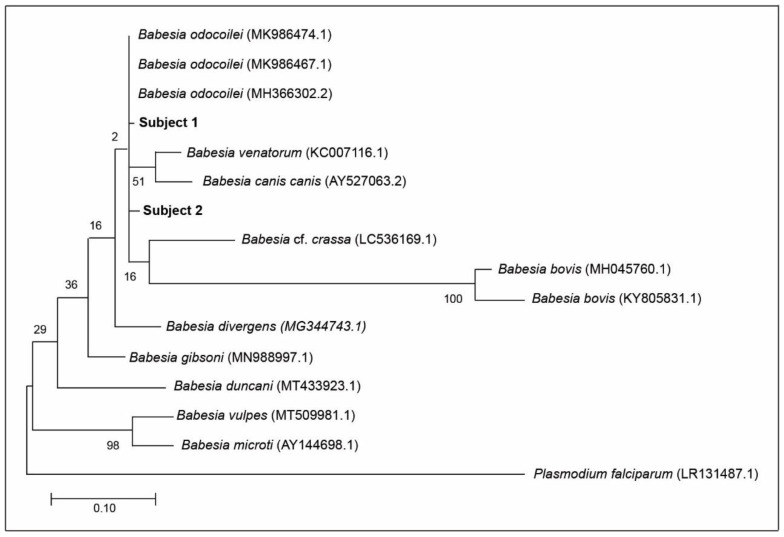
Human babesiosis is a life-threatening infectious disease that causes societal and economic impact worldwide. Several species of Babesia cause babesiosis in terrestrial vertebrates, including humans. A one-day clinic was held in Ontario, Canada, to see if a red blood cell parasite, which is present in blacklegged ticks, Ixodes scapularis, is present in humans. Based on PCR testing and DNA sequencing of the 18S rRNA gene, we unveiled B. odocoilei in two of 19 participants. DNA amplicons from these two patients are almost identical matches with the type strains of B. odocoilei in GenBank. In addition, the same two human subjects had the hallmark symptoms of human babesiosis, including night sweats, chills, fevers, and profound fatigue. Based on symptoms and molecular identification, we provide substantive evidence that B. odocoilei is pathogenic to humans. Dataset reveals that B. odocoilei serologically cross-reacts with Babesia duncani. Clinicians must realize that there are more than two Babesia spp. in North America that cause human babesiosis. This discovery signifies the first report of B. odocoilei causing human babesiosis.
Keywords: 18S rRNA; Babesia odocoilei; Ixodes scapularis; human babesiosis; human pathogen; molecular identification; parasite; piroplasm; ticks; white-tailed deer.
Conflict of interest statement
The authors declare no conflict of interest.
Figures
References
-
- Babes V. Sur l’hémoglobinurie bactérienne du boeuf. C. R. Acad. Sci. 1888;107:692–694.
-
- Smith T., Kilborne F.L. Investigation into the Nature, Causation, and Prevention of Southern Cattle Fever. 1st ed. United States Government Printing Office; Washington, DC, USA: 1893. pp. 85–116.
-
- Škrabalo Z., Deanović Z. Piroplasmosis in man: Report on a case. Doc. Med. Geogr. Trop. 1957;9:11–16. - PubMed
Grants and funding
LinkOut - more resources
Full Text Sources
Miscellaneous
