


Assessment of the Dynamic Exposure to PM2.5 Based on Hourly Cell Phone Location and Land Use Regression Model in Beijing
- PMID: 34070868
- PMCID: PMC8199116
- DOI: 10.3390/ijerph18115884
Assessment of the Dynamic Exposure to PM2.5 Based on Hourly Cell Phone Location and Land Use Regression Model in Beijing
Abstract
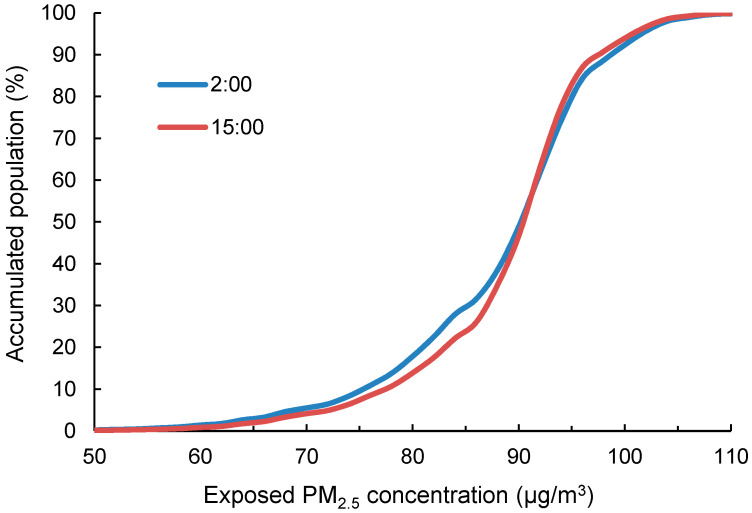
The spatiotemporal locations of large populations are difficult to clearly characterize using traditional exposure assessment, mainly due to their complicated daily intraurban activities. This study aimed to extract hourly locations for the total population of Beijing based on cell phone data and assess their dynamic exposure to ambient PM2.5. The locations of residents were located by the cellular base stations that were keeping in contact with their cell phones. The diurnal activity pattern of the total population was investigated through the dynamic spatial distribution of all of the cell phones. The outdoor PM2.5 concentration was predicted in detail using a land use regression (LUR) model. The hourly PM2.5 map was overlapped with the hourly distribution of people for dynamic PM2.5 exposure estimation. For the mobile-derived total population, the mean level of PM2.5 exposure was 89.5 μg/m3 during the period from 2013 to 2015, which was higher than that reported for the census population (87.9 μg/m3). The hourly activity pattern showed that more than 10% of the total population commuted into the center of Beijing (e.g., the 5th ring road) during the daytime. On average, the PM2.5 concentration at workplaces was generally higher than in residential areas. The dynamic PM2.5 exposure pattern also varied with seasons. This study exhibited the strengths of mobile location in deriving the daily spatiotemporal activity patterns of the population in a megacity. This technology would refine future exposure assessment, including either small group cohort studies or city-level large population assessments.
Keywords: activity pattern; cell phone; exposure assessment; fine particulate matter; land use regression model.
Conflict of interest statement
The authors declare no conflict of interest.
Figures


References
-
- Brokamp C., Rao M.B., Fan Z., Ryan P.H. Does the elemental composition of indoor and outdoor PM2.5 accurately represent the elemental composition of personal PM2.5? Atmos. Environ. 2015;101:226–234. doi: 10.1016/j.atmosenv.2014.11.022. - DOI
-
- Ragettli M.S., Corradi E., Braun-Fahrländer C., Schindler C., de Nazelle A., Jerrett M., Ducret-Stich R.E., Künzli N., Phuleria H.C. Commuter exposure to ultrafine particles in different urban locations, transportation modes and routes. Atmos. Environ. 2013;77:376–384. doi: 10.1016/j.atmosenv.2013.05.003. - DOI
-
- Li R.K., Li Z.P., Gao W.J., Ding W.J., Xu Q., Song X.F. Diurnal, seasonal, and spatial variation of PM2.5 in Beijing. Sci. Bull. 2015;60:387–395. doi: 10.1007/s11434-014-0607-9. - DOI
Publication types
MeSH terms
Substances
LinkOut - more resources
Full Text Sources
Medical
