


Development and Bio-Predictive Evaluation of Biopharmaceutical Properties of Sustained-Release Tablets with a Novel GPR40 Agonist for a First-in-Human Clinical Trial
- PMID: 34071286
- PMCID: PMC8227174
- DOI: 10.3390/pharmaceutics13060804
Development and Bio-Predictive Evaluation of Biopharmaceutical Properties of Sustained-Release Tablets with a Novel GPR40 Agonist for a First-in-Human Clinical Trial
Abstract
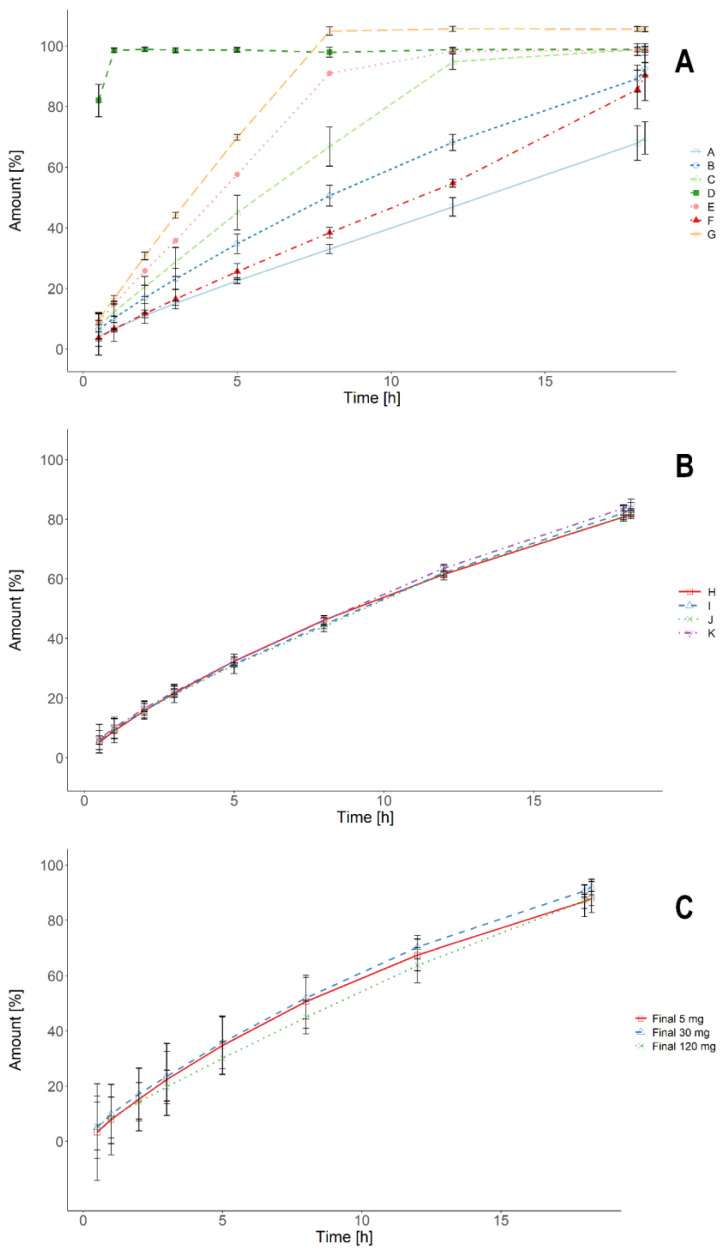
Sustained-release (SR) formulations may appear advantageous in first-in-human (FIH) study of innovative medicines. The newly developed SR matrix tablets require prolonged maintenance of API concentration in plasma and should be reliably assessed for the risk of uncontrolled release of the drug. In the present study, we describe the development of a robust SR matrix tablet with a novel G-protein-coupled receptor 40 (GPR40) agonist for first-in-human studies and introduce a general workflow for the successful development of SR formulations for innovative APIs. The hydrophilic matrix tablets containing the labeled API dose of 5, 30, or 120 mg were evaluated with several methods: standard USP II dissolution, bio-predictive dissolution tests, and the texture and matrix formation analysis. The standard dissolution tests allowed preselection of the prototypes with the targeted dissolution rate, while the subsequent studies in physiologically relevant conditions revealed unwanted and potentially harmful effects, such as dose dumping under an increased mechanical agitation. The developed formulations were exceptionally robust toward the mechanical and physicochemical conditions of the bio-predictive tests and assured a comparable drug delivery rate regardless of the prandial state and dose labeled. In conclusion, the introduced development strategy, when implemented into the development cycle of SR formulations with innovative APIs, may allow not only to reduce the risk of formulation-related failure of phase I clinical trial but also effectively and timely provide safe and reliable medicines for patients in the trial and their further therapy.
Keywords: GPR40 agonist; biorelevant dissolution testing; first in human clinical trials; simulation of gastrointestinal passage; stress test device; sustained-release tablets.
Conflict of interest statement
This article reflects the authors’ view only. Neither the Research Executive Agency nor the Polish Ministry of Science and Higher Education may be held responsible for the use which may be made of the information contained therein. The funders had no role in the design of the study; in the collection, analyses, or interpretation of data; in the writing of the manuscript, or in the decision to publish the results.
Figures



References
-
- Lu C., Chang C., Chuang L., Wang C.Y., Jiang Y.D., Wu H.P. Double-blind, randomized, multicentre study of the efficacy and safety of gliclazide-modified release in the treatment of Chinese type 2 diabetic patients. Diabetes Obes. Metab. 2006;8:184–191. doi: 10.1111/j.1463-1326.2005.00501.x. - DOI - PubMed
-
- Wang L., Sun X., Du L., Yuan Q., Li H., Tian H., Li Y. Effects and patient compliance of sustained-release versus immediate-release glipizides in patients with type 2 diabetes mellitus: A systematic review and meta-analysis. J. Evid. Based Med. 2011;4:232–241. doi: 10.1111/j.1756-5391.2011.01158.x. - DOI - PubMed
-
- Van Dijk F., Teekamp N., Beljaars L., Post E., Zuidema J., Steendam R., Kim Y.O., Frijlink H.W., Schuppan D., Poelstra K., et al. Pharmacokinetics of a sustained release formulation of PDGF β -receptor directed carrier proteins to target the fi brotic liver. J. Control. Release. 2018;269:258–265. doi: 10.1016/j.jconrel.2017.11.029. - DOI - PubMed
Grants and funding
LinkOut - more resources
Full Text Sources
Other Literature Sources
Research Materials
