Review
. 2021 May 28;13(6):1021.
doi: 10.3390/v13061021.

The Putative Roles and Functions of Indel, Repetition and Duplication Events in Alphavirus Non-Structural Protein 3 Hypervariable Domain (nsP3 HVD) in Evolution, Viability and Re-Emergence

Affiliations
Review

The Putative Roles and Functions of Indel, Repetition and Duplication Events in Alphavirus Non-Structural Protein 3 Hypervariable Domain (nsP3 HVD) in Evolution, Viability and Re-Emergence

Nurshariza Abdullah et al. Viruses. .

Abstract

Alphavirus non-structural proteins 1-4 (nsP1, nsP2, nsP3, and nsP4) are known to be crucial for alphavirus RNA replication and translation. To date, nsP3 has been demonstrated to mediate many virus-host protein-protein interactions in several fundamental alphavirus mechanisms, particularly during the early stages of replication. However, the molecular pathways and proteins networks underlying these mechanisms remain poorly described. This is due to the low genetic sequence homology of the nsP3 protein among the alphavirus species, especially at its 3' C-terminal domain, the hypervariable domain (HVD). Moreover, the nsP3 HVD is almost or completely intrinsically disordered and has a poor ability to form secondary structures. Evolution in the nsP3 HVD region allows the alphavirus to adapt to vertebrate and insect hosts. This review focuses on the putative roles and functions of indel, repetition, and duplication events that have occurred in the alphavirus nsP3 HVD, including characterization of the differences and their implications for specificity in the context of virus-host interactions in fundamental alphavirus mechanisms, which have thus directly facilitated the evolution, adaptation, viability, and re-emergence of these viruses.

Keywords: HVD; alphavirus; duplication; emergence; evolution; indel; mutation; nsP3; phosphorylation; repetition.


Conflict of interest statement

The authors declare no conflicts of interest.

Figures
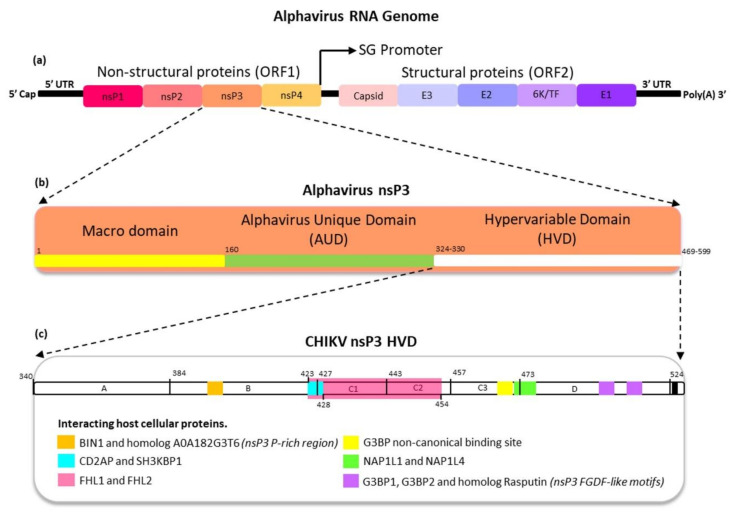
Figure 1
Figure 1
A summary of the alphavirus ss(+)RNA genome and nsP3 characteristics with putative binding regions for various host proteins. (a) The ~12 kb alphavirus RNA genome encodes four non-structural proteins (ORF1) and six structural proteins (ORF2), including the newly discovered TF protein. These ORFs are flanked by 5′ and 3′ UTRs. (b) The size of the alphavirus nsP3 ORF may vary (1–469/599 bp) and contains three domains: the macrodomain at position 1–160 bp (yellow), the alphavirus unique domain at position 161–324/330 bp (green), and the hypervariable domain at position 324/331–469/599 (white). (c) The nsP3 hypervariable domain (HVD) with putative binding regions for various interacting host proteins indicated according to the most recent available information. The putative nsP3 regions interacting with host proteins have been highlighted with different colors. UTR—untranslated region; ORF—open reading frame; SG—subgenomic promoter; Poly(A)—polyadenylation; BIN1—bridging integrator 1; CD2AP—CD2-associated protein; SH3KBP1—SH3 domain containing kinase binding protein 1; FHL1—four and a half LIM domain protein 1; FHL2—four and a half LIM domain protein 2; G3BP—ras-GTPase-activating protein (Ras-GAP) SH3 domain binding protein; G3BP1—ras GTPase-activating protein-binding protein 1; G3BP2—ras GTPase-activating protein-binding protein 2; NAP1L1—nucleosome assembly protein 1 like 1 and NAP1L4—nucleosome assembly protein 1 like 4. This figure is modified from Ahola and Merits, 2016; Gotte, Liu, and McInerney, 2018; Meshram et al., 2018; and Schnierle, 2020.
Figure 2
Figure 2
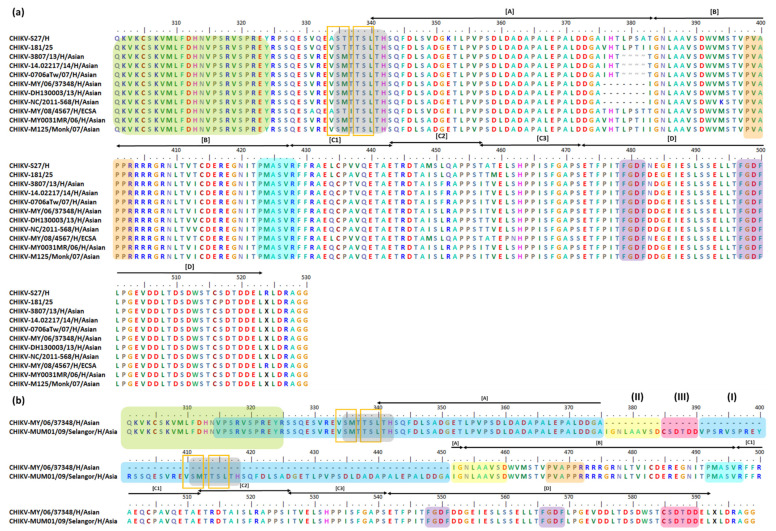
Important motifs and mutation events in CHIKV nsP3 HVD. The HVD starts at position 325. It has one P-rich region at positions (i) 388–393 (a) or (ii) 467–472 (b) (peach) and two FGDF-like motifs at positions (i) 479–482 and 497–500 (a) or (ii) 548–551 and 566–569 (b) (purple). For the fragment A of certain CHIKV strains, there is a 4 aa deletion at position 379–382 and a 7 aa deletion at position 376–382 (a). For CHIKV MUM001–2009-Selangor, there is a 76 aa duplication event at position 376–456 (b). The 76 aa duplication motif is indicated as motif (I) at position 391–456 (blue), motif (II) at position 376–384 (yellow), and motif (III) at position 385–390 (red). The template positions as follows: motif (I) 315–375; motif (II) 452–460; and motif (III) 585–590 (b). The PMASVR motif is at position 423–428 (a) or 491–497 (b) (turquoise), while the Ae. aegypti S(M/T)(T/I)TSLTH motif is at position 335–342 (a), and its duplicate is at positions 335–342 and 411–418 (b) (gray). Short motifs are possibly conserved/inserted/repeated/duplicated among CHIKV strains; the (V/A)S(M/T) and TSL are at positions 334–336 and 338–340 (a) and 410–412 and 414–417 (b) (orange boxes). Interestingly, these motifs are located in the Ae. aegypti inserted S(M/T)(T/I)TSLTH motif.
Figure 3
Figure 3
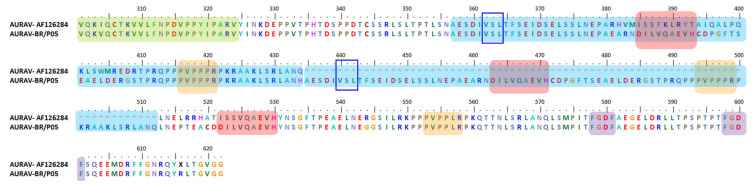
Important motifs and mutation events in AURAV nsP3 HVD. The HVD starts at position 325. It has two P-rich regions at positions 416–421 and 553–558 (peach) as well as two FGDF-like motifs at positions 578–581 and 598–601 (purple). There is a duplication motif for BR/P05 at position 435–512, with a motif sequence template from 357–434 (blue). There is also a repetitive motif, DILVQAEVH, at positions 385–393 and 522–530 as well as one duplication motif at position 463–471 (red). There is also a short motif, VSL, that is possibly conserved and duplicated among AURAV strains at positions 362–364 and 440–442 (blue boxes).
Figure 4
Figure 4
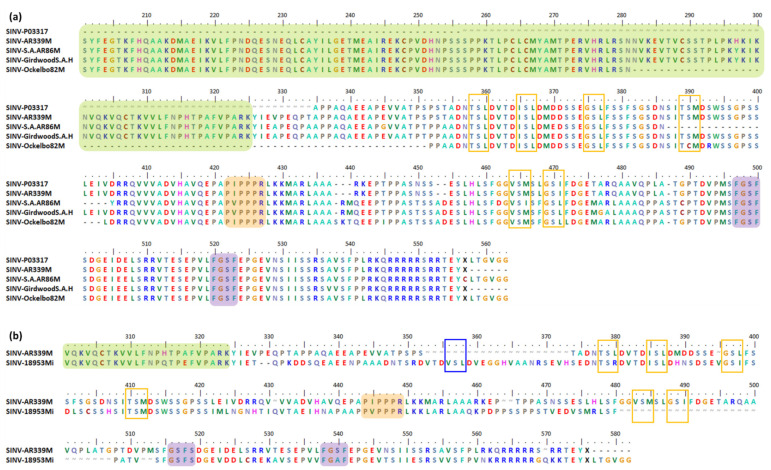
Important motifs and mutation events in SINV nsP3 HVD. The HVD starts at position 325. It has a P-rich region at position 422–427 (a) or 444–449 (b) (peach), and two FGDF-like motifs at positions 497–500 and 520–523 (a) or 516–519 and 538–541 (b) (purple). In (a), the Ockelbo82 has a 70 aa deletion at position 282–351, from AUD (green) to HVD (white). Meanwhile, S.A.AR86 and Ockelbo82 have 18 and 3 aa deletions at positions 387–404 and 401–403, respectively, which overlap at 401–403. There are 3 and 2 aa insertions in Ockelbo82 and both S.A.AR and Girdwood S.A at positions 438–440 and 439–440, respectively. At position 458–459, Ockelbo82, S.A.AR, and Girdwood S.A have a 2 aa insertion, while at position 487, S.A.AR86 and Girdwood S.A have a small 1 aa insertion. In (b), the SINV SINV_AUS_1975_18953 is shown to have a 21 aa insertion and a 27 aa deletion at positions 353–373 and 481–507, respectively. There is also a conserved short motif, the VSL, at position 356–358 (b) (blue box), which is possibly inserted in SINV_AUS_1975_18953. A few predicted VSL motifs such as TS(L/R), ISL, GS(L/I), and (T/V)(S/C)(M/I) have been conserved/inserted/deleted/repeated in SINV strains as well (a and b) (orange boxes).
Figure 5
Figure 5
Important motifs and mutation events in SFV nsP3 HVD. The HVD starts at position 325. It has an extended P-rich region at position 408–416 (peach), and two FGDF-like motifs at positions 451–454 and 468–471 (purple). A7(74) has a 7 aa deletion at position 387–393. The duplicate motif ADVHPEPA flanks the GIADLAA deletion motif at positions 379–386 and 393–400 (blue). A predicted conserved motif, MSL, can be observed at position 355–356 (orange box).
Figure 6
Figure 6
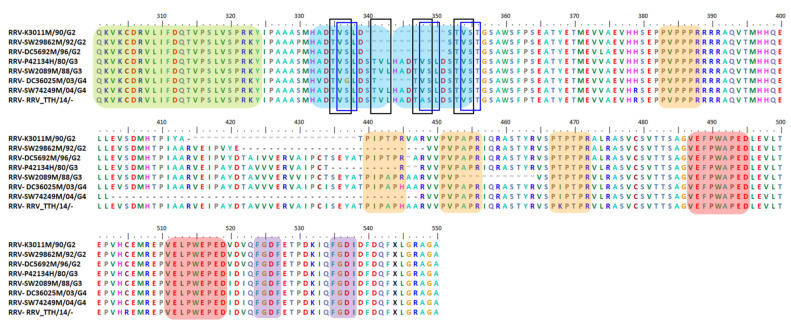
Important motifs and mutation events in RRV nsP3 HVD. The HVD starts at position 325. It has four P-rich regions at positions 383–388, 440–445, 451–456, and 467–472 (peach) as well as two FGDF-like motifs at positions 524–527 and 535–538 (purple). There are 1–45 aa deletions, starting at position 403–464, which mostly abolished half of or the entire second or third P-rich regions of the selected strains, such as SW29862, P42134, SW2089, and SW74249. It also has duplication motifs of VE(F/L)PW(A/E)PED at positions 487–495 and 511–519 (red), and the HADT(V/A)(S/G)LDSTV(L/S) duplication motif in blue boxes at positions 332–343 and 344–355 (blue). Meanwhile, another study suggested that despite having duplication events at positions 332–343 and 344–355, there was a 12 aa insertion in the STVLHADT(V/A)SLD at position 340–351. Notably, there are four duplicates of T(V/A)(S/G/L) at positions 335–337, 341–343, 347–349, and 353–355 (black boxes). There is also a short motif that is possibly conserved/inserted/repeated among RRV strains, (V/A)(S/G)(L/T), at positions 336–338, 348–350, and 354–356 (blue boxes).
Figure 7
Figure 7
Important motifs and mutation events in BFV nsP3 HVD. The HVD starts at position 325. It consists of four P-rich regions at positions 363–368, 373–378, 387–392, and 407–412 (peach) as well as two FGDF-like motifs at positions 429–432 and 447–450 (purple). The SW94457 has a 9 aa deletion motif at position 352–350. A predicted conserved motif for GS(L/V) has been observed at position 355–356 (orange box).
Figure 8
Figure 8
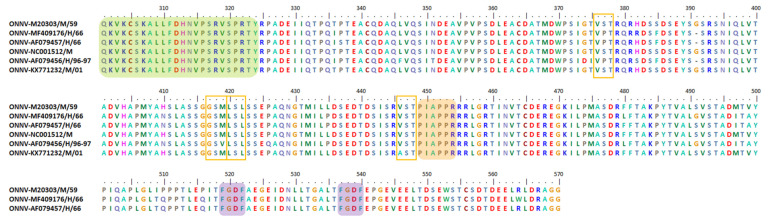
MSA and important motif locations in the nsP3 of selected ONNV strains. The HVD starts at position 325. It has one P-rich region at position 449–454 (peach) and two FGDF-like motifs at positions 519–522 and 538–540 (purple). The MF409176, AF079457, and AF079456 have 1 aa deletion at position 391. A predicted conserved motif, (V/A)(S/P)T, at positions 376–378 and 446–448; GS(M/V) at position 417–419; and LSL at 420–422 have been observed (orange box).

Similar articles

Cited by

References

    1. Virus Pathogen Resource (ViPR) Togaviridae. [(accessed on 3 January 2020)];2020 Available online: https://www.viprbrc.org/brc/home.spg?decorator=toga.
    1. Meshram D.C., Agback P., Shiliaev N., Urakova N., Mobley J.A., Agback T., Frolova E.I., Frolov I. Multiple host factors interact with hypervariable domain of Chikungunya virus nsP3 and determine viral replication in cell-specific mode. J. Virol. 2018;92:e00838-18. doi: 10.1128/JVI.00838-18. - DOI - PMC - PubMed
    1. Gotte B., Liu L., McInerney G.M. The enigmatic Alphavirus non-structural protein 3 (nsP3) revealing its secrets at last. Viruses. 2018;10:105. doi: 10.3390/v10030105. - DOI - PMC - PubMed
    1. Strauss J.H., Strauss E.G. The alphaviruses: Gene expression, replication, and evolution. Microbiol. Rev. 1994;58:491–562. doi: 10.1128/MR.58.3.491-562.1994. - DOI - PMC - PubMed
    1. Zhang R., Earnest J.T., Kim A.S., Winkler E.S., Desai P., Adams L.J., Hu G., Bullock C., Gold B., Cherry S., et al. Expression of the Mxra8 receptor promotes alphavirus infection and pathogenesis in mice and drosophila. Cell Rep. 2019;28:e5. doi: 10.1016/j.celrep.2019.07.105. - DOI - PMC - PubMed

Publication types

Substances

LinkOut - more resources