


Sensitivity to Haptic Sound-Localization Cues at Different Body Locations
- PMID: 34071729
- PMCID: PMC8198414
- DOI: 10.3390/s21113770
Sensitivity to Haptic Sound-Localization Cues at Different Body Locations
Abstract
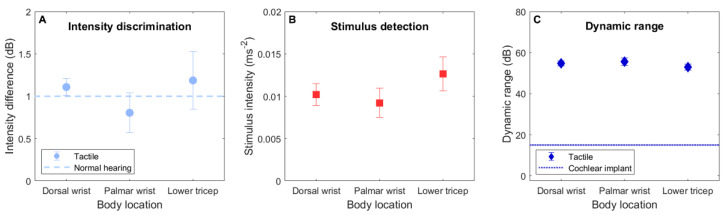
Cochlear implants (CIs) recover hearing in severely to profoundly hearing-impaired people by electrically stimulating the cochlea. While they are extremely effective, spatial hearing is typically severely limited. Recent studies have shown that haptic stimulation can supplement the electrical CI signal (electro-haptic stimulation) and substantially improve sound localization. In haptic sound-localization studies, the signal is extracted from the audio received by behind-the-ear devices and delivered to each wrist. Localization is achieved using tactile intensity differences (TIDs) across the wrists, which match sound intensity differences across the ears (a key sound localization cue). The current study established sensitivity to across-limb TIDs at three candidate locations for a wearable haptic device, namely: the lower tricep and the palmar and dorsal wrist. At all locations, TID sensitivity was similar to the sensitivity to across-ear intensity differences for normal-hearing listeners. This suggests that greater haptic sound-localization accuracy than previously shown can be achieved. The dynamic range was also measured and far exceeded that available through electrical CI stimulation for all of the locations, suggesting that haptic stimulation could provide additional sound-intensity information. These results indicate that an effective haptic aid could be deployed for any of the candidate locations, and could offer a low-cost, non-invasive means of improving outcomes for hearing-impaired listeners.
Keywords: cochlear implant; cross-modal; electro-haptic stimulation; haptic sound-localization; hearing aid; hearing impaired; neuroprosthetic; somatosensory; tactile; vibrotactile.
Conflict of interest statement
The authors declare no conflict of interest. The funders had no role in the design of the study; in the collection, analyses, or interpretation of data; in the writing of the manuscript; or in the decision to publish the results.
Figures


References
-
- Spriet A., Van Deun L., Eftaxiadis K., Laneau J., Moonen M., van Dijk B., van Wieringen A., Wouters J. Speech understanding in background noise with the two-microphone adaptive beamformer BEAM™ in the Nucleus Freedom™ cochlear implant system. Ear Hear. 2007;28:62–72. doi: 10.1097/01.aud.0000252470.54246.54. - DOI - PubMed
MeSH terms
Grants and funding
LinkOut - more resources
Full Text Sources
Medical
