. 2021 May 29;11(6):807.
doi: 10.3390/biom11060807.

Activation of Anopheles stephensi Pantothenate Kinase and Coenzyme A Biosynthesis Reduces Infection with Diverse Plasmodium Species in the Mosquito Host

Affiliations

Activation of Anopheles stephensi Pantothenate Kinase and Coenzyme A Biosynthesis Reduces Infection with Diverse Plasmodium Species in the Mosquito Host

Raquel M Simão-Gurge et al. Biomolecules. .

Abstract

Malaria parasites require pantothenate from both human and mosquito hosts to synthesize coenzyme A (CoA). Specifically, mosquito-stage parasites cannot synthesize pantothenate de novo or take up preformed CoA from the mosquito host, making it essential for the parasite to obtain pantothenate from mosquito stores. This makes pantothenate utilization an attractive target for controlling sexual stage malaria parasites in the mosquito. CoA is synthesized from pantothenate in a multi-step pathway initiated by the enzyme pantothenate kinase (PanK). In this work, we manipulated A. stephensi PanK activity and assessed the impact of mosquito PanK activity on the development of two malaria parasite species with distinct genetics and life cycles: the human parasite Plasmodium falciparum and the mouse parasite Plasmodium yoelii yoelii 17XNL. We identified two putative A. stephensi PanK isoforms encoded by a single gene and expressed in the mosquito midgut. Using both RNAi and small molecules with reported activity against human PanK, we confirmed that A. stephensi PanK manipulation was associated with corresponding changes in midgut CoA levels. Based on these findings, we used two small molecule modulators of human PanK activity (PZ-2891, compound 7) at reported and ten-fold EC50 doses to examine the effects of manipulating A. stephensi PanK on malaria parasite infection success. Our data showed that oral provisioning of 1.3 nM and 13 nM PZ-2891 increased midgut CoA levels and significantly decreased infection success for both Plasmodium species. In contrast, oral provisioning of 62 nM and 620 nM compound 7 decreased CoA levels and significantly increased infection success for both Plasmodium species. This work establishes the A. stephensi CoA biosynthesis pathway as a potential target for broadly blocking malaria parasite development in anopheline hosts. We envision this strategy, with small molecule PanK modulators delivered to mosquitoes via attractive bait stations, working in concert with deployment of parasite-directed novel pantothenamide drugs to block parasite infection in the human host. In mosquitoes, depletion of pantothenate through manipulation to increase CoA biosynthesis is expected to negatively impact Plasmodium survival by starving the parasite of this essential nutrient. This has the potential to kill both wild type parasites and pantothenamide-resistant parasites that could develop under pantothenamide drug pressure if these compounds are used as future therapeutics for human malaria.

Keywords: Anopheles stephensi; CoA; PZ-2891; PanK; Plasmodium falciparum; Plasmodium yoelii; coenzyme A; compound 7; malaria; midgut; pantothenate kinase; small molecules.


Conflict of interest statement

The authors declare no conflict of interest.

Figures
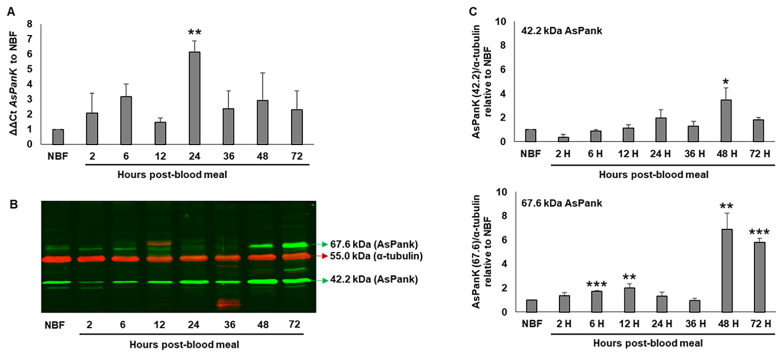
Figure 1
Figure 1
A. stephensi PanK transcript and protein levels in the midgut throughout a reproductive cycle. (A). A. stephensi PanK (AsPanK) transcript levels prior to (NBF) and following (2–72 h) a blood meal relative to a ribosomal S17 internal control. Error bars represent the standard error of the mean. Differences among respective timepoints were evaluated using one-way ANOVA with Tukey’s post hoc test. Three biological replicates with distinct cohorts of mosquitoes (ten mosquito midguts pooled per replicate) were performed. (B). Representative immunoblot showing changes in mosquito midgut PanK proteins prior to and during a reproductive cycle. α-tubulin antibody was used to assess loading. Three biological replicates with distinct cohorts of mosquitoes were performed and each lane represents one midgut equivalent from pools of ten mosquito midguts. (C). Densitometry analysis of the putative A. stephensi 42.2 and 67.6 kDa PanK isoforms from replicate immunoblots. Bars represent the density ratios of the respective PanK isoforms relative to α-tubulin. Error bars represent the standard error of the mean. Differences among respective timepoints compared to NBF were evaluated using one-way ANOVA with Tukey’s post hoc test. p-values: *** p < 0.001, ** p < 0.01, and * p < 0.05.
Figure 2
Figure 2
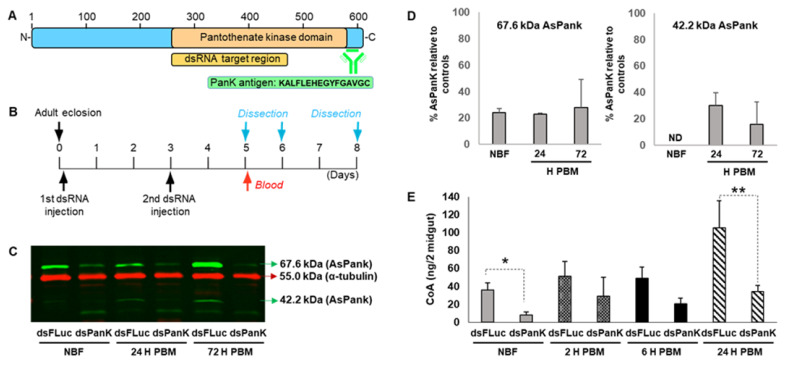
A. stephensi PanK RNAi reduced midgut PanK protein and coenzyme A (CoA) levels. (A). Schematic of A. stephensi PanK indicating the target location of the dsRNA construct and the peptide sequence used to generate the custom polyclonal antibody. (B). Experimental design for RNAi assays. A. stephensi females were injected with dsRNA targeting A. stephensi (dsPanK) or firefly luciferase (dsFLuc) within 4 h after adult eclosion and again at 3 d post-emergence. Mosquitoes were provided human blood on day 5 and midguts were dissected prior to blood feeding (non-blood-fed, NBF) and at 24 h and 72 h post-blood meal (PBM). (C). Representative immunoblot showing putative A. stephensi PanK isoforms (67.6 kDa and 42.2 kDa; green bands) following PanK RNAi relative to FLuc RNAi control (red band). Each lane represents one midgut equivalent from pools of ten mosquito midguts. RNAi and immunoblots were replicated twice with distinct cohorts of mosquitoes. (D). Densitometry analysis of the 67.6 kDa and 42.2 kDa A. stephensi PanK isoforms. Bars represent mean and standard deviation of percent PanK protein expression in mosquitoes inoculated with dsPanK relative to mosquitoes injected with dsFLuc. (E). Midgut CoA levels in dsPanK- and dsFLuc-treated A. stephensi. Differences between treatment groups for respective timepoints were evaluated using Student’s t-test. ** p < 0.01 and * p < 0.05. Experiments were replicated three times with independent cohorts of mosquitoes.
Figure 3
Figure 3
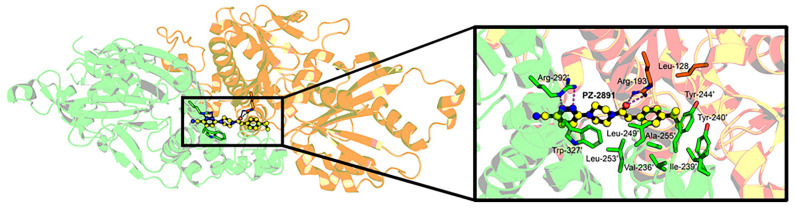
Homology model of A. stephensi PanK with bound PZ-2891. Interactions between PZ-2891 and A. stephensi PanK predict that the mosquito protein is regulated by the same allosteric mechanism described for PZ-2891 regulation of human PanKs. PZ-2891 interacts with both protomers through hydrophobic interactions, hydrogen bond contacts, and π-π stacking interactions. Sequence numbering is assigned to A. stephensi PanK. The two A. stephensi PanK protomers are colored green and orange and PZ-2891 is yellow.
Figure 4
Figure 4
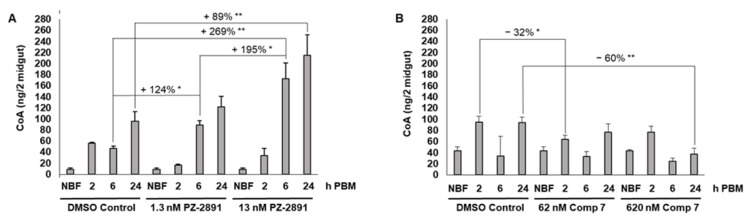
Oral provisioning of PZ-2891 increased and compound 7 decreased A. stephensi midgut CoA levels, respectively. (A). Mosquitoes provisioned with PZ-2891 had significantly increased levels of midgut CoA at 6 h (13 nM and 1.3 nM) and 24 h (13 nM) relative to DMSO control, with a pattern of greater increases in midgut CoA for 13 nM vs. 1.3 nM PZ-2891 at 6 h and 24 h. Differences between treatments and controls were evaluated using Student’s t-test. ** p < 0.01 and * p < 0.05. Three distinct biological cohorts of mosquitoes were assayed. (B). Mosquitoes provisioned with 620 nM and 62 nM compound 7 had reduced levels of midgut CoA at 24 h and 2 h, respectively, relative to DMSO control. Five distinct biological cohorts of mosquitoes were assayed. Differences between treatments and DMSO controls were evaluated using Student’s t-test. ** p < 0.01 and * p < 0.05. Five distinct biological cohorts of mosquitoes were assayed.
Figure 5
Figure 5
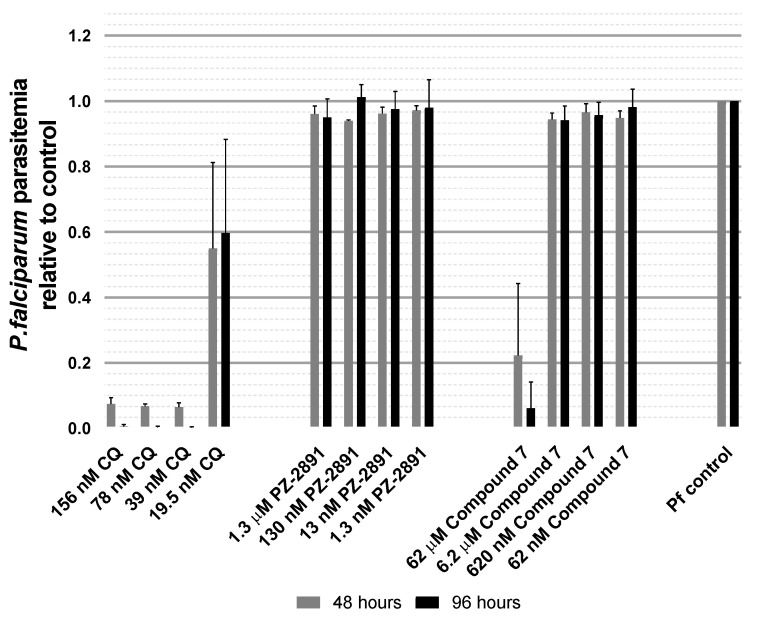
PZ-2891 and compound 7 at doses used in our biological assays had no direct effects on P. falciparum NF54 growth in vitro. Synchronized asexual stage P. falciparum NF54 strain was grown and treated with medium supplemented with chloroquine as a positive control for parasite killing (156 nM, 78 nM, 39 nM or 19.5 nM), PZ-2891 (1.3 µM, 130 nM, 13 nM or 1.3 nM), compound 7 (62 µM, 6.2 µM, 620 nM or 62 nM) or DMSO as a negative control at a volume equivalent to that used to deliver small molecules (indicated as “Pf control”, set to 1). Samples were collected 48 h and 96 h after treatment, stained with PI and analyzed by flow cytometry. The data are represented as mean parasitemia +/− SEM of the treated cultures relative to Pf control. The assays were replicated twice with distinct parasite cultures.
Figure 6
Figure 6
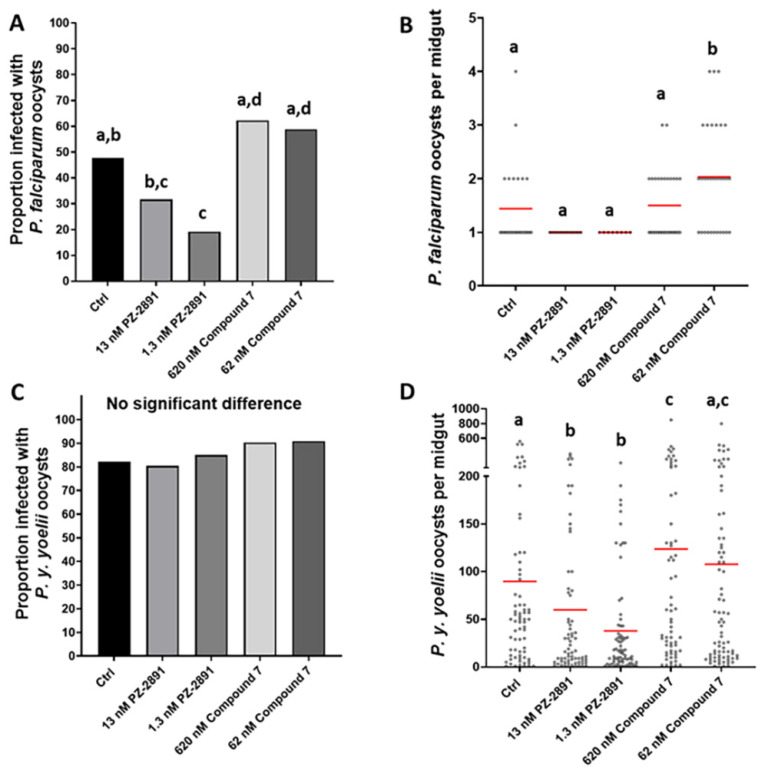
PZ-2891 and compound 7 decreased and increased, respectively, P. y. yoelii 17XNL and P. falciparum infection of A. stephensi. Graphs A and C represent infection prevalence for P. yoelii and P. falciparum, respectively, while B and D show infection intensity. Prevalence data (A,C) were analyzed by Chi-square and Fisher’s exact tests and infection intensity data (B,D) were analyzed by one-way ANOVA and Tukey’s post hoc test. Different lower case letters above data columns indicate groups that are significantly different by Chi-square (graphs A,C) or ANOVA and Tukey’s (graphs B,D) at the α = 0.05 level of significance (i.e., data indicated as “a” are significantly different from data indicated as “b” within a single graph). (A). P. falciparum infection prevalence. Specific p-values for significant differences are as follows: Control (Ctrl) vs. 1.3 nM PZ-2891 p = 0.0073; 13 nM PZ-2891 vs. 620 nM compound 7 p = 0.0009; 13 nM PZ-2891 vs. 62 nM compound 7 p = 0.0022; 1.3 nM PZ-2891 vs. 620 nM compound 7 p < 0.0001; 1.3 nM PZ-2891 vs. 62 nM compound 7 p = 0.0001. Two biological replicates were performed with unique cohorts of mosquitoes (n = 28–30 mosquitoes per control and treatment groups). (B). P. falciparum infection intensity. Numbers of oocysts per midgut of individual female A. stephensi mosquitoes infected with P. falciparum are represented by black circles. Red bars represent mean oocysts/midgut. Specific p-values for significant differences are as follows: Ctrl vs. 62 nM compound 7 p = 0.0266; 13 nM PZ-2891 vs. 62 nM compound 7 p = 0.0004; 1.3 nM PZ-2891 vs. 62 nM compound 7 p = 0.0051; 620 nM compound 7 vs. 62 nM compound 7 p = 0.0424. (C). P. yoelii prevalence. No significant differences were observed among groups, likely due to the high infection prevalence overall. Three biological replicates were performed with unique cohorts of mosquitoes (n = 70–88 mosquitoes per group). (D). P. yoelii infection intensity. Numbers of oocysts per midgut of female A. stephensi mosquitoes infected with P. yoelii. Red bars represent mean oocysts/midgut. Specific p-values for significant differences are as follows: Ctrl vs. 13 nM PZ-2891 p = 0.0164; Ctrl vs. 1.3 nM PZ-2891 p = 0.0003; Ctrl vs. 620 nM compound 7 p = 0.055; 13 nM PZ-2891 vs. 620 nM compound 7 p = 0.0009; 13 nM PZ-2891 vs. 62 nM compound 7 p = 0.0081; 1.3 nM PZ-2891 vs. 620 nM compound 7 p < 0.0001; 1.3 nM PZ-2891 vs. 62 nM compound 7 p < 0.0001.

References

    1. Spry C., Van Schalkwyk D., Strauss E., Saliba K. Pantothenate utilization by Plasmodium as a target for antimalarial chemotherapy. Infect. Disord.-Drug Targets (Former. Curr. Drug Targets-Infect. Disord.) 2010;10:200–216. doi: 10.2174/187152610791163390. - DOI - PubMed
    1. Hart R.J., Abraham A., Aly A.S. Genetic characterization of coenzyme A biosynthesis reveals essential distinctive functions during malaria parasite development in blood and mosquito. Front. Cell. Infect. Microbiol. 2017;7:260. doi: 10.3389/fcimb.2017.00260. - DOI - PMC - PubMed
    1. Rock C.O., Calder R.B., Karim M.A., Jackowski S. Pantothenate kinase regulation of the intracellular concentration of coenzyme A. J. Biol. Chem. 2000;275:1377–1383. doi: 10.1074/jbc.275.2.1377. - DOI - PubMed
    1. Sinka M., Pironon S., Massey N., Longbottom J., Hemingway J., Moyes C., Willis K. A new malaria vector in Africa: Predicting the expansion range of Anopheles stephensi and identifying the urban populations at risk. Proc. Natl. Acad. Sci. USA. 2020;117:24900–24908. doi: 10.1073/pnas.2003976117. - DOI - PMC - PubMed
    1. Zhyvoloup A., Nemazanyy I., Babich A., Panasyuk G., Pobigailo N., Vudmaska M., Naidenov V., Kukharenko O., Palchevskii S., Savinska L. Molecular cloning of CoA synthase: The missing link in CoA biosynthesis. J. Biol. Chem. 2002;277:22107–22110. doi: 10.1074/jbc.C200195200. - DOI - PubMed

Publication types

MeSH terms

LinkOut - more resources