Review
. 2021 May 29;22(11):5850.
doi: 10.3390/ijms22115850.

Current Understanding of Neurofibromatosis Type 1, 2, and Schwannomatosis

Affiliations
Review

Current Understanding of Neurofibromatosis Type 1, 2, and Schwannomatosis

Ryota Tamura. Int J Mol Sci. .

Abstract

Neurofibromatosis (NF) is a neurocutaneous syndrome characterized by the development of tumors of the central or peripheral nervous system including the brain, spinal cord, organs, skin, and bones. There are three types of NF: NF1 accounting for 96% of all cases, NF2 in 3%, and schwannomatosis (SWN) in <1%. The NF1 gene is located on chromosome 17q11.2, which encodes for a tumor suppressor protein, neurofibromin, that functions as a negative regulator of Ras/MAPK and PI3K/mTOR signaling pathways. The NF2 gene is identified on chromosome 22q12, which encodes for merlin, a tumor suppressor protein related to ezrin-radixin-moesin that modulates the activity of PI3K/AKT, Raf/MEK/ERK, and mTOR signaling pathways. In contrast, molecular insights on the different forms of SWN remain unclear. Inactivating mutations in the tumor suppressor genes SMARCB1 and LZTR1 are considered responsible for a majority of cases. Recently, treatment strategies to target specific genetic or molecular events involved in their tumorigenesis are developed. This study discusses molecular pathways and related targeted therapies for NF1, NF2, and SWN and reviews recent clinical trials which involve NF patients.

Keywords: clinical trial; molecular targeted therapy; neurofibromatosis type 1; neurofibromatosis type 2; schwannomatosis.


Conflict of interest statement

The authors declare no conflict of interest.

Figures
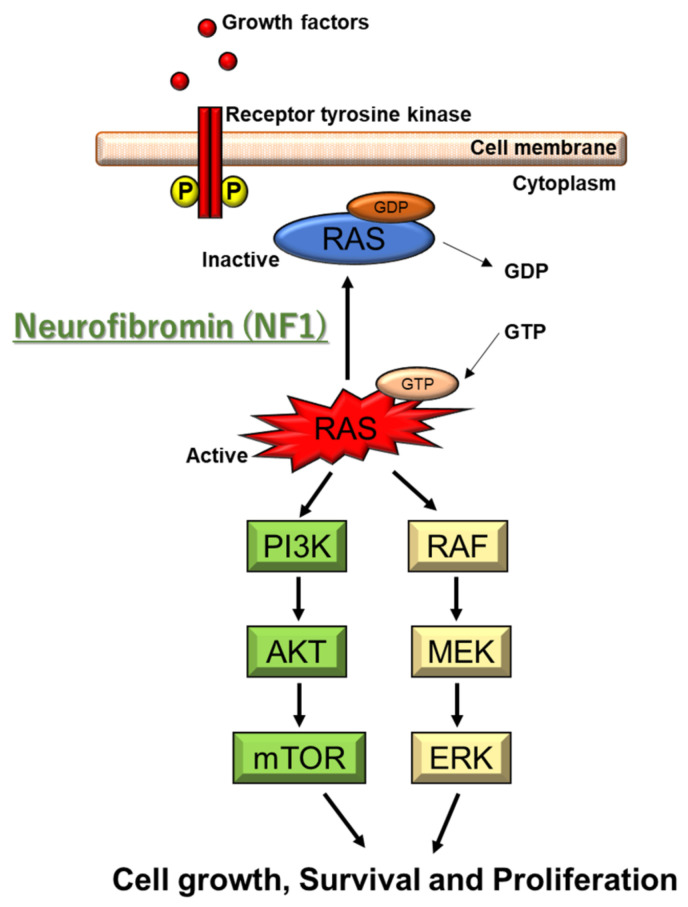
Figure 1
Figure 1
Molecular pathogenesis of NF1. NF1 codes for neurofibromin, which is a Ras-GTPase-activating protein (Ras-GAP). NF1 gene deficiency leads to Ras hyperactivation, which causes the subsequent activation of the AKT/mTOR and Raf/MEK/ERK pathways. ERK activates SYN1 modulating GABA release. Ras-GTP also activates Rac1 and Cdc42 pathways, leading to overactivation of PAK1.
Figure 2
Figure 2
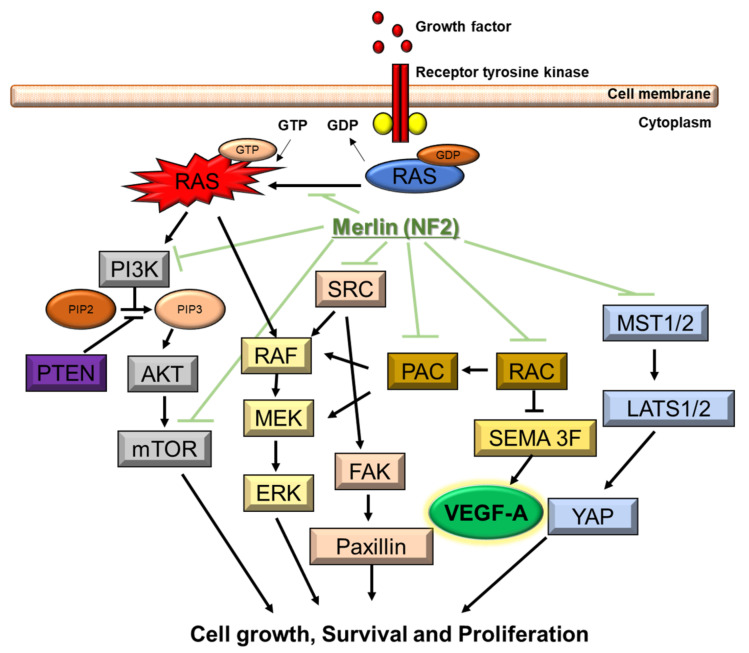
Molecular pathogenesis of NF2. NF2 gene encodes merlin. Merlin regulates multiple proliferative signaling pathways. At the membrane, merlin blocks signaling caused by integrins and tyrosine receptor kinases. Merlin can also inhibit downstream signalings, including the p21-activated kinase signaling, Ras/Raf/MEK/ERK, FAK/Src, PI3K/AKT, Rac/PAK/JNK, mTORC1, and Wnt/β-catenin pathways. Downstream signaling of NF2 includes VEGF-A.
Figure 3
Figure 3
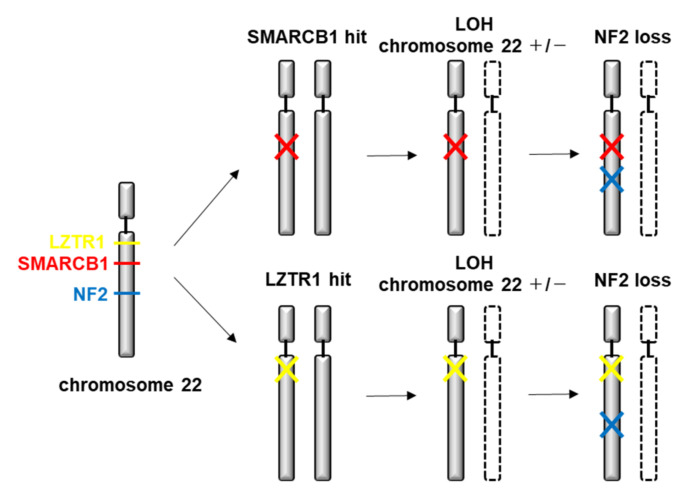
Molecular pathogenesis of SWN.

References

    1. Coy S., Rashid R., Stemmer-Rachamimov A., Santagata S. An update on the CNS manifestations of neurofibromatosis type 2. Acta Neuropathol. 2020;139:643–665. doi: 10.1007/s00401-019-02029-5. - DOI - PMC - PubMed
    1. Evans D.G., Bowers N.L., Tobi S., Hartley C., Wallace A.J., King A.T., Lloyd S.K.W., Rutherford S.A., Hammerbeck-Ward C., Pathmanaban O.N., et al. Schwannomatosis: A genetic and epidemiological study. J. Neurol. Neurosurg. Psychiatry. 2018;89:1215. doi: 10.1136/jnnp-2018-318538. - DOI - PubMed
    1. Nix J.S., Blakeley J., Rodriguez F.J. An update on the central nervous system manifestations of neurofibromatosis type 1. Acta Neuropathol. 2020;139:625–641. doi: 10.1007/s00401-019-02002-2. - DOI - PMC - PubMed
    1. Kresak J.L. Neurofibromatosis: A Review of NF1, NF2, and Schwannomatosis. J. Pediatr. Genet. 2016;5:98–104. - PMC - PubMed
    1. Blakeley J.O., Plotkin S.R. Therapeutic advances for the tumors associated with neurofibromatosis type 1, type 2, and schwannomatosis. Neuro. Oncol. 2016;18:624–638. doi: 10.1093/neuonc/nov200. - DOI - PMC - PubMed

MeSH terms

Substances

Supplementary concepts