


The Long-Term Prognostic Significance of Circulating Tumor Cells in Ovarian Cancer-A Study of the OVCAD Consortium
- PMID: 34073412
- PMCID: PMC8198007
- DOI: 10.3390/cancers13112613
The Long-Term Prognostic Significance of Circulating Tumor Cells in Ovarian Cancer-A Study of the OVCAD Consortium
Abstract
Introduction: We previously reported the prognostic impact of circulating tumor cells (CTCs) in a multicenter study on minimal residual disease in primary ovarian cancer. With additional follow-up data, we evaluated the combined CTC approach (CTCscombo), in particular for the patients who had survived more than five years.
Material and methods: Blood samples taken at baseline and six months after adjuvant treatment (follow-up) were assessed by quantitative PCR (qPCR) measuring PPIC transcripts and immunofluorescent staining (IF). A positive result with either IF or qPCR was classified as CTCcombo-positive. Further, PPIC was assessed in the primary tumor tissue.
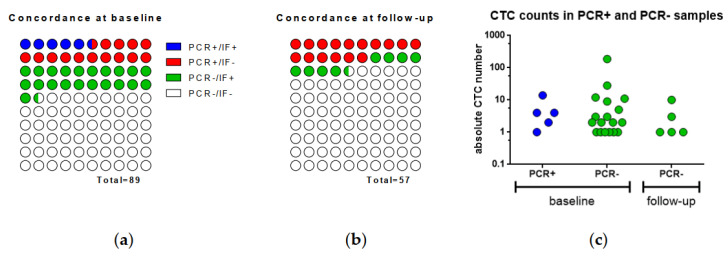
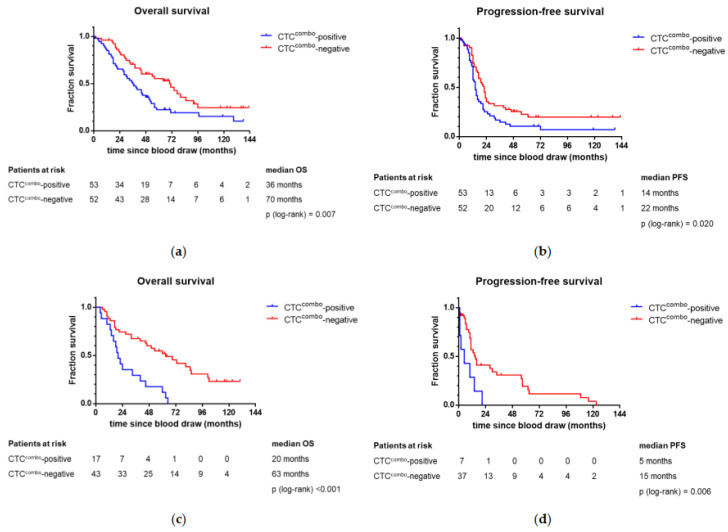
Results: The concordance of IF and qPCR was 65% at baseline and 83% after treatment. Results showed that 50.5% of the baseline and 29.5% of the follow-up samples were CTCcombo-positive. CTCscombo after treatment were associated with increased mortality after adjusting for FIGO stage (HR 2.574, 95% CI: 1.227-5.398, p = 0.012), a higher risk of recurrence after adjusting for peritoneal carcinosis (HR 4.068, 95% CI: 1.948-8.498, p < 0.001), and increased mortality after five survived years.
Discussion: The two-sided analytical approach revealed CTC subpopulations associated with ovarian cancer progression and may illuminate a potential treatment-related shift in molecular phenotypes. That approach can identify patients who have elevated risk of recurrence and death due to ovarian cancer and who may require risk-adapted treatment strategies.
Keywords: circulating tumor cells; long-term survival; primary epithelial ovarian cancer.
Conflict of interest statement
S.V. declares research support, advisory board, honoraria, and travel expenses from AbbVie, AstraZeneca, Clovis, Eisai, GlaxoSmithKline, Medac, MSD, Novartis, Olympus, PharmaMar, Pfizer, Roche, Sensor Kinesis, Teva, Tesaro. I.V. declares research support from Amgen, Roche, Oncoinventand Genmab and honoraria advisory boards from Amgen, AstraZeneca, Clovis Oncology Inc., -Carrick Therapeutics, Deciphera Pharmaceuticals, -Elevar Therapeutics, F. Hoffmann-La Roche, Genmab, GSK, Immunogen Inc., Jazzpharma, Mersana, MSD, Novocure, Octimet Oncology, Oncoinvent, Sotio, Verastem Oncology, Zentalis. J.S., A.R., L.L., L.W., N.C., B.B., and I.B., declare no conflicts of interest.
Figures
References
-
- De Angelis R., Sant M., Coleman M.P., Francisci S., Baili P., Pierannunzio D., Trama A., Visser O., Brenner H., Ardanaz E., et al. Cancer survival in Europe 1999-2007 by country and age: Results of EUROCARE—5-a population-based study. Lancet Oncol. 2014;15:23–34. doi: 10.1016/S1470-2045(13)70546-1. - DOI - PubMed
-
- Obermayr E., Bednarz-Knoll N., Orsetti B., Weier H.U., Lambrechts S., Castillo-Tong D.C., Reinthaller A., Braicu E.I., Mahner S., Sehouli J., et al. Circulating tumor cells: Potential markers of minimal residual disease in ovarian cancer? A study of the OVCAD consortium. Oncotarget. 2017;8:106415–106428. doi: 10.18632/oncotarget.22468. - DOI - PMC - PubMed
LinkOut - more resources
Full Text Sources
Miscellaneous
