


Food Waste Biorefinery: Pathway towards Circular Bioeconomy
- PMID: 34073698
- PMCID: PMC8225055
- DOI: 10.3390/foods10061174
Food Waste Biorefinery: Pathway towards Circular Bioeconomy
Abstract
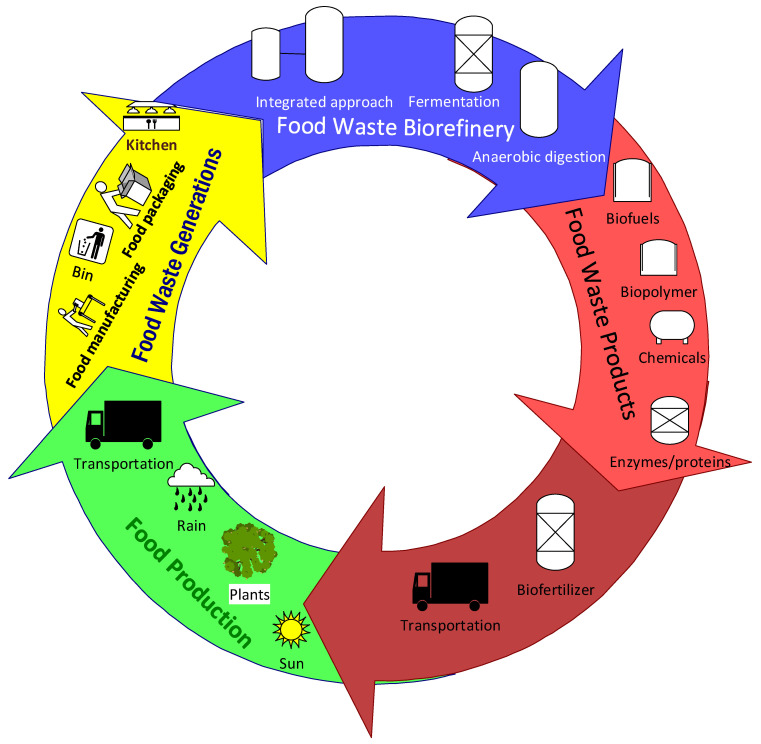
Food waste biorefineries for the production of biofuels, platform chemicals and other bio-based materials can significantly reduce a huge environmental burden and provide sustainable resources for the production of chemicals and materials. This will significantly contribute to the transition of the linear based economy to a more circular economy. A variety of chemicals, biofuels and materials can be produced from food waste by the integrated biorefinery approach. This enhances the bioeconomy and helps toward the design of more green, ecofriendly, and sustainable methods of material productions that contribute to sustainable development goals. The waste biorefinery is a tool to achieve a value-added product that can provide a better utilization of materials and resources while minimizing and/or eliminating environmental impacts. Recently, food waste biorefineries have gained momentum for the production of biofuels, chemicals, and bio-based materials due to the shifting of regulations and policies towards sustainable development. This review attempts to explore the state of the art of food waste biorefinery and the products associated with it.
Keywords: bio-based materials; biofuels; biopolymer; biorefinery; platform chemicals; sustainable development goal; sustainable production.
Conflict of interest statement
The authors declare no conflict of interest.
Figures
References
-
- FAO . Global Food Losses and Food Waste—Extent, Causes and Prevention. FAO; Rome, Italy: 2011.
-
- UN . Transforming Our World: The 2030 Agenda for Sustainable Development Preamble. United Nations; New York, NY, USA: 2015.
Publication types
LinkOut - more resources
Full Text Sources
Molecular Biology Databases
