


Genetic Patterns Found in the Nuclear Localization Signals (NLSs) Associated with EBV-1 and EBV-2 Provide New Insights into Their Contribution to Different Cell-Type Specificities
- PMID: 34073836
- PMCID: PMC8197229
- DOI: 10.3390/cancers13112569
Genetic Patterns Found in the Nuclear Localization Signals (NLSs) Associated with EBV-1 and EBV-2 Provide New Insights into Their Contribution to Different Cell-Type Specificities
Abstract
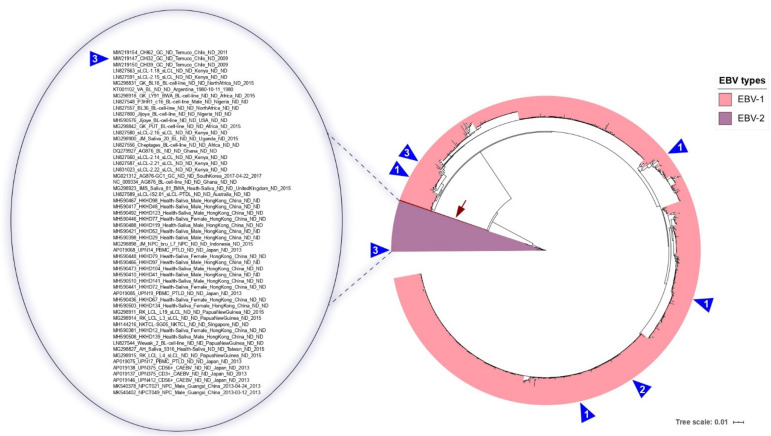
The Epstein-Barr virus (EBV) is a globally dispersed pathogen involved in several human cancers of B-cell and non-B-cell origin. EBV has been classified into EBV-1 and EBV-2, which have differences in their transformative ability. EBV-1 can transform B-cells into LCL more efficiently than EBV-2, and EBV-2 preferentially infects T-cell lymphocytes. The EBNA3A oncoprotein is a transcriptional regulator of virus and host cell genes, and is required in order to transform B-cells. EBNA3A has six peptide motifs called nuclear localization signals (NLSs) that ensure nucleocytoplasmic protein trafficking. The presence of multiple NLSs has been suggested to enhance EBNA3 function or different specificities in different cell types. However, studies about the NLS variability associated with EBV types are scarce. Based on a systematic sequence analysis considering more than a thousand EBNA3A sequences of EBV from different human clinical manifestations and geographic locations, we found differences in NLSs' nucleotide structures among EBV types. Compared with the EBNA3A EBV-1, EBNA3A EBV-2 has two of the six NLSs altered, and these mutations were possibly acquired by recombination. These genetic patterns in the NLSs associated with EBV-1 and EBV-2 provide new information about the traits of EBNA3A in EBV biology.
Keywords: EBV classification; EBV nuclear antigen EBNA 3A (EBNA3A); Epstein–Barr virus (EBV); nuclear localization signal (NLS); phylogeny; recombination.
Conflict of interest statement
The authors declare no conflict of interest.
Figures


References
-
- Corvalan A., Koriyama C., Akiba S., Eizuru Y., Backhouse C., Palma M., Argandoña J., Tokunaga M. Epstein-Barr virus in gastric carcinoma is associated with location in the cardia and with a diffuse histology: A study in one area of Chile. Int. J. Cancer. 2001;94:527–530. doi: 10.1002/ijc.1510. - DOI - PubMed
Grants and funding
- 3210687/Fondo Nacional de Desarrollo Científico y Tecnológico
- 3170826/Fondo Nacional de Desarrollo Científico y Tecnológico
- 3210618/Fondo Nacional de Desarrollo Científico y Tecnológico
- 3210604/Fondo Nacional de Desarrollo Científico y Tecnológico
- 11150622/Fondo Nacional de Desarrollo Científico y Tecnológico
- 1210440/Fondo Nacional de Desarrollo Científico y Tecnológico
- VRIP20P002/Universidad de La Frontera
- 21201835/Comisión Nacional de Investigación Científica y Tecnológica
- DIM20-0019/Universidad de La Frontera
- DI20-0160/Universidad de La Frontera
- DI20-0128/Universidad de La Frontera
- DIUA 226-2021/Universidad Autonoma de Chile
LinkOut - more resources
Full Text Sources
