


Latency Reversing Agents: Kick and Kill of HTLV-1?
- PMID: 34073995
- PMCID: PMC8197370
- DOI: 10.3390/ijms22115545
Latency Reversing Agents: Kick and Kill of HTLV-1?
Abstract
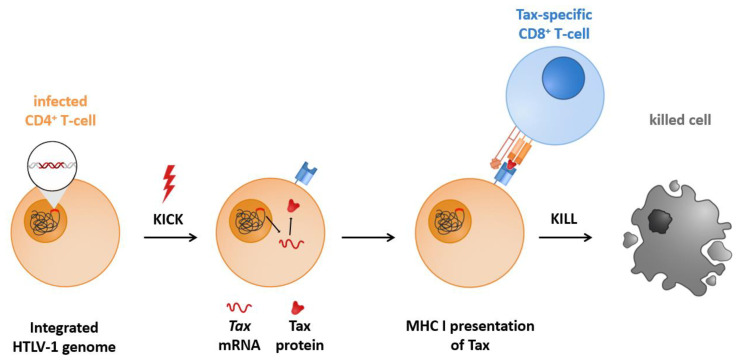
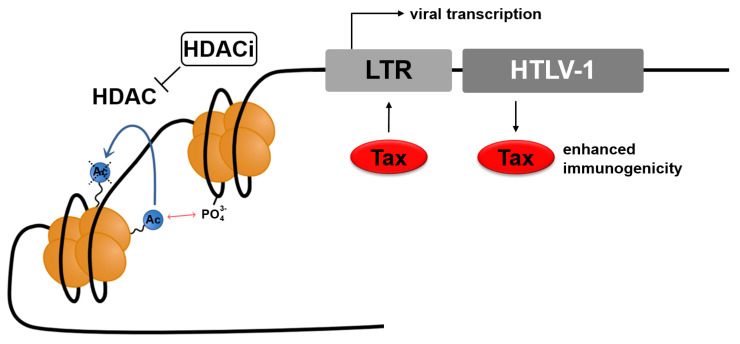
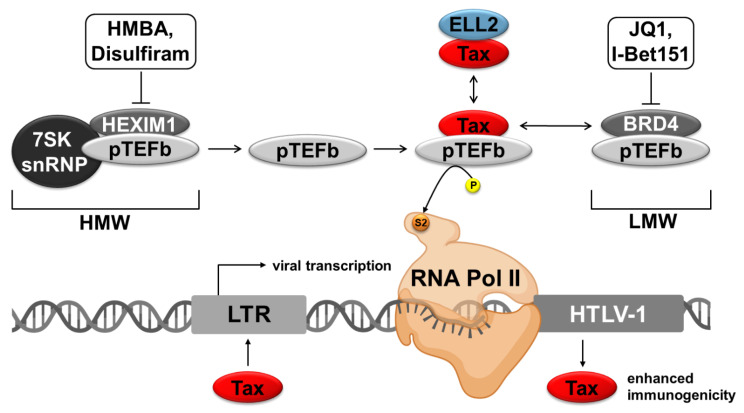
Human T-cell leukemia virus type 1 (HTLV-1), the cause of adult T-cell leukemia/lymphoma (ATLL), is a retrovirus, which integrates into the host genome and persistently infects CD4+ T-cells. Virus propagation is stimulated by (1) clonal expansion of infected cells and (2) de novo infection. Viral gene expression is induced by the transactivator protein Tax, which recruits host factors like positive transcription elongation factor b (P-TEFb) to the viral promoter. Since HTLV-1 gene expression is repressed in vivo by viral, cellular, and epigenetic mechanisms in late phases of infection, HTLV-1 avoids an efficient CD8+ cytotoxic T-cell (CTL) response directed against the immunodominant viral Tax antigen. Hence, therapeutic strategies using latency reversing agents (LRAs) sought to transiently activate viral gene expression and antigen presentation of Tax to enhance CTL responses towards HTLV-1, and thus, to expose the latent HTLV-1 reservoir to immune destruction. Here, we review strategies that aimed at enhancing Tax expression and Tax-specific CTL responses to interfere with HTLV-1 latency. Further, we provide an overview of LRAs including (1) histone deacetylase inhibitors (HDACi) and (2) activators of P-TEFb, that have mainly been studied in context of human immunodeficiency virus (HIV), but which may also be powerful in the context of HTLV-1.
Keywords: ATLL; HDAC-inhibitor (HDACi); HIV; HTLV-1; P-TEFb; Tax; kick and kill; latency; latency reversing agents (LRA); shock and kill.
Conflict of interest statement
The authors declare no conflict of interest. The funders had no role in the design of the study; in the collection, analyses, or interpretation of data; in the writing of the manuscript, or in the decision to publish the results.
Figures
References
-
- Poiesz B.J., Ruscetti F.W., Gazdar A.F., Bunn P.A., Minna J.D., Gallo R.C. Detection and isolation of type C retrovirus particles from fresh and cultured lymphocytes of a patient with cutaneous T-cell lymphoma. Proc. Natl. Acad. Sci. USA. 1980;77:7415–7419. doi: 10.1073/pnas.77.12.7415. - DOI - PMC - PubMed
Publication types
MeSH terms
Substances
Grants and funding
LinkOut - more resources
Full Text Sources
Research Materials
