Risk of COVID-19 Disease, Dialysis Unit Attributes, and Infection Control Strategy among London In-Center Hemodialysis Patients
- PMID: 34074636
- PMCID: PMC8455047
- DOI: 10.2215/CJN.03180321
Risk of COVID-19 Disease, Dialysis Unit Attributes, and Infection Control Strategy among London In-Center Hemodialysis Patients
Abstract
Background and objectives: Patients receiving in-center hemodialysis treatment face unique challenges during the coronavirus disease 2019 (COVID-19) pandemic, specifically the need to attend for treatment that prevents self-isolation. Dialysis unit attributes and isolation strategies that might reduce dialysis center COVID-19 infection rates have not been previously examined.
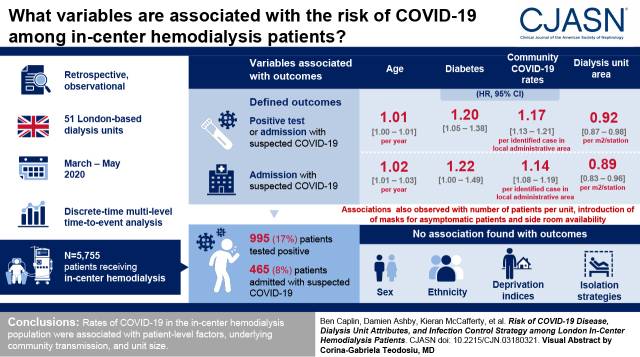
Design, setting, participants, & measurements: We explored the role of variables, including community disease burden, dialysis unit attributes (size and layout), and infection control strategies, on rates of COVID-19 among patients receiving in-center hemodialysis in London, United Kingdom, between March 2, 2020 and May 31, 2020. The two outcomes were defined as (1) a positive test for infection or admission with suspected COVID-19 and (2) admission to the hospital with suspected infection. Associations were examined using a discrete time multilevel time-to-event analysis.
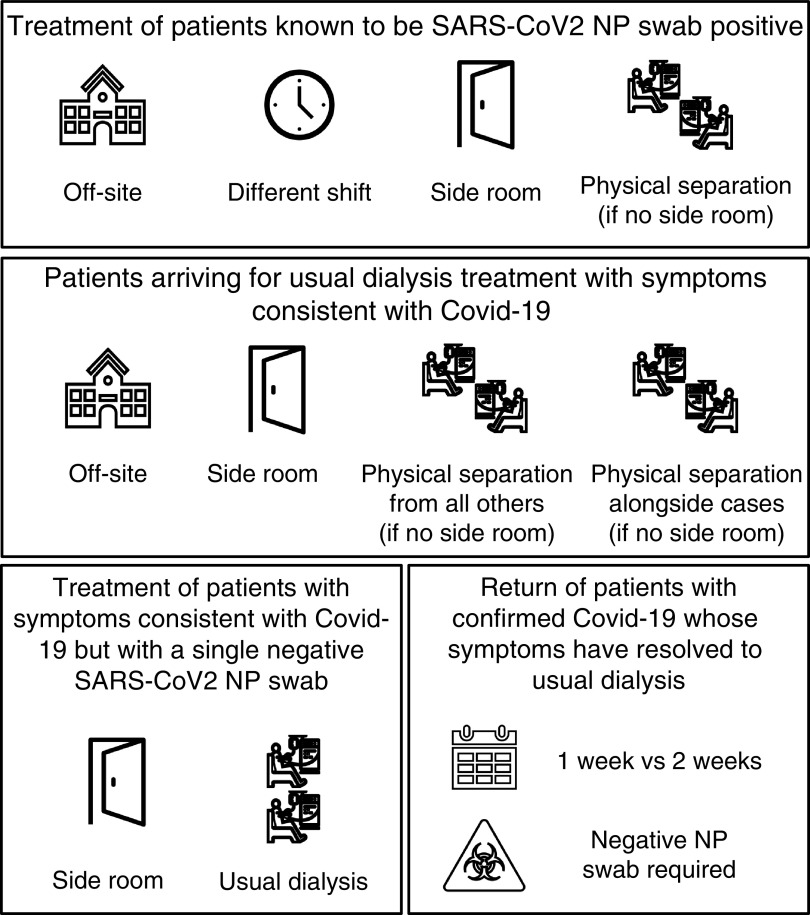
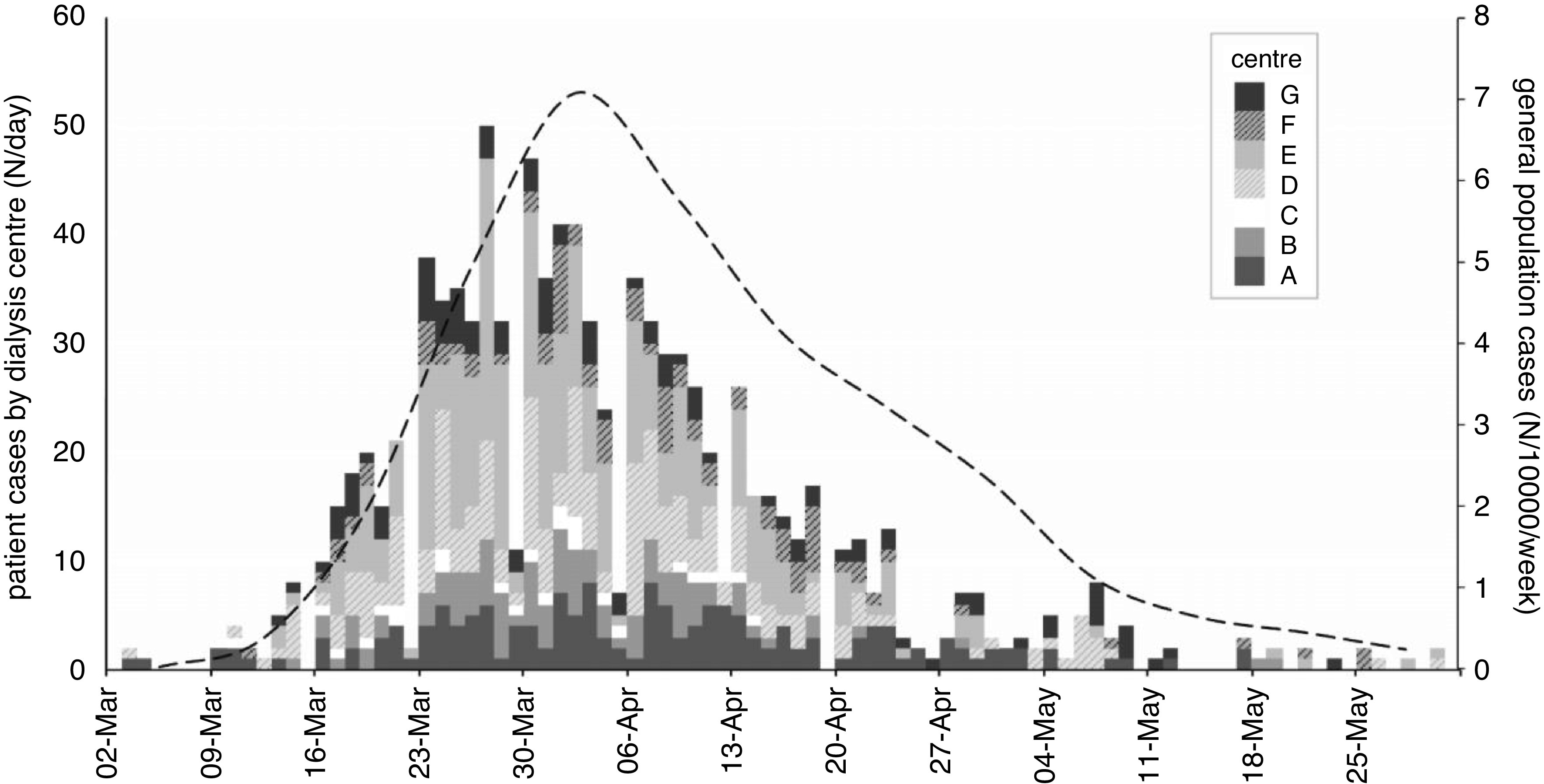
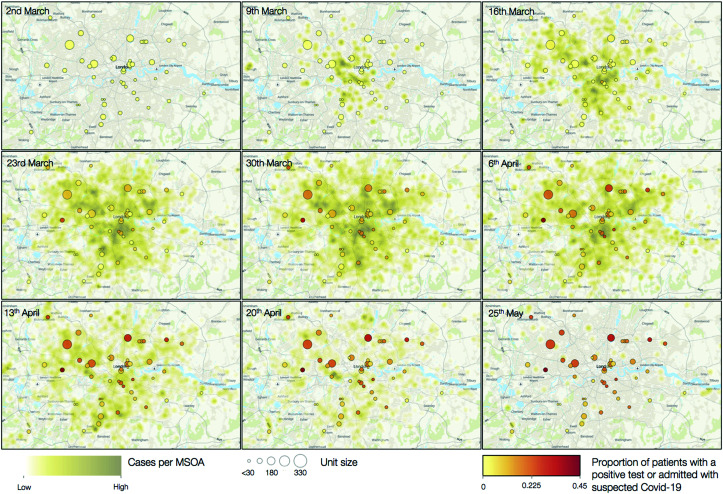
Results: Data on 5755 patients dialyzing in 51 units were analyzed; 990 (17%) tested positive and 465 (8%) were admitted with suspected COVID-19 between March 2 and May 31, 2020. Outcomes were associated with age, diabetes, local community COVID-19 rates, and dialysis unit size. A greater number of available side rooms and the introduction of mask policies for asymptomatic patients were inversely associated with outcomes. No association was seen with sex, ethnicity, or deprivation indices, nor with any of the different isolation strategies.
Conclusions: Rates of COVID-19 in the in-center hemodialysis population relate to individual factors, underlying community transmission, unit size, and layout.
Keywords: COVID-19; hemodialysis; infection control.
Copyright © 2021 by the American Society of Nephrology.
Figures
Comment in
-
Evidence-Based Practices to Reduce COVID-19 Transmission in Dialysis Facilities.Clin J Am Soc Nephrol. 2021 Aug;16(8):1146-1148. doi: 10.2215/CJN.07220521. Epub 2021 Aug 4. Clin J Am Soc Nephrol. 2021. PMID: 34348929 Free PMC article. No abstract available.
References
-
- UK Renal Registry: COVID-19 surveillance report for renal centres in the UK: All regions and centres. Bristol, United Kingdom, UK Renal Registry, 2020
-
- Department of Health: Coronavirus (COVID-19) in the UK, 2020. Available at: https://coronavirus.data.gov.uk. Accessed June 16, 2020
-
- Basile C, Combe C, Pizzarelli F, Covic A, Davenport A, Kanbay M, Kirmizis D, Schneditz D, van der Sande F, Mitra S: Recommendations for the prevention, mitigation and containment of the emerging SARS-CoV-2 (COVID-19) pandemic in haemodialysis centres. Nephrol Dial Transplant 35: 737–741, 2020 - PMC - PubMed
-
- Department of Health: Guidance on infection prevention and control for COVID-19, 2020. Available at: https://www.gov.uk/government/publications/wuhan-novel-coronavirus-infec.... Accessed July 1, 2020
MeSH terms
LinkOut - more resources
Full Text Sources
Medical