


Mobile Health Applications, Cancer Survivors, and Lifestyle Modification: An Integrative Review
- PMID: 34074873
- PMCID: PMC8578050
- DOI: 10.1097/CIN.0000000000000781
Mobile Health Applications, Cancer Survivors, and Lifestyle Modification: An Integrative Review
Abstract
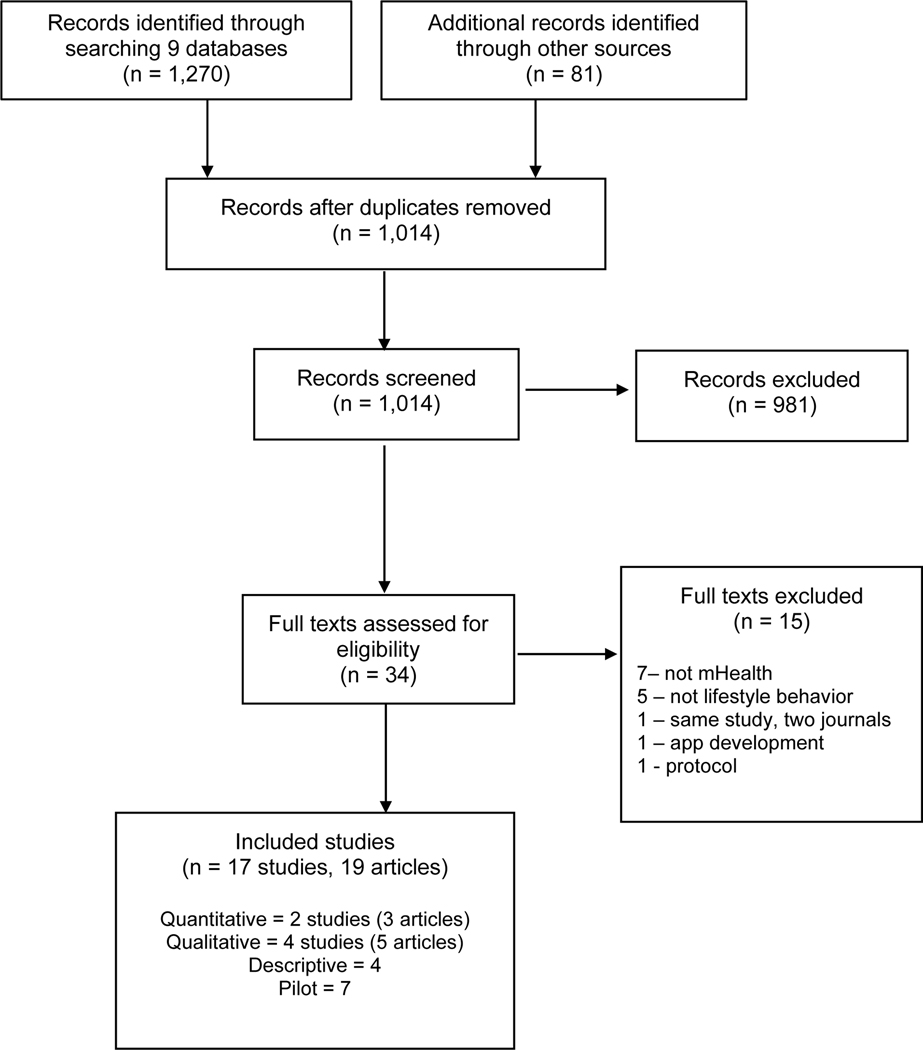
Cancer survivors' well-being is threatened by the risk of cancer recurrence and the increased risk of chronic diseases resulting from cancer treatments. Improving lifestyle behaviors attenuates these risks. Traditional approaches to lifestyle modification (ie, counseling) are expensive, require significant human resources, and are difficult to scale. Mobile health interventions offer a novel alternative to traditional approaches. However, to date, systematic reviews have yet to examine the use of mobile health interventions for lifestyle behavior improvement among cancer survivors. The objectives of this integrative review were to synthesize research findings, critically appraise the scientific literature, examine the use of theory in intervention design, and identify survivors' preferences in using mobile health interventions for lifestyle improvement. Nineteen articles met eligibility requirements. Only two studies used quantitative methods. Study quality was low, and only one study reported the use of theory in app design. Unfortunately, the evidence has not yet sufficiently matured, in quality or in rigor, to make recommendations on how to improve health behaviors or outcomes. However, six themes emerged as important considerations for intervention development for cancer survivors (app features/functionality, social relationships/support, provider relationships/support, app content, app acceptability, and barriers to use). These findings underscored the need for rigorous, efficacy studies before the use of mobile health interventions can be safely recommended for cancer survivors.
Copyright © 2021 Wolters Kluwer Health, Inc. All rights reserved.
Conflict of interest statement
References
-
- WHO. Who cancer fact sheet. World Health Organization. https://www.who.int/en/news-room/fact-sheets/detail/cancer. Accessed: 2019–05-12. (Archived by WebCite® at http://www.webcitation.org/78K0amYOl). Published 2017. Accessed June 17, 2017, 2017.
-
- Institute NC. Late side effects of cancer treatment. NIH NCI. https://www.cancer.gov/about-cancer/coping/survivorship/late-effects. Published 2017. Accessed June 16, 2017, 2017.
-
- Blanchard C, Courneya K, Stein K. American cancer society’s scs-ii. Cancer survivors’ adherence to lifestyle behavior recommendations and associations with health-related quality of life: Results from the american cancer society’s scs-ii. J Clin Oncol. 2008;26(13):2198–2204. - PubMed
Publication types
MeSH terms
Grants and funding
LinkOut - more resources
Full Text Sources
Medical
Miscellaneous
