At-Home Specimen Self-Collection and Self-Testing for Sexually Transmitted Infection Screening Demand Accelerated by the COVID-19 Pandemic: a Review of Laboratory Implementation Issues
- PMID: 34076475
- PMCID: PMC8525576
- DOI: 10.1128/JCM.02646-20
At-Home Specimen Self-Collection and Self-Testing for Sexually Transmitted Infection Screening Demand Accelerated by the COVID-19 Pandemic: a Review of Laboratory Implementation Issues
Abstract
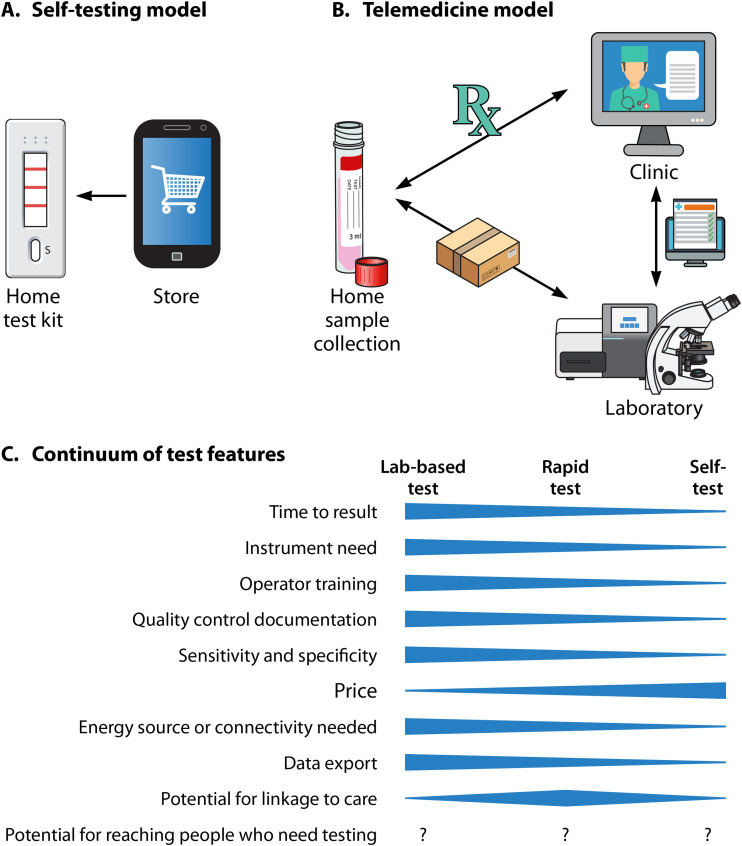
The coronavirus disease 2019 (COVID-19) pandemic reduced the sexually transmitted infection (STI) testing volume due to social-distancing and stay-at-home orders, among other reasons. These events highlighted previously known benefits of at-home STI self-testing or specimen self-collection and accelerated testing demand via telemedicine. We review testing outside traditional clinical settings. We focus on three curable bacterial STIs among the top 10 U.S. nationally notifiable conditions with screening recommendations: syphilis, gonorrhea (Neisseria gonorrhoeae, also known as the gonococcus [GC]), and chlamydia (Chlamydia trachomatis). At least 19 million GC/C. trachomatis (GC/CT) screening or diagnostic tests are performed annually, presenting a considerable challenge during the pandemic. Unlike for HIV, STI at-home tests are currently not commercially available. However, innovative telemedicine providers currently offer services where specimen self-collection kits are mailed to patients at home who then ship them to laboratories for processing. We discuss technical and regulatory aspects of modifications for home-based specimen self-collection. The telemedicine provider typically manages and communicates results, provides linkage to care, and is responsible for billing and case reporting. We also describe rapid testing devices in development that may present an opportunity for future self-testing. In summary, COVID-19 has accelerated the evaluation and development of STI self-tests and specimen self-collection. The remaining obstacles are high price, regulatory approval, support for laboratories offering the service, and uncertainty regarding whether target populations with the greatest need are reached effectively. However, increased testing, convenience, and privacy are potential benefits that may enhance uptake and outlast the pandemic.
Keywords: laboratory-developed test; rapid test; self-testing; specimen self-collection.
Figures
References
-
- National Association of County and City Health Officials. 2019. Issue brief. STI express services: increasing access and testing while maximizing resources. National Association of County and City Health Officials, Washington, DC. https://www.naccho.org/uploads/downloadable-resources/issue-brief_STI-Ex....
-
- Centers for Disease Control and Prevention. 2019. 2018 STD surveillance report. Centers for Disease Control and Prevention, Atlanta, GA. https://www.cdc.gov/nchhstp/newsroom/2019/2018-STD-surveillance-report.h.... Accessed 7 September 2021.
Publication types
MeSH terms
LinkOut - more resources
Full Text Sources
Medical
Miscellaneous