


The Impact of Technology-Enabled Care Coordination in a Complex Mental Health System: A Local System Dynamics Model
- PMID: 34077384
- PMCID: PMC8274674
- DOI: 10.2196/25331
The Impact of Technology-Enabled Care Coordination in a Complex Mental Health System: A Local System Dynamics Model
Abstract
Background: Prior to the COVID-19 pandemic, major shortcomings in the way mental health care systems were organized were impairing the delivery of effective care. The mental health impacts of the pandemic, the recession, and the resulting social dislocation will depend on the extent to which care systems will become overwhelmed and on the strategic investments made across the system to effectively respond.
Objective: This study aimed to explore the impact of strengthening the mental health system through technology-enabled care coordination on mental health and suicide outcomes.
Methods: A system dynamics model for the regional population catchment of North Coast New South Wales, Australia, was developed that incorporated defined pathways from social determinants of mental health to psychological distress, mental health care, and suicidal behavior. The model reproduced historic time series data across a range of outcomes and was used to evaluate the relative impact of a set of scenarios on attempted suicide (ie, self-harm hospitalizations), suicide deaths, mental health-related emergency department (ED) presentations, and psychological distress over the period from 2021 to 2030. These scenarios include (1) business as usual, (2) increase in service capacity growth rate by 20%, (3) standard telehealth, and (4) technology-enabled care coordination. Each scenario was tested using both pre- and post-COVID-19 social and economic conditions.
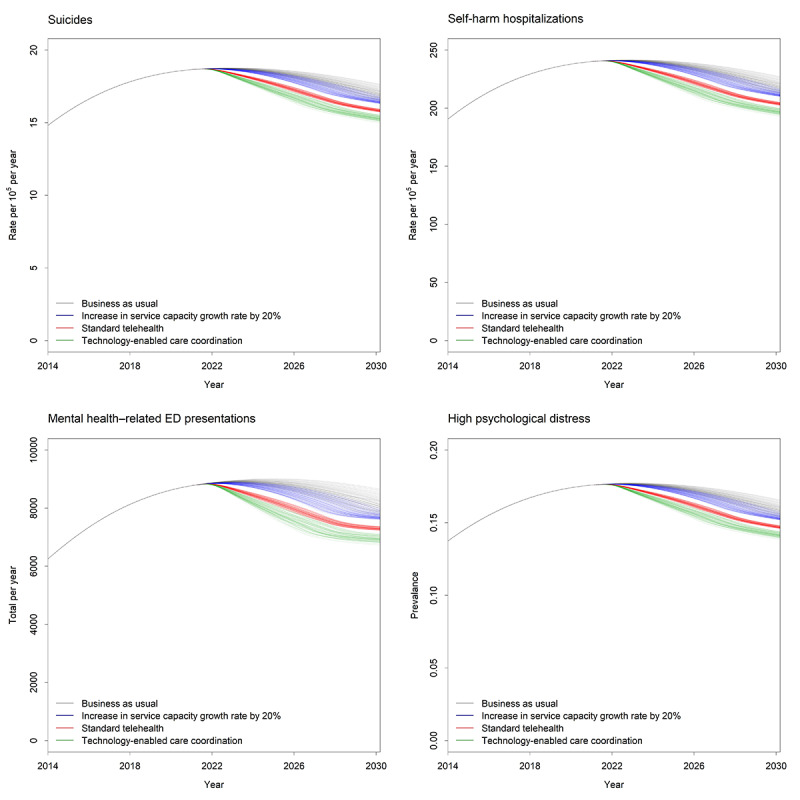
Results: Technology-enabled care coordination was forecast to deliver a reduction in self-harm hospitalizations and suicide deaths by 6.71% (95% interval 5.63%-7.87%), mental health-related ED presentations by 10.33% (95% interval 8.58%-12.19%), and the prevalence of high psychological distress by 1.76 percentage points (95% interval 1.35-2.32 percentage points). Scenario testing demonstrated that increasing service capacity growth rate by 20% or standard telehealth had substantially lower impacts. This pattern of results was replicated under post-COVID-19 conditions with technology-enabled care coordination being the only tested scenario, which was forecast to reduce the negative impact of the pandemic on mental health and suicide.
Conclusions: The use of technology-enabled care coordination is likely to improve mental health and suicide outcomes. The substantially lower effectiveness of targeting individual components of the mental health system (ie, increasing service capacity growth rate by 20% or standard telehealth) reiterates that strengthening the whole system has the greatest impact on patient outcomes. Investments into more of the same types of programs and services alone will not be enough to improve outcomes; instead, new models of care and the digital infrastructure to support them and their integration are needed.
Keywords: care coordination; complex systems; health systems; internet; medical informatics; mental health; policy; simulation.
©Frank Iorfino, Jo-An Occhipinti, Adam Skinner, Tracey Davenport, Shelley Rowe, Ante Prodan, Julie Sturgess, Ian B Hickie. Originally published in the Journal of Medical Internet Research (https://www.jmir.org), 30.06.2021.
Conflict of interest statement
Conflicts of Interest: IBH was an inaugural commissioner on Australia’s National Mental Health Commission (2012-2018). He is the Co-Director, Health and Policy at the Brain and Mind Centre (BMC), University of Sydney. The BMC operates an early-intervention youth services program at Camperdown under contract to Headspace. He is the Chief Scientific Advisor to, and a 5% equity shareholder in, InnoWell Pty Ltd. InnoWell was formed by the University of Sydney (45% equity) and PwC (Australia; 45% equity) to deliver the Aus $30 million (~US $23,212,500) Australian Government–funded Project Synergy (2017-2020; a 3-year program for the transformation of mental health services) and to lead the transformation of mental health services internationally through the use of innovative technologies. JAO is Head of Systems Modelling, Simulation & Data Science and Co-Director of the Mental Wealth Initiative at the University of Sydney’s BMC, and is Managing Director of Computer Simulation & Advanced Research Technologies (CSART). TD is the Director of Research & Insights at the Australian Digital Health Agency.
Figures
Similar articles
-
Systems modelling and simulation to inform strategic decision making for suicide prevention in rural New South Wales (Australia).Aust N Z J Psychiatry. 2020 Sep;54(9):892-901. doi: 10.1177/0004867420932639. Epub 2020 Jun 17. Aust N Z J Psychiatry. 2020. PMID: 32551878
-
Federal and state cooperation necessary but not sufficient for effective regional mental health systems: insights from systems modelling and simulation.Sci Rep. 2021 May 27;11(1):11209. doi: 10.1038/s41598-021-90762-x. Sci Rep. 2021. PMID: 34045644 Free PMC article.
-
Sound Decision Making in Uncertain Times: Can Systems Modelling Be Useful for Informing Policy and Planning for Suicide Prevention?Int J Environ Res Public Health. 2022 Jan 27;19(3):1468. doi: 10.3390/ijerph19031468. Int J Environ Res Public Health. 2022. PMID: 35162491 Free PMC article.
-
Employing telehealth strategies for opioid addiction during COVID-19: implications for social work health care.Soc Work Health Care. 2021 Aug 9;60(6-7):499-508. doi: 10.1080/00981389.2021.1953207. Epub 2021 Jul 18. Soc Work Health Care. 2021. PMID: 34278979 Review.
-
Implications of telehealth and digital care solutions during COVID-19 pandemic: a qualitative literature review.Inform Health Soc Care. 2021 Mar 2;46(1):68-83. doi: 10.1080/17538157.2020.1839467. Epub 2020 Nov 29. Inform Health Soc Care. 2021. PMID: 33251894
Cited by
-
Evaluating the tailored implementation of a multisite care navigation service for mental health in rural and remote Australia (The Bridging Study): protocol for a community-engaged hybrid effectiveness-implementation study.Implement Sci. 2024 Sep 4;19(1):62. doi: 10.1186/s13012-024-01391-7. Implement Sci. 2024. PMID: 39232820 Free PMC article.
-
Informing the Future of Integrated Digital and Clinical Mental Health Care: Synthesis of the Outcomes From Project Synergy.JMIR Ment Health. 2022 Mar 9;9(3):e33060. doi: 10.2196/33060. JMIR Ment Health. 2022. PMID: 34974414 Free PMC article.
-
Personalized and collaborative use of digital measurement-based care tools enhances engagement among young adults: a mixed-methods study.BMC Health Serv Res. 2025 May 26;25(1):752. doi: 10.1186/s12913-025-12889-1. BMC Health Serv Res. 2025. PMID: 40420311 Free PMC article.
-
Young People's Experiences Using a Digital Mental Health Tool to Support Their Care in a Real-World Service: Lived Experience-Led Qualitative Study.JMIR Ment Health. 2025 Jun 23;12:e70154. doi: 10.2196/70154. JMIR Ment Health. 2025. PMID: 40550130 Free PMC article. Clinical Trial.
-
Digital therapeutics in the hospital for suicide crisis - content and design recommendations from young people and hospital staff.Digit Health. 2024 Feb 14;10:20552076241230072. doi: 10.1177/20552076241230072. eCollection 2024 Jan-Dec. Digit Health. 2024. PMID: 38362237 Free PMC article.
References
-
- Copeland WE, Wolke D, Shanahan L, Costello EJ. Adult functional outcomes of common childhood psychiatric problems: A prospective, longitudinal study. JAMA Psychiatry. 2015 Sep;72(9):892–899. doi: 10.1001/jamapsychiatry.2015.0730. http://europepmc.org/abstract/MED/26176785 - DOI - PMC - PubMed
-
- Merikangas KR, Nakamura EF, Kessler RC. Epidemiology of mental disorders in children and adolescents. Dialogues Clin Neurosci. 2009;11(1):7–20. http://europepmc.org/abstract/MED/19432384 - PMC - PubMed
-
- Contributing Lives, Thriving Communities – Report of the National Review of Mental Health Programmes and Services. Sydney, Australia: National Mental Health Commission, Australian Government; 2014. [2021-06-14]. https://www.mentalhealthcommission.gov.au/monitoring-and-reporting/natio....
MeSH terms
LinkOut - more resources
Full Text Sources
