Eliminating onchocerciasis within the Meme River Basin of Cameroon: A social-ecological approach to understanding everyday realities and health systems
- PMID: 34077416
- PMCID: PMC8202923
- DOI: 10.1371/journal.pntd.0009433
Eliminating onchocerciasis within the Meme River Basin of Cameroon: A social-ecological approach to understanding everyday realities and health systems
Abstract
Background: Onchocerciasis affects some of the world's most marginalized people, perpetuating poverty and inequalities. Mass Drug Administration (MDA) with Ivermectin has taken place within the Meme River basin region in Cameroon for over 15 years. Despite this, onchocerciasis is still prevalent in the region due to existing and emerging contextual challenges. Using a social-ecological approach we explore the everyday realities of communities, highlighting the challenges and potential solutions that could support Neglected Tropical Disease (NTD) programmes when transitioning from control to elimination of onchocerciasis in this highly endemic area and other similar communities.
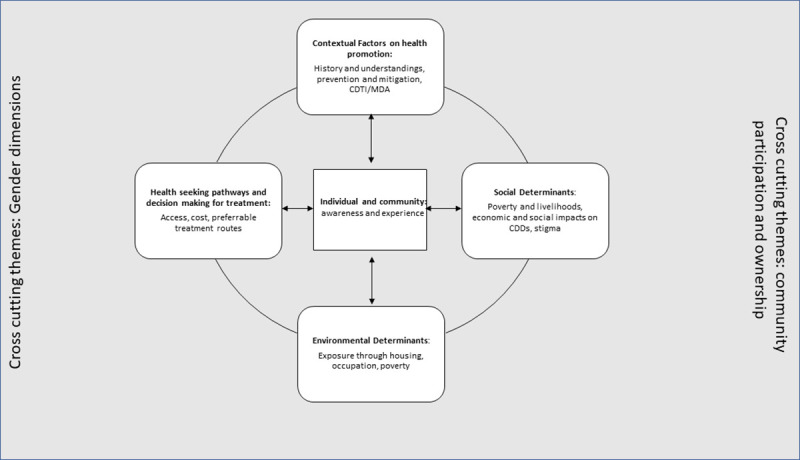
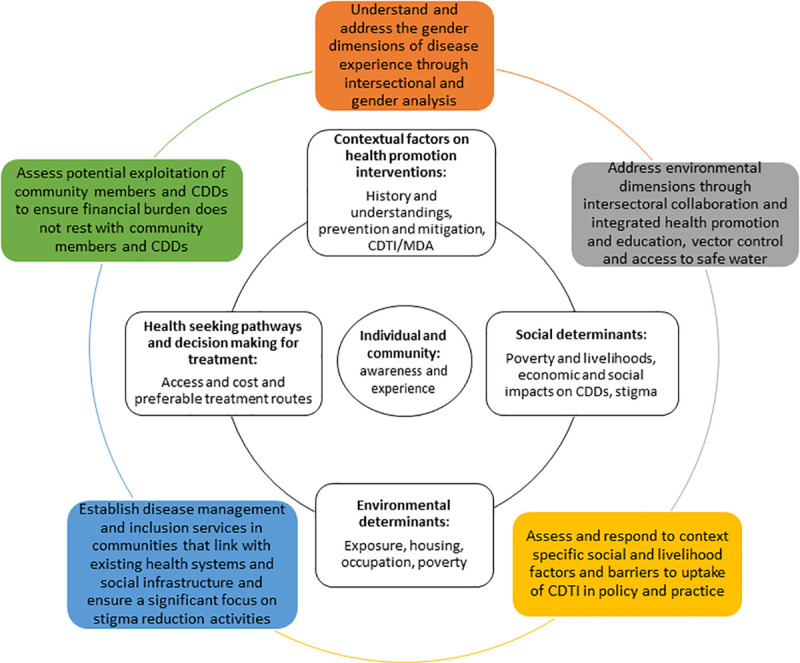
Methodology/principal finding: In-depth interviews (71) with community members and Community Drug Distributors (CDDs) were conducted to understand current knowledge, attitudes, and behaviours in relation to transmission, prevention and treatment of onchocerciasis. Through application of the social-ecological model, four key themes were identified: 1. Contextual factors on health promotion interventions (Onchocerciasis history and understanding of the disease, prevention and mitigation strategies and MDA experience); 2. Social determinants (poverty and livelihoods, economic and social impacts on CDD volunteers and stigma); 3. Environmental determinants (exposure, housing, occupation and poverty); and 4. health seeking pathways and decision making for treatment (access, cost and preferable treatment routes). We discuss these core and cross cutting themes (gender differences and community participation/ownership) in relation to intersectoral collaboration, gender equity and health systems support, making recommendations for NTD programmes within the context of integrated and interdisciplinary approaches. These include the need for; intersectional and gender analysis at the local level, addressing environmental dimensions of onchocerciasis through integrated and regular health promotion, vector control strategies and access to safe water sources; reflection and action that embeds responses to social and economic barriers to MDA; integrated case detection and management that is responsive to onchocerciasis symptoms and related stigma and a fair and just support network for CDDs.
Conclusion/significance: NTD programmes need to respond to diverse community circumstances and behaviours. Communities are not a homogeneous risk group and treating them in this way will delay elimination. A deeper understanding of individual needs and their capacity to seek prevention and treatment must be considered if onchocerciasis is to be eliminated and the remaining impacts managed.
Conflict of interest statement
The authors have declared that no competing interests exist
Figures
References
-
- World Health Organization. Ending the neglect to attain the Sustainable Development Goals: a road map for neglected tropical diseases 2021–2030. Geneva: 2020.
-
- Theobald S, MacPherson EE, Dean L, Jacobson J, Ducker C, Gyapong M, et al. 20 years of gender mainstreaming in health: lessons and reflections for the neglected tropical diseases community. Bmj Global Health. 2017;2(4). UNSP e000512 doi: 10.1136/bmjgh-2017-000512 WOS:000429769600035. - DOI - PMC - PubMed
-
- World Health Organization. Ending the neglect to attain the sustainable development goals: a road map for neglected tropical diseases 2021–2030 Summary. World Health Organization, 2020.
Publication types
MeSH terms
Substances
LinkOut - more resources
Full Text Sources