Review
. 2021 Aug 11;72(16):5893-5904.
doi: 10.1093/jxb/erab239.

Hydrogen sulfide signaling in plant adaptations to adverse conditions: molecular mechanisms

Affiliations
Review

Hydrogen sulfide signaling in plant adaptations to adverse conditions: molecular mechanisms

Angeles Aroca et al. J Exp Bot. .

Abstract

Hydrogen sulfide (H2S) is a signaling molecule that regulates critical processes and allows plants to adapt to adverse conditions. The molecular mechanism underlying H2S action relies on its chemical reactivity, and the most-well characterized mechanism is persulfidation, which involves the modification of protein thiol groups, resulting in the formation of persulfide groups. This modification causes a change of protein function, altering catalytic activity or intracellular location and inducing important physiological effects. H2S cannot react directly with thiols but instead can react with oxidized cysteine residues; therefore, H2O2 signaling through sulfenylation is required for persulfidation. A comparative study performed in this review reveals 82% identity between sulfenylome and persulfidome. With regard to abscisic acid (ABA) signaling, widespread evidence shows an interconnection between H2S and ABA in the plant response to environmental stress. Proteomic analyses have revealed persulfidation of several proteins involved in the ABA signaling network and have shown that persulfidation is triggered in response to ABA. In guard cells, a complex interaction of H2S and ABA signaling has also been described, and the persulfidation of specific signaling components seems to be the underlying mechanism.

Keywords: Abscisic acid; persulfidation; proteomics; redox modifications; stomatal movement; sulfenylation.


Figures

Fig. 1.
Fig. 1.
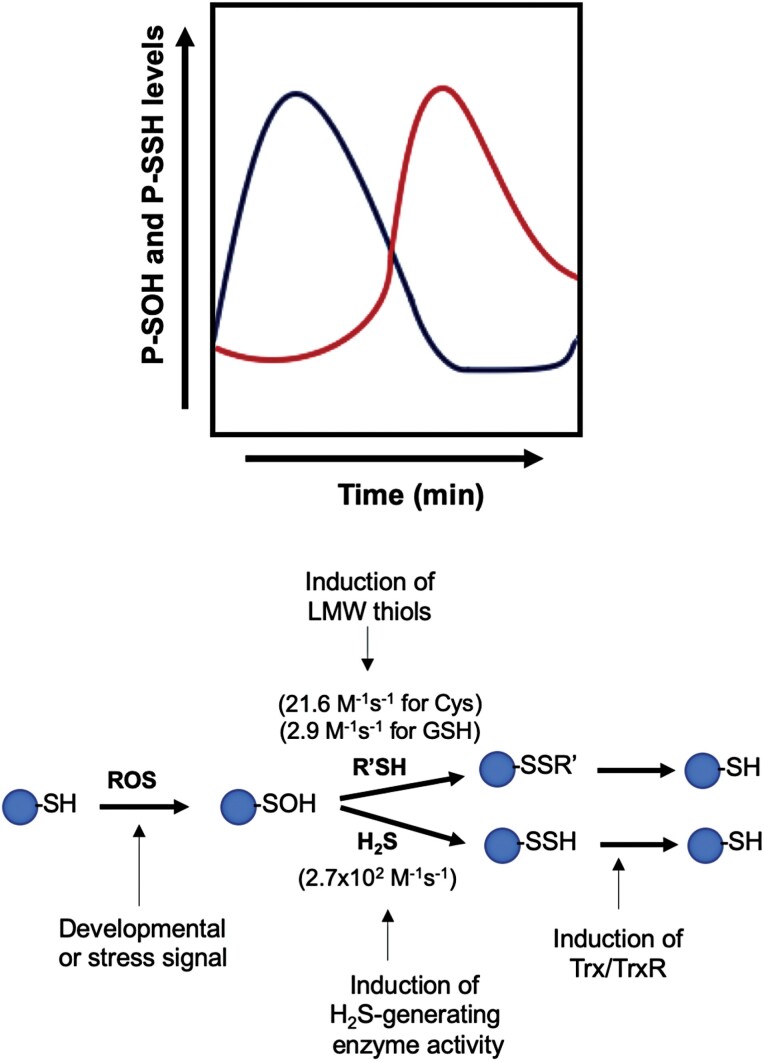
Schematic representation of the temporal dynamic of protein sulfenylation (P-SOH) and persulfidation (P-SSH) in different cell types (after Zivanovic et al., 2019). After a transient ROS production induced by developmental or stress signals, the levels of sulfenylation in proteins are increased, accompanied by an increase in the activity of sulfide-generating enzymes and/or induction of low molecular weight (LMW) thiols, followed by a transient increase in protein persulfidation reversed by the action of reducing enzymes such as the thioredoxin system (Trx/TrxR). The rate constants for the reaction of R-SOH with LMW thiols and H2S at physiological pH 7.4 are shown (Cuevasanta et al., 2015).
Fig. 2.
Fig. 2.
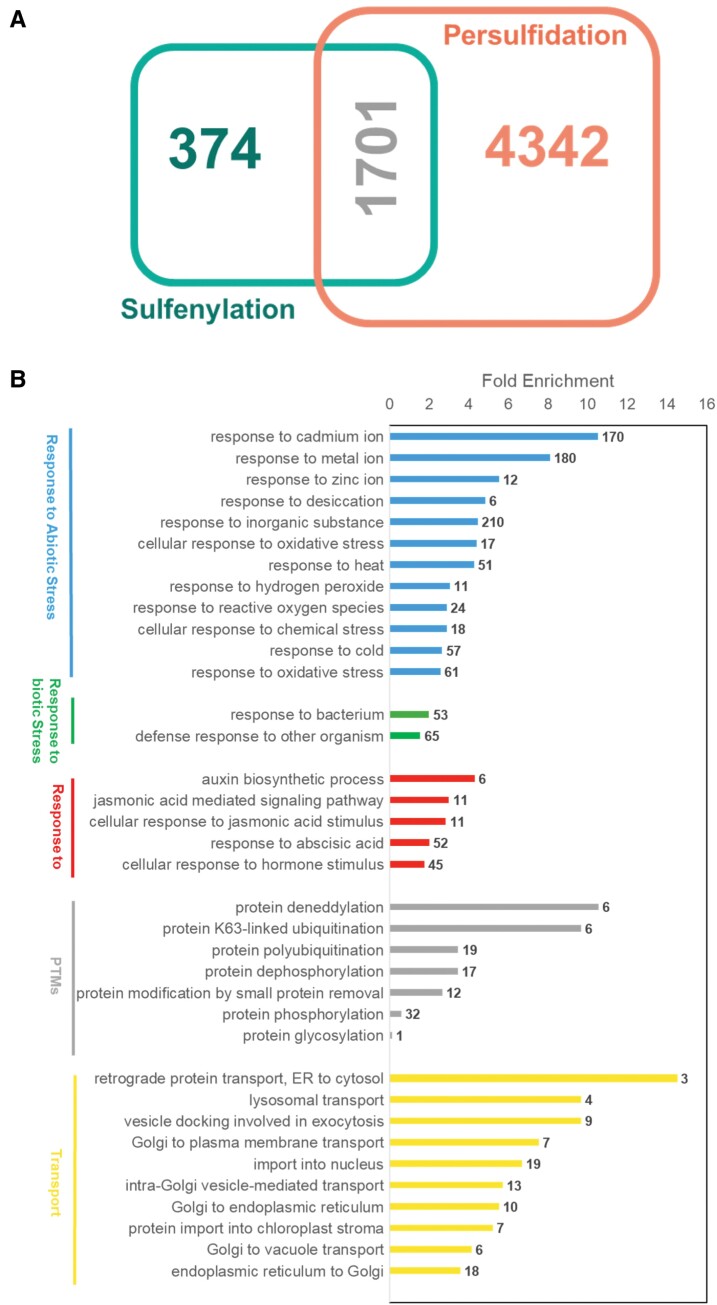
Comparison of persulfidated and sulfenylated proteins. (A) Venn diagram showing the number of proteins. (B) Fold change enrichment of GO terms of common proteins modified by sulfenylation and persulfidation. Analysis was performed with PANTHER software. The numbers beside the bars indicate the number of proteins associated with each GO term for the input set.
Fig. 3.
Fig. 3.
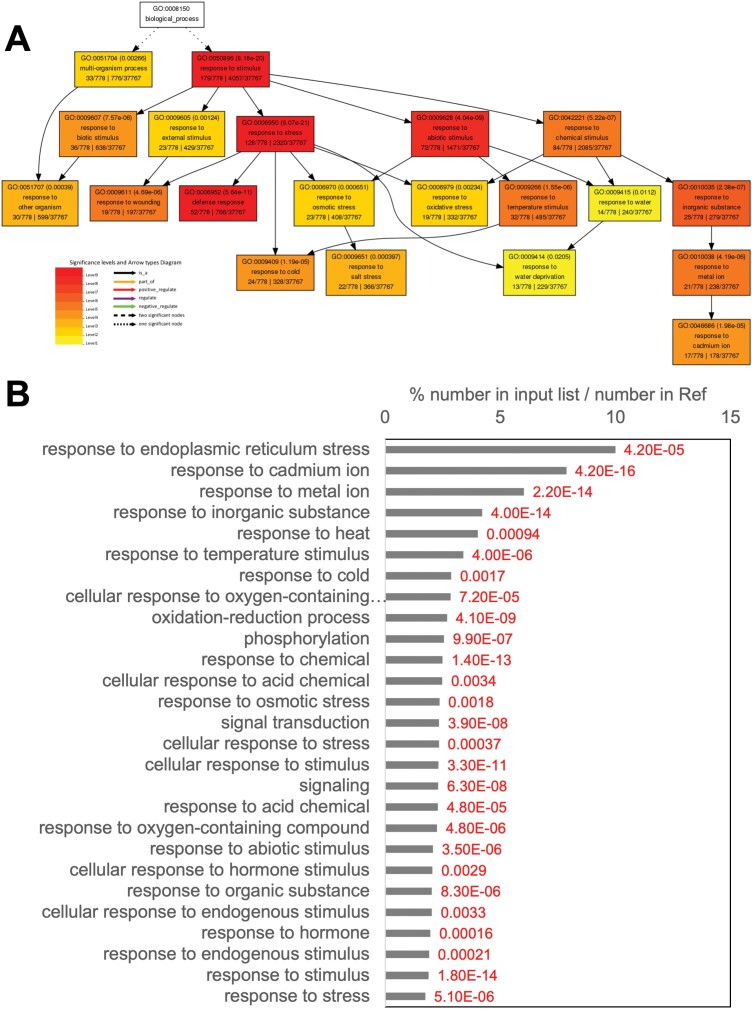
Gene Ontology (GO) enrichment. (A) GO enrichment of ABA-induced persulfidated proteins involved in response to stimulus. (B) GO enrichment of persulfidated targets in response to ABA susceptible to sulfenylation. The P-value for each GO term is annotated in red numbers.
Fig. 4.
Fig. 4.
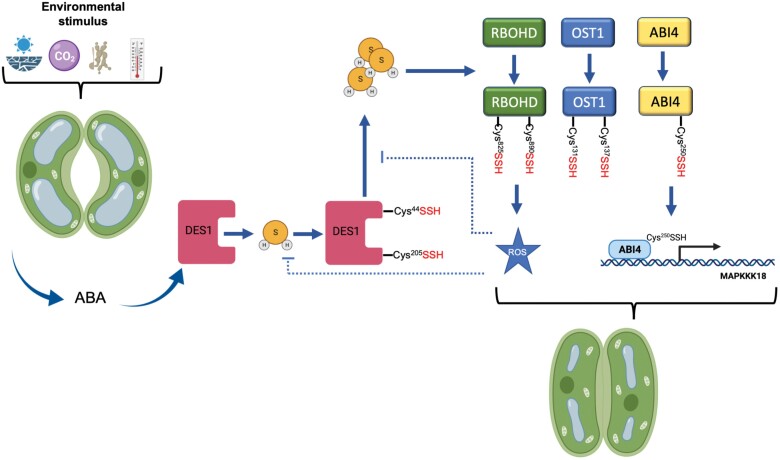
Graphical model of interconnections between H2S and ABA signaling networks in guard cells through the persulfidation of specific proteins. Under various environmental stress conditions, in guard cells, ABA concentrations increase and trigger the DES1 activity to induce the production of H2S to persulfidate specific protein targets. DES1 itself is persulfidated at Cys44 and Cys205, and causes the persulfidation of open stomata 1 (OST1) at Cys131 and Cys137, the NADPH oxidase RBOHD at Cys825 and Cys890, and ABI4 at Cys250. Persulfidated RBOHD produces a ROS burst that results in stomatal closure. Overaccumulation of ROS induces persulfide oxidation leading to ABA desensitivity. Persulfidated ABI4 promotes MAPKKK18 transactivation and MAPK signaling.

References

    1. Abe K, Kimura H. 1996. The possible role of hydrogen sulfide as an endogenous neuromodulator. Journal of Neuroscience 16, 1066–1071. - PMC - PubMed
    1. Akaike T, Ida T, Wei FY, et al. 2017. Cysteinyl-tRNA synthetase governs cysteine polysulfidation and mitochondrial bioenergetics. Nature Communications 8, 1177. - PMC - PubMed
    1. Alvarez C, Bermudez MA, Romero LC, Gotor C, Garcia I. 2012. Cysteine homeostasis plays an essential role in plant immunity. New Phytologist 193, 165–177. - PubMed

    1. Alvarez C, Calo L, Romero LC, García I, Gotor C. 2010. An O-acetylserine(thiol)lyase homolog with l-cysteine desulfhydrase activity regulates cysteine homeostasis in Arabidopsis. Plant Physiology 152, 656–669. - PMC - PubMed
    1. Aroca A, Benito JM, Gotor C, Romero LC. 2017a. Persulfidation proteome reveals the regulation of protein function by hydrogen sulfide in diverse biological processes in Arabidopsis. Journal of Experimental Botany 68, 4915–4927. - PMC - PubMed

Publication types