


Post-polypectomy surveillance colonoscopy: Comparison of the updated guidelines
- PMID: 34077635
- PMCID: PMC8280808
- DOI: 10.1002/ueg2.12106
Post-polypectomy surveillance colonoscopy: Comparison of the updated guidelines
Abstract
Background: Recently, three updated guidelines for post-polypectomy colonoscopy surveillance (PPCS) have been published. These guidelines are based on a comprehensive summary of the literature, while some recommendations are similar, different surveillance intervals are recommended after detection of specific types of polyps.
Aim: In this review, we aimed to compare and contrast these recommendations.
Methods: The updated guidelines for PPCS were reviewed and the recommendations were compared.
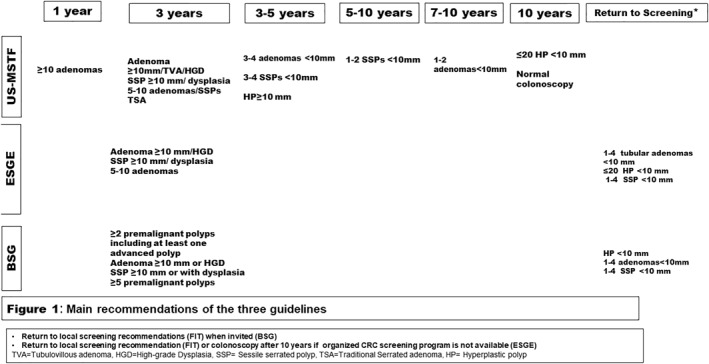
Results: For patients with 1-4 adenomas <10 mm with low-grade dysplasia, irrespective of villous components, or 1-4 serrated polyps <10 mm without dysplasia, the European Society of Gastrointestinal Endoscopy (ESGE) and British Society of Gastroenterology (BSG), the Association of Coloproctology of Great Britain and Ireland (ACPGBI) and Public Health England (PHE) (BSG/ACPGBI/PHE) guidelines do not recommend colonoscopic surveillance and instead recommend that the participate in routine CRC screening program (typically based on the fecal immunochemical test), while the USMSTF recommends surveillance colonoscopies 7-10 years after diagnosis of 1-2 tubular adenomas <10 mm and 3-5 years for 3-4 tubular adenomas of the same size. The USMSTF define adenomas with tubulovillous or villous histology as high-risk adenomas; thus, surveillance colonoscopy is recommended after 3 years. However, the ESGE and BSG do not consider such histology as a criterion for repeating colonoscopy at this short interval. For patients with 1-2 sessile serrated polyps (SSPs) <10 mm and those with 3-4 SSPs <10 mm, the USMSTF recommends surveillance colonosocopy after 5-10 and 3-5 years, respectively.
Keywords: colonoscopy; guidelines; polypectomy; surveillance.
© 2021 The Authors. United European Gastroenterology Journal published by Wiley Periodicals LLC. on behalf of United European Gastroenterology.
Conflict of interest statement
There are no conflicts of interest for any of the authors, and no financial disclosures. We transfer the copyright to the publisher where the article be published.
Figures
References
-
- Kahi CJ, Imperiale TF, Juliar BE, Rex DK. Effect of screening colonoscopy on colorectal cancer incidence and mortality. Clin Gastroenterol Hepatol. 2009;7:770–5. - PubMed
-
- Hassan C, Giulio A, Dumoncreau JM. Post‐polepectomy colonoscopy surveillance: Europena Society of Gastrointestinal Endoscopy (ESGE) guideline‐update 2020. Endoscopy. 2020;52(8):687–700. - PubMed
Publication types
MeSH terms
LinkOut - more resources
Full Text Sources
Medical
Miscellaneous
