


Health-related quality of life of refugees: a systematic review of studies using the WHOQOL-Bref instrument in general and clinical refugee populations in the community setting
- PMID: 34078413
- PMCID: PMC8173726
- DOI: 10.1186/s13031-021-00378-1
Health-related quality of life of refugees: a systematic review of studies using the WHOQOL-Bref instrument in general and clinical refugee populations in the community setting
Abstract
Purpose: To systematically review studies on HRQOL, measured by the WHOQOL-Bref instrument, of refugees in general and clinical populations who are settled in the community of the hosting country, and outline the differences in scores among the two population groups and across the four domains of WHOQOL-Bref (physical, psychological, social relationships and environment domain) as well as factors impacting those outcomes.
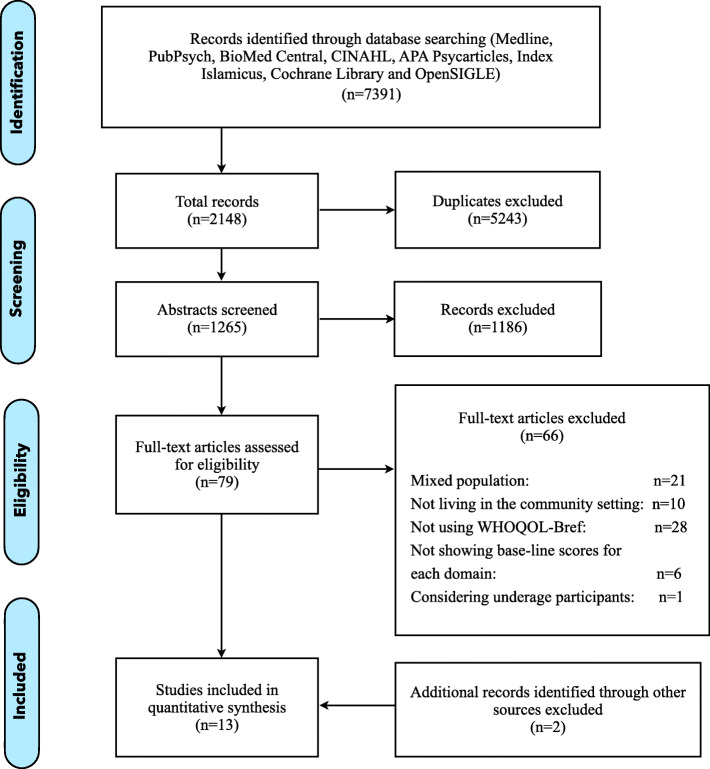
Methods: Several databases were systematically searched by using a broad search strategy. Additionally, a hand search for grey literature was performed. Studies had to comply with the following inclusion criteria: (a) population of refugees; (b) living in the community of the country of destination; (c) assessing HRQOL through the WHOQOL-Bref instrument.
Results: 15 studies were identified and divided into two subgroups: (a) general population of refugees (b) clinical population of refugees, who were specifically selected for their mental status or because they had experienced relevant past traumas. Although we can outline common patterns among the two groups, in terms of domains scoring the highest and the lowest, heterogeneous values of HRQOL are observed across the studies included.
Conclusions: Individuals who were included in the clinical refugee group have a lower quality of life in respect to the general population of refugees. However, among the two groups different patterns can be outlined considering each domain of HRQOL: higher scores for the Physical and lower for the Environment domain when considering the general population of refugees and higher scores for the Environment and lower for the Psychological domain when referring to the clinical one. These lower scores are probably due to having a higher rate of mental distress and being more exposed to somatization, stigmatization and barriers to access the healthcare system of the hosting country.
Keywords: Health-related quality of life; Mental health disorders; Refugee; Trauma; WHOQOL-Bref.
Conflict of interest statement
The authors declare no potential competing interests with respect to the research, authorship, and/or publication of this article.
References
-
- UNHCR. The UN Refugee Agency, Figures at a glance. [online] Available at: https://www.unhcr.org/figures-at-a-glance.html. 2020. [Accessed July 2020].
-
- McAuliffe M, Khadria B, Bauloz C, Nguyen M, Qu S, Kitimbo A, Acosta D. World Migration Report, 2020. International Organisation for Migration. [online] Available at: https://publications.iom.int/system/files/pdf/wmr_2020.pdf. 2020. [Accessed: Apr 2020].
-
- Cattaneo C, Beine M, Fröhlich CJ, Kniveton D, Martinez-Zarzoso I, Mastrorillo M, Schraven B. Human migration in the era of climate change. Rev Environ Econ Policy. 2019;13(2):189–206. doi: 10.1093/reep/rez008. - DOI
-
- Arsenijević J, Schillberg E, Ponthieu A, Malvisi L, Ahmed WAE, Argenziano S, de Vingne B. A crisis of protection and safe passage: violence experienced by migrants/refugees travelling along the Western Balkan corridor to northern Europe. Confl Heal. 2017;11(1):1–9. doi: 10.1186/s13031-017-0103-3. - DOI - PMC - PubMed
-
- Campion ED. The career adaptive refugee: exploring the structural and personal barriers to refugee resettlement. J Vocat Behav. 2017;105:6–16. doi: 10.1016/j.jvb.2017.10.008. - DOI
Publication types
LinkOut - more resources
Full Text Sources
Medical
Miscellaneous
